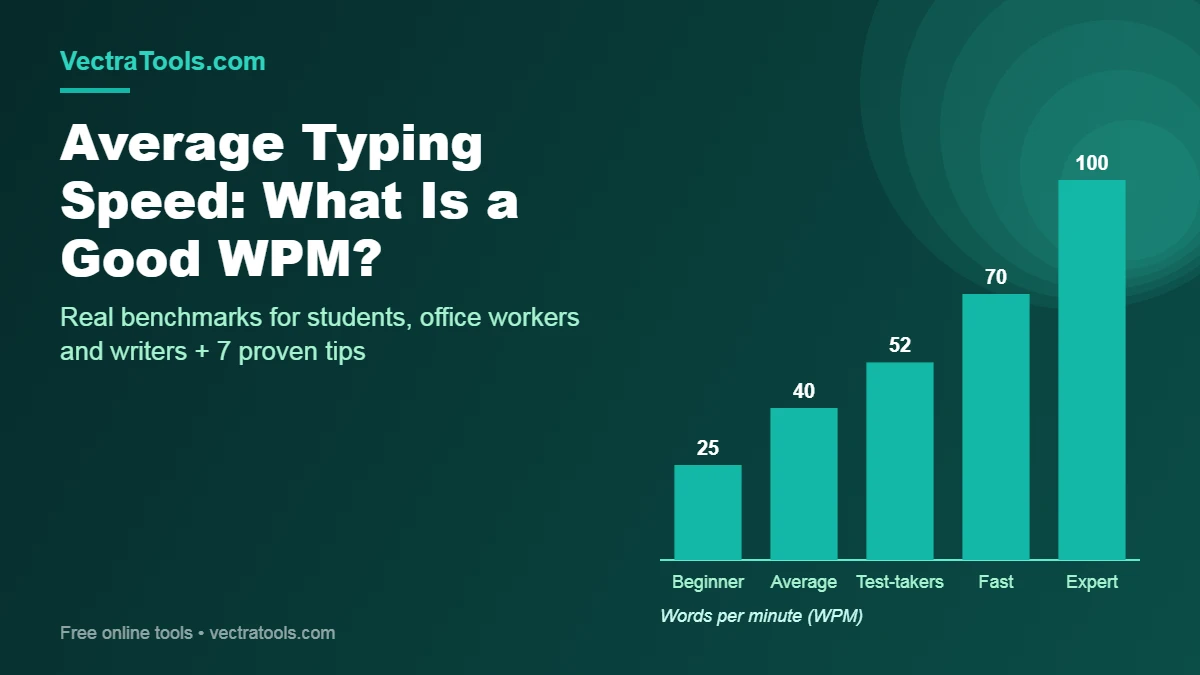
Quick answer: The average typing speed is about 40 words per minute (WPM) for everyday computer users and around 52 WPM for people who take online typing tests, based on a study of 136 million keystrokes. Anything above 60 WPM is fast, and professional typists usually work at 70–90 WPM with 95%+ accuracy. Check your own score in 60 seconds with our free Typing Speed Test (WPM).
Typing speed matters more than most people think. Students write essays, freelancers bill by the hour, developers write code, and almost every office job now involves hours of email and chat. Moving from 35 WPM to 60 WPM can save close to an hour on a long writing day.
In this guide you will learn what the average typing speed really is, how WPM is calculated, what counts as a good typing speed for your job, and 7 proven tips that actually move your number up.
What Does WPM Mean?
WPM stands for words per minute. Because real words have different lengths, typing tests use a standard "word" of five characters, including spaces and punctuation. If you type 250 characters in one minute, your gross speed is 50 WPM. The words per minute standard makes scores comparable across tests, languages and keyboards.
Most typing tests show three numbers:
- Gross WPM – total characters typed ÷ 5 ÷ minutes, ignoring mistakes.
- Net WPM – gross WPM minus uncorrected errors per minute. This is the number employers care about.
- Accuracy – the percentage of correct keystrokes. Aim for 95% or higher before chasing speed.
WPM formula with an example
Say you type 1,300 characters in 5 minutes and leave 10 uncorrected errors. Gross WPM = 1,300 ÷ 5 ÷ 5 = 52. Errors per minute = 10 ÷ 5 = 2. Net WPM = 52 − 2 = 50 WPM. Our Character Counter is handy if you want to measure a typed passage yourself.
Average Typing Speed: The Real Numbers
In 2018, researchers from Aalto University and the University of Cambridge analysed 136 million keystrokes from 168,000 volunteers in more than 200 countries. The average participant typed 52 WPM, most people landed between 30 and 60 WPM, and the fastest typists reached about 120 WPM.
People who choose to take a typing test are usually more confident typists than the general public. That is why the average typing speed for all computer users is commonly quoted closer to 40 WPM.
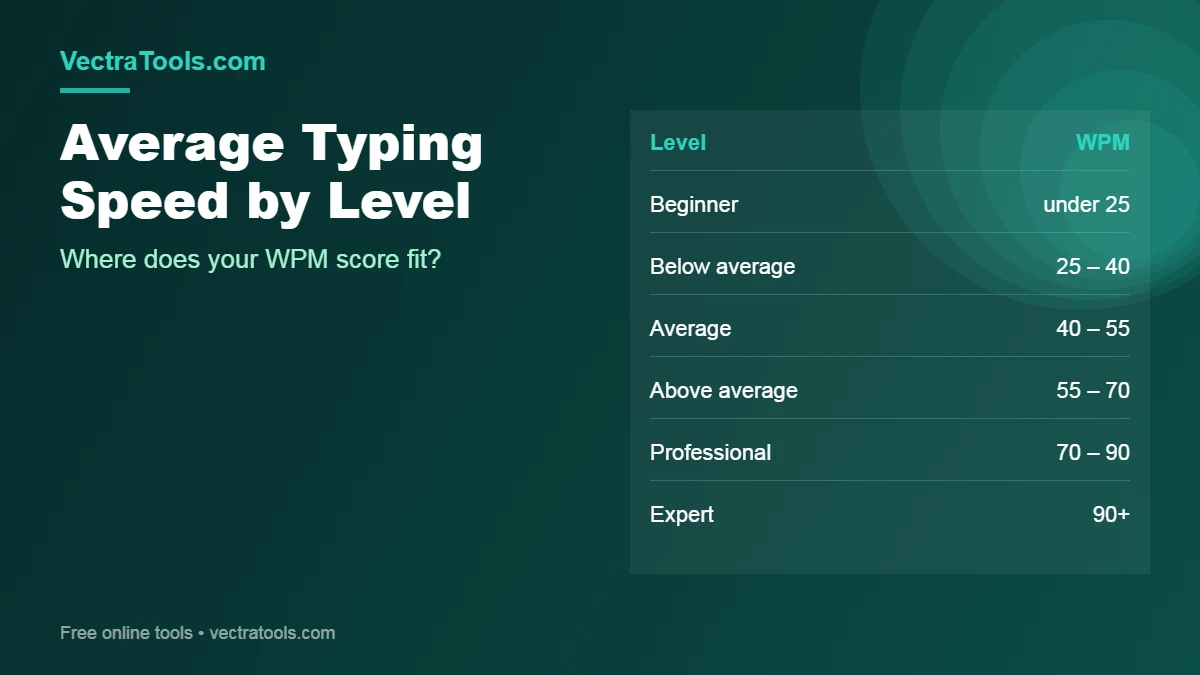
| Typing speed | Level | What it means |
|---|---|---|
| Under 25 WPM | Beginner | Hunt-and-peck; looking at the keyboard |
| 25–40 WPM | Below average | Fine for casual use and short messages |
| 40–55 WPM | Average | Typical office and student speed |
| 55–70 WPM | Above average | Comfortable for writing-heavy work |
| 70–90 WPM | Professional | Transcription, data entry, content writing |
| 90+ WPM | Expert | Competitive typists |
Average Typing Speed by Age and Experience
Age by itself does not set your speed – practice does. Younger users who grew up with keyboards often score higher, but adults who type daily for work regularly beat them. In general:
- Beginners and young students: 10–25 WPM while learning key positions.
- Teens and college students: 35–50 WPM, mostly from daily chat and assignments.
- Office workers: 40–55 WPM, close to the overall average typing speed.
- Writers, coders and VAs: 60–80 WPM after years of daily typing.
What Is a Good Typing Speed for Your Job?
A "good" score is relative. Use the average typing speed as your floor and these targets as your goal:
| Role | Good WPM target |
|---|---|
| Students | 35–45 WPM |
| General office / admin | 40–50 WPM |
| Data entry / virtual assistant | 50–60+ WPM |
| Content writer / blogger | 60–75 WPM |
| Transcriptionist / scribe | 70–90+ WPM |
| Programmer | 40–60 WPM (accuracy on symbols matters more) |
What Fast Typists Do Differently
The same study found that fast typists were not always formal touch typists. Their biggest advantage was rollover typing – pressing the next key before releasing the previous one. The fastest users used rollover on 40–70% of keystrokes, and they made fewer errors in the first place instead of fixing them later.
Three lessons follow: accuracy builds speed, consistent finger placement builds rhythm, and smooth overlapping keystrokes beat hard, separate taps.
7 Proven Tips to Beat the Average Typing Speed

- Take a baseline test. Do three 1-minute runs on our WPM test and note your average net WPM and accuracy.
- Fix posture and the home row. Wrists floating, fingers on ASDF and JKL;, eyes on the screen – not the keys.
- Slow down to 98% accuracy. For one week, type only as fast as you can stay almost error-free. Clean muscle memory turns into speed quickly.
- Practise 15 minutes a day. Short daily sessions beat one long weekend session. Mix common-word drills with real paragraphs.
- Drill your weak keys. Numbers, punctuation and letters like Q, Z, X and P are where most people lose time.
- Learn editing shortcuts. Ctrl/Cmd + Backspace deletes a whole word; Ctrl/Cmd + arrows jump by word. Less mouse time means higher real-world speed.
- Re-test weekly. Track net WPM. A gain of 5–10 WPM per month is realistic for most people.
Small habits that add up
- Use a keyboard with consistent key travel – laptop and mechanical keyboards feel very different.
- Type real content such as emails and blog drafts, then check length with our Word Counter.
- Take a short break every 30–45 minutes to avoid wrist fatigue.
- Keep your typing rhythm even; steady beats bursty.
Typing Speed vs. Reading Speed
Most adults read silently at roughly 200–300 words per minute, so even a fast typist writes several times slower than they read. That is why writers plan reading time separately from writing time. If you publish articles, our Reading Time Calculator shows how long your post takes to read, and the Text Case Converter cleans up headings in seconds.
Working on money skills too? Read our guide on compound interest vs simple interest – it pairs well with any productivity plan.
Frequently Asked Questions
What is the average typing speed?
The average typing speed is about 40 WPM for everyday users and around 52 WPM for people who take online typing tests.
Is 40 WPM a good typing speed?
Yes. 40 WPM is about average and enough for most computer work. For writing-heavy or data-entry jobs, aim for 55–60 WPM or more.
Is 60 WPM fast?
Yes. 60 WPM is above the average typing speed. With 95%+ accuracy it is strong for office jobs, freelancing and content writing.
How long does it take to improve typing speed?
With 15–20 minutes of focused daily practice, most people gain 5–10 WPM within a month. Beginners often improve faster.
Does accuracy matter more than speed?
Yes. Net WPM subtracts errors and fixing mistakes costs time. Build accuracy first and speed follows.
How is WPM calculated?
Divide characters typed by 5, then divide by minutes. Subtract uncorrected errors per minute to get net WPM.
Test Your Typing Speed Now
Ready to compare yourself with the average typing speed? Take the free VectraTools Typing Speed Test – no sign-up, instant WPM and accuracy results. Re-test every week and watch your number climb.