

Compound Interest Calculator
Compound Interest Calculator
Track your wealth accumulation and compounding growth
Quick answer
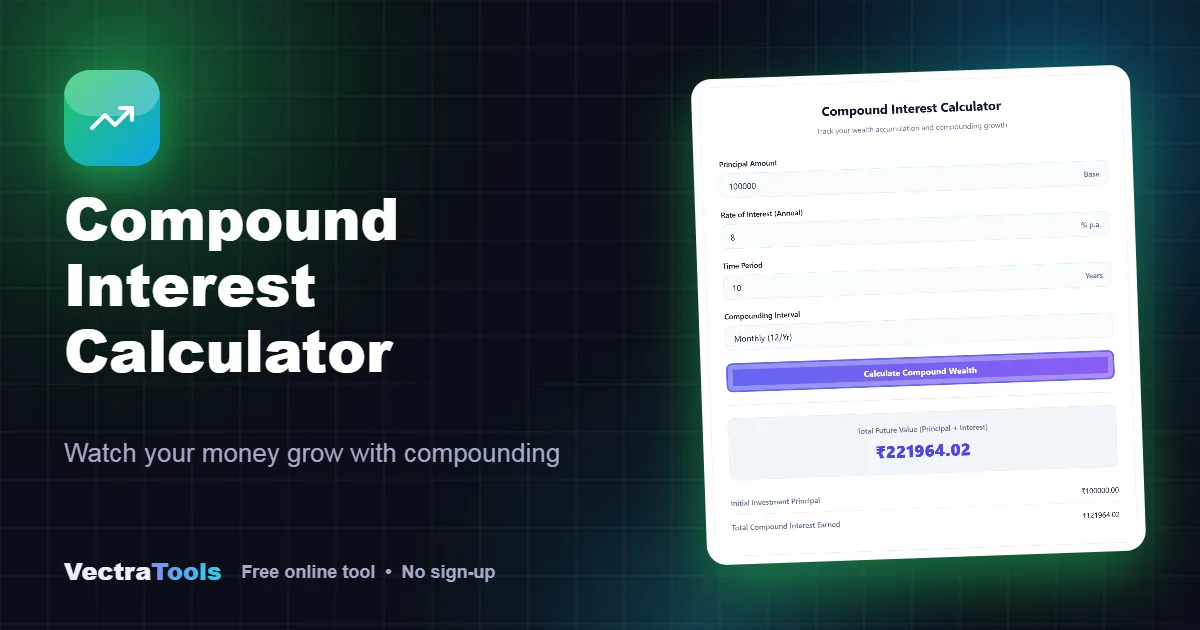
A compound interest calculator uses the formula A = P (1 + r/n)nt to find how much an investment grows when interest is added to the balance and earns interest itself. For example, 100,000 invested at 8% a year, compounded monthly for 10 years, grows to 221,964.02, which is 121,964.02 in interest.
Our free compound interest calculator shows how your savings, deposits or investments grow over time when interest is compounded monthly, quarterly, half-yearly or yearly. Enter the principal, the annual rate, the number of years and the compounding interval, and you instantly see the maturity value and the total interest earned.
It is useful for planning fixed deposits, savings accounts, mutual fund and retirement goals, or for checking how much a loan with compounding interest will really cost. It works with any currency and runs entirely in your browser.
What Is Compound Interest?
Compound interest is interest earned on both the original principal and the interest that has already been added. Each time interest is compounded, the balance grows, so the next round of interest is calculated on a larger amount. This snowball effect is why compounding is often called the most powerful idea in personal finance.
The more often interest is compounded and the longer you stay invested, the bigger the effect. For background on the maths, see this explanation of compound interest.
A = P × (1 + r ÷ n)n × t
Compound Interest = A − P
P = principal, r = annual rate as a decimal (8% = 0.08), n = times compounded per year, t = years
How to Use the Compound Interest Calculator
Follow these five quick steps:
Step 1: Enter the Principal Amount
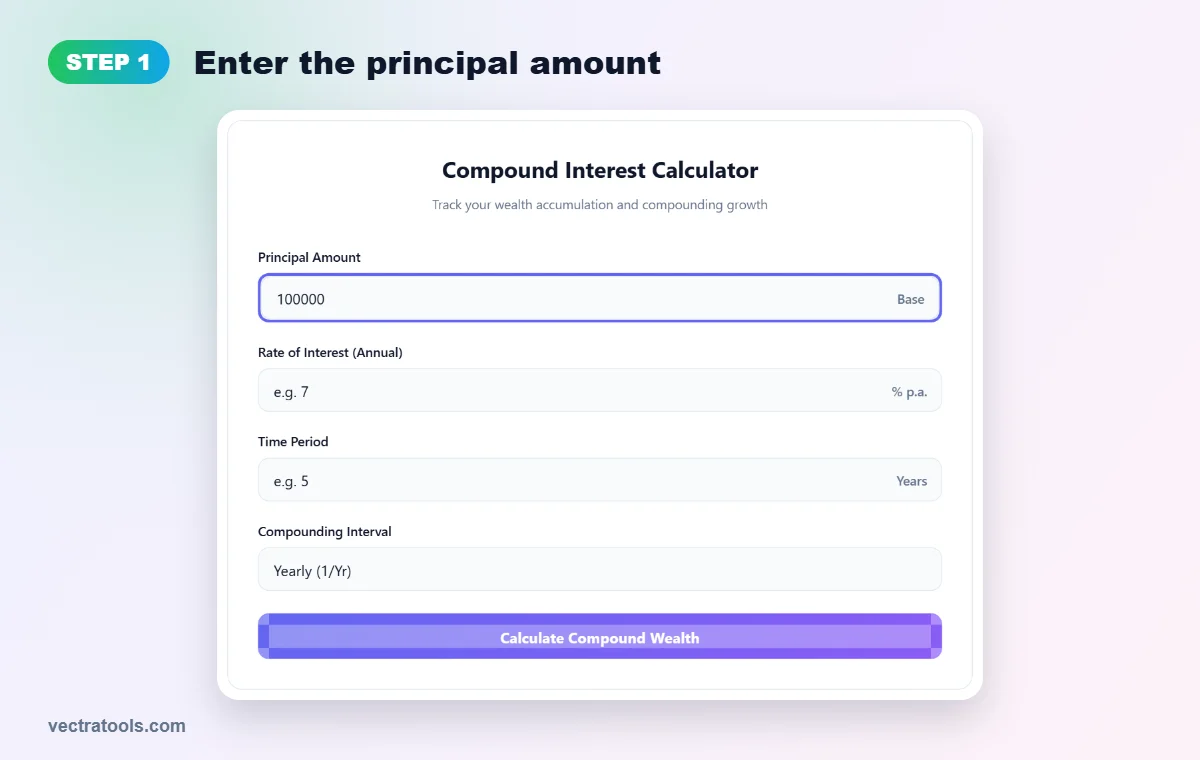
Type your starting investment or deposit in the Principal Amount box, for example 100000.
Step 2: Enter the Interest Rate and Time Period
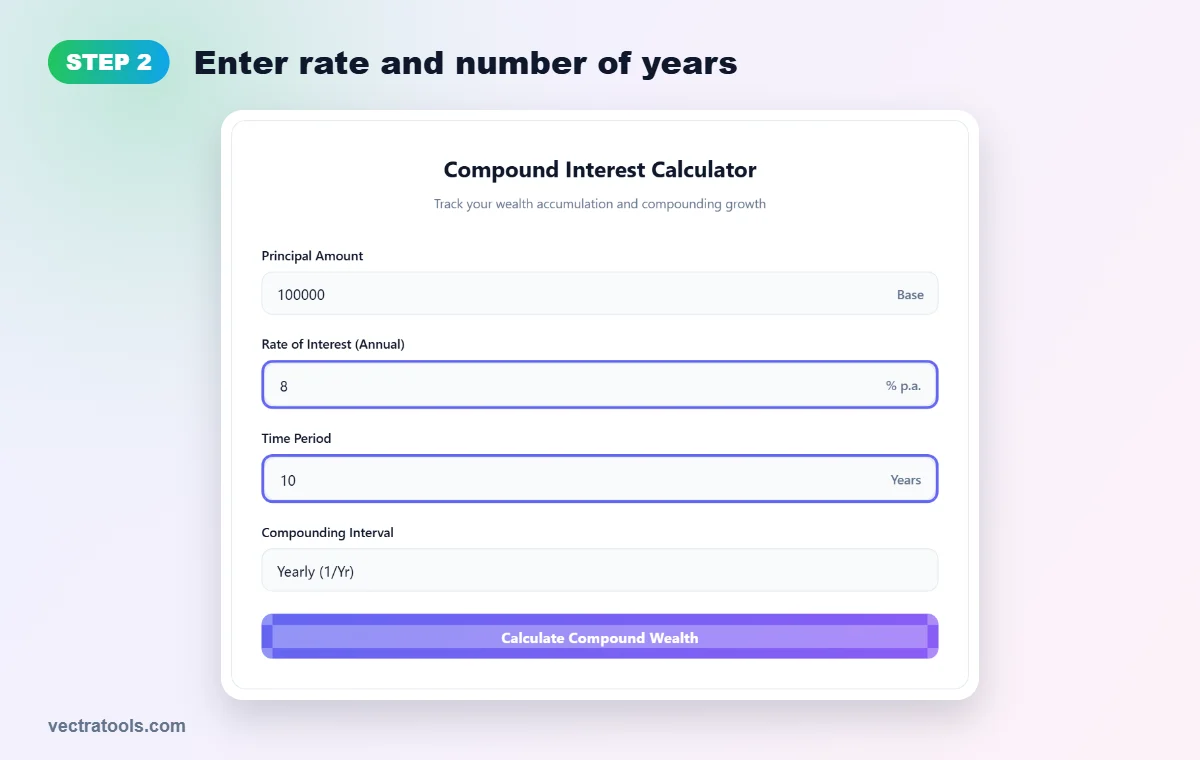
Enter the annual interest rate (for example 8) and the number of years you plan to stay invested (for example 10).
Step 3: Choose the Compounding Interval
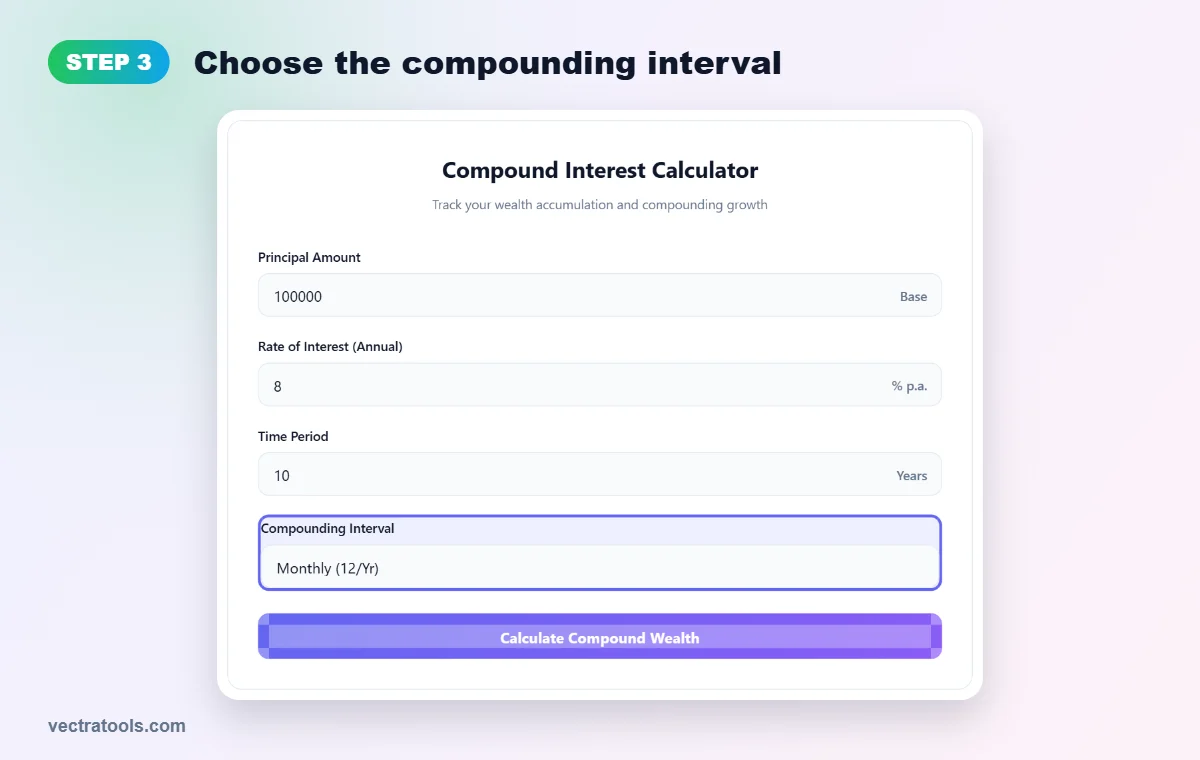
Select how often interest is added: Monthly, Quarterly, Half-Yearly or Yearly. Check your bank or fund documents if you are not sure; many savings accounts compound monthly or quarterly.
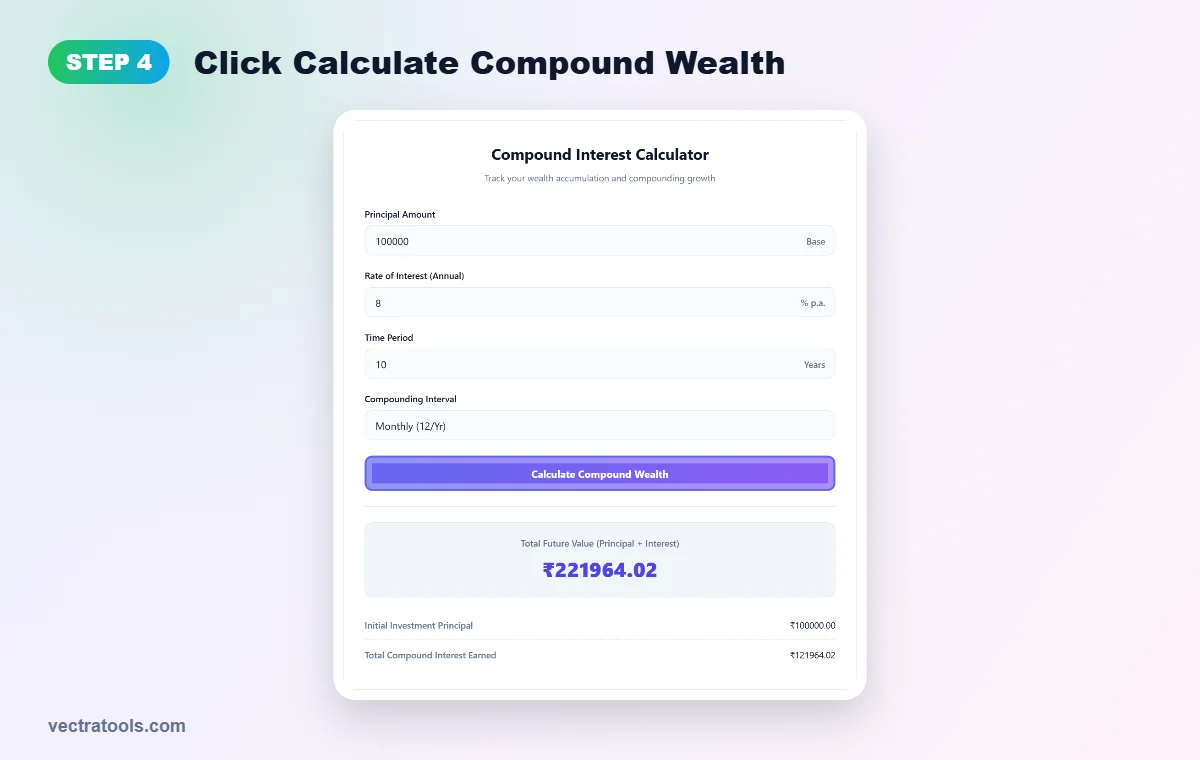
Step 4: Click Calculate Compound Wealth
Press the Calculate Compound Wealth button. The compound interest calculator applies the formula and shows your results below the form.
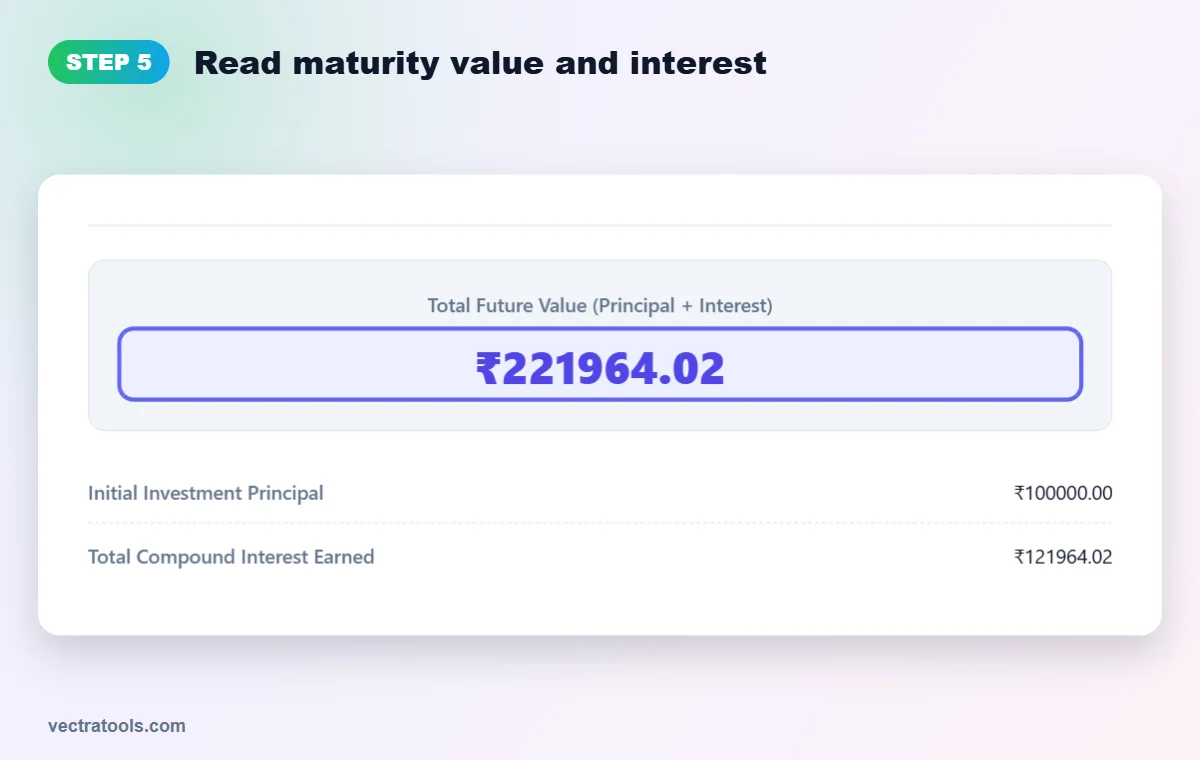
Step 5: Read Your Maturity Value and Interest
You will see the Total Future Value at maturity, your Initial Investment Principal and the Total Compound Interest Earned.
Compound Interest Formula Explained With an Example
- Write down the values: P = 100,000, r = 8% = 0.08, n = 12 (monthly), t = 10 years.
- Rate per period: r ÷ n = 0.08 ÷ 12 = 0.006667.
- Number of periods: n × t = 12 × 10 = 120.
- Growth factor: (1.006667)120 ≈ 2.21964.
- Maturity amount: 100,000 × 2.21964 = 221,964.02, so interest = 121,964.02.
How Compounding Frequency Changes Your Returns
Here is the same 100,000 invested at 8% for 10 years with different compounding intervals:
| Compounding | Periods per year | Maturity amount | Interest earned |
|---|---|---|---|
| Yearly | 1 | 215,892.50 | 115,892.50 |
| Half-yearly | 2 | 219,112.31 | 119,112.31 |
| Quarterly | 4 | 220,803.97 | 120,803.97 |
| Monthly | 12 | 221,964.02 | 121,964.02 |
More frequent compounding gives a slightly higher result because interest starts earning interest sooner.
Compound Interest Calculator Examples
| Principal | Rate | Years | Compounding | Maturity amount |
|---|---|---|---|---|
| 10,000 | 6% | 5 | Yearly | 13,382.26 |
| 50,000 | 10% | 3 | Quarterly | 67,244.44 |
| 100,000 | 8% | 5 | Yearly | 146,932.81 |
| 100,000 | 8% | 10 | Monthly | 221,964.02 |
| 100,000 | 12% | 20 | Yearly | 964,629.31 |
Compound Interest vs Simple Interest
Simple interest is paid only on the original principal, so it grows in a straight line. Compound interest grows faster every year. At 8% for 10 years, 100,000 earns 80,000 with simple interest but 115,892.50 with yearly compounding. Compare both with our Simple Interest Calculator.
The Rule of 72
A quick way to estimate how long money takes to double with compound interest is to divide 72 by the annual rate. At 8%, money doubles in about 72 ÷ 8 = 9 years. At 12%, it takes about 6 years. The compound interest calculator gives the exact figure.
Tips to Make Compounding Work for You
- Start early: time is the biggest driver of compound growth.
- Reinvest returns: withdrawing interest stops it from compounding.
- Compare effective rates: a lower rate compounded more often can beat a higher rate compounded yearly.
- Remember inflation and tax: results are before tax and do not adjust for rising prices.
Frequently Asked Questions
What is the formula for compound interest?
A = P (1 + r/n)^(nt), where P is the principal, r is the annual rate as a decimal, n is the number of compounding periods per year and t is the number of years. Compound interest is A minus P.
Which is better, monthly or yearly compounding?
For savings, monthly compounding is better because interest is added more often and starts earning sooner. For loans, yearly compounding costs you less.
How long does it take to double money with compound interest?
Use the Rule of 72: divide 72 by the annual interest rate. At 8% a year, money doubles in roughly 9 years.
Does this compound interest calculator include monthly deposits?
No. It calculates growth on a single lump-sum principal. For regular monthly investments, use a SIP or recurring deposit calculator.
Is compound interest the same as annual percentage yield?
Not exactly. APY, or effective annual rate, shows the yearly return after compounding. For 8% compounded monthly, the effective annual rate is about 8.30%.
Is the compound interest calculator free?
Yes. It is free, needs no sign-up and works on mobile, tablet and desktop.