

Simple Interest Calculator
Simple Interest Calculator
Calculate your investment returns or loan interest easily

Quick answer
A simple interest calculator uses the formula SI = P × R × T ÷ 100, where P is the principal, R is the yearly interest rate and T is the time in years. For example, 100,000 invested at 8% a year for 5 years earns 40,000 in simple interest, so the total maturity amount is 140,000.
Our free simple interest calculator shows how much interest a loan or deposit earns when interest is charged only on the original amount. Enter the principal, the annual rate and the time in years or months, and you instantly see the interest earned and the total amount payable or receivable.
Students use it to check homework, borrowers use it to compare short-term loans, and savers use it to estimate returns on fixed deposits or informal loans between family and friends. Everything is calculated in your browser, and it works with any currency.
What Is Simple Interest?
Simple interest is interest calculated only on the principal, the amount you originally borrow or invest. Unlike compound interest, the interest earned in one year is not added back to the principal, so the interest stays the same every year. That makes simple interest easy to predict and easy to check by hand.
It is common in car loans, some personal and gold loans, short-term deposits, treasury bills and many classroom problems. You can read more about how interest works and how it differs between simple and compound methods.
SI = (P × R × T) ÷ 100
Total Amount (A) = P + SI
P = principal, R = annual rate of interest (%), T = time in years (months ÷ 12)
How to Use the Simple Interest Calculator
Follow these four quick steps:
Step 1: Enter the Principal Amount
Type the amount you are investing or borrowing in the Principal Amount box, for example 100000. Do not add currency symbols or commas.

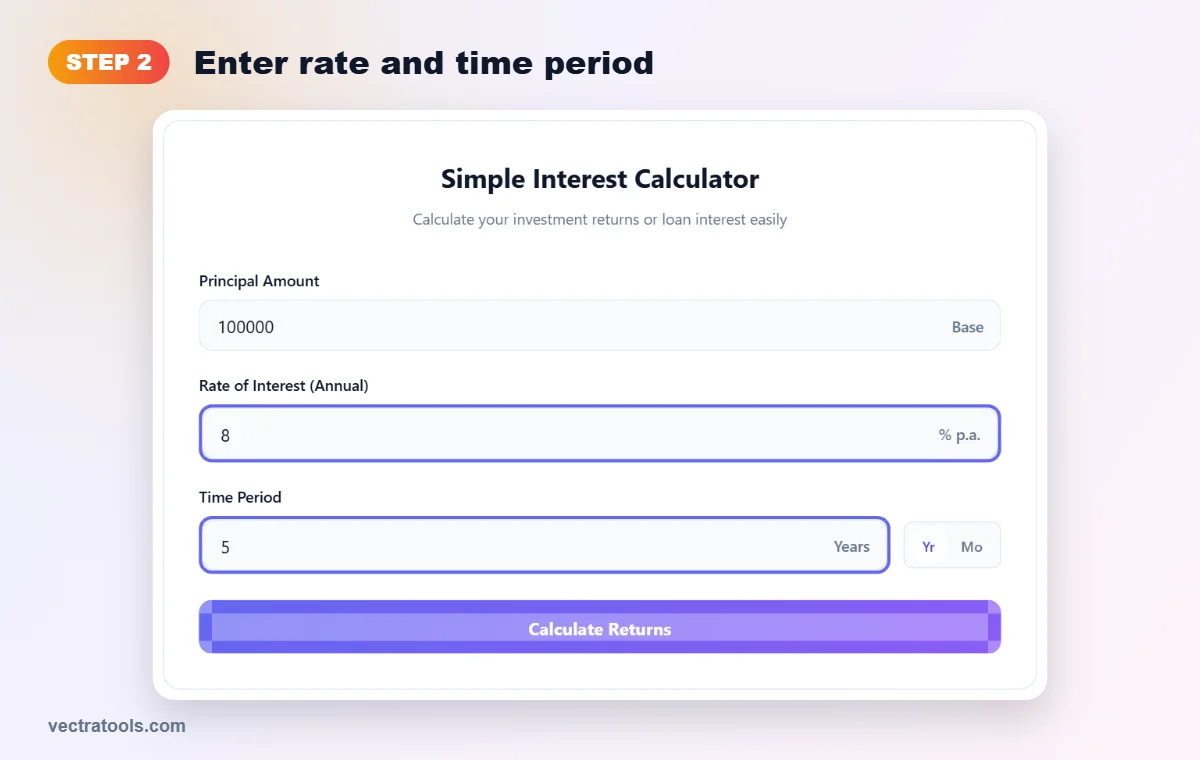
Step 2: Enter the Interest Rate and Time Period
Add the annual interest rate in the Rate of Interest box, for example 8. Then enter the time and choose Yr for years or Mo for months using the toggle next to the field.
Step 3: Click Calculate Returns
Press the Calculate Returns button. The simple interest calculator applies the SI formula and shows the results below the form straight away.
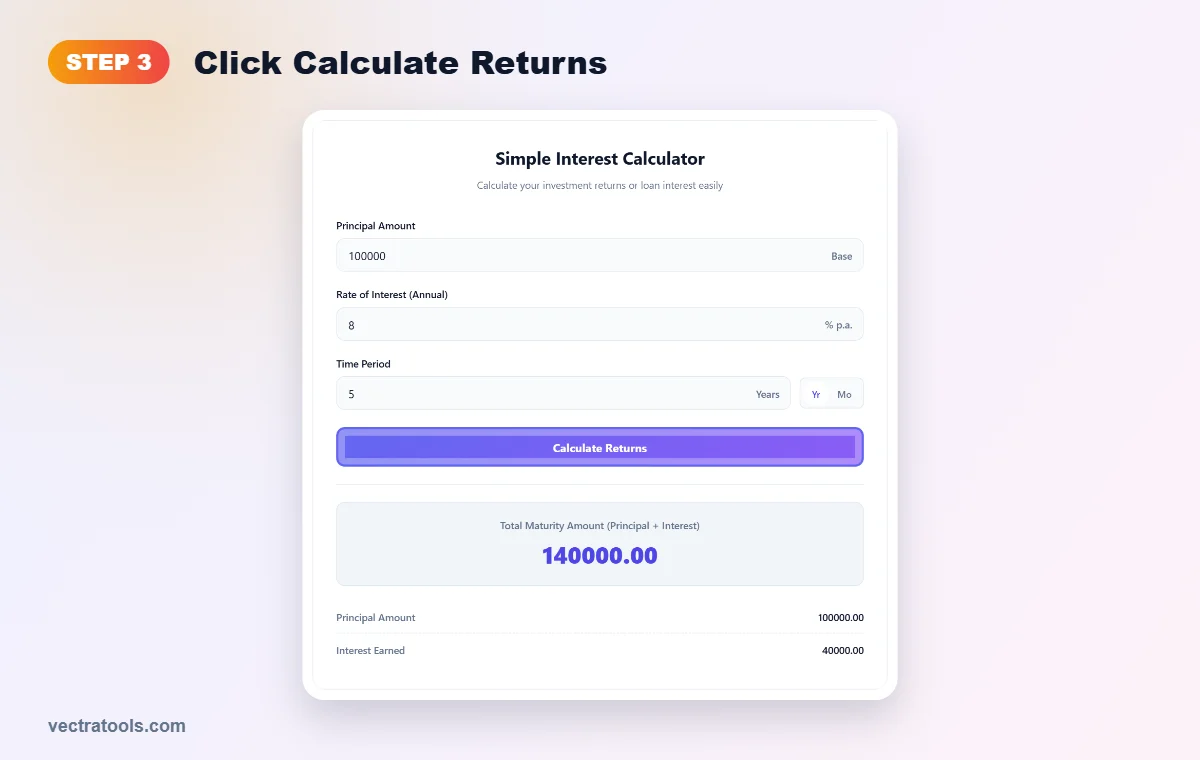
Step 4: Read the Interest and Total Amount
The results show the Total Maturity Amount (principal plus interest), the original Principal Amount and the Interest Earned. For a loan, the interest is the cost of borrowing; for a deposit, it is your return.

Simple Interest Formula Explained With an Example
- Write down the values: P = 100,000, R = 8% per year, T = 5 years.
- Multiply P × R × T: 100,000 × 8 × 5 = 4,000,000.
- Divide by 100: 4,000,000 ÷ 100 = 40,000 simple interest.
- Add the principal: 100,000 + 40,000 = 140,000 total amount.
Time in months: if the period is 18 months, convert it to years first: 18 ÷ 12 = 1.5 years. Then SI = 100,000 × 8 × 1.5 ÷ 100 = 12,000. The calculator does this conversion automatically when you select Mo.
Simple Interest Calculator Examples
| Principal | Rate (p.a.) | Time | Simple interest | Total amount |
|---|---|---|---|---|
| 10,000 | 5% | 2 years | 1,000 | 11,000 |
| 50,000 | 10% | 3 years | 15,000 | 65,000 |
| 100,000 | 8% | 5 years | 40,000 | 140,000 |
| 100,000 | 8% | 18 months | 12,000 | 112,000 |
| 250,000 | 12% | 6 months | 15,000 | 265,000 |
Simple Interest vs Compound Interest
With simple interest, you earn or pay the same amount of interest every year. With compound interest, each year's interest is added to the balance, so the next year's interest is calculated on a bigger number. Over short periods the difference is small, but over many years compound interest grows much faster.
| 100,000 at 8% | Simple interest total | Compound interest total (yearly) |
|---|---|---|
| 1 year | 108,000 | 108,000 |
| 5 years | 140,000 | 146,933 |
| 10 years | 180,000 | 215,892 |
| 20 years | 260,000 | 466,096 |
To see how compounding changes your returns, try our Compound Interest Calculator.
Where Simple Interest Is Used
- Car and vehicle loans: many lenders quote a flat rate that works like simple interest on the original loan.
- Short-term deposits and bills: treasury bills and some short fixed deposits pay simple interest.
- Personal and informal loans: loans between friends, family or small businesses are often agreed on a simple interest basis.
- Education: simple interest is one of the first finance topics taught in school maths.
Tips for Accurate Results
- Use the annual rate: if a lender quotes a monthly rate, multiply it by 12 before entering it.
- Pick the right time unit: choose Mo for periods under a year so the tool converts months to years for you.
- Flat rate vs reducing balance: a flat-rate loan costs more than a reducing-balance EMI loan at the same rate. Compare with our EMI Calculator.
- Taxes and fees: results are before tax, processing fees or penalties.
Frequently Asked Questions
What is the formula for simple interest?
Simple interest = Principal × Rate × Time ÷ 100, where the rate is the yearly percentage and time is in years. The total amount is the principal plus the simple interest.
How do I calculate simple interest for months?
Divide the number of months by 12 to convert it to years, then use the normal formula. For 9 months, T = 9 ÷ 12 = 0.75 years. In this simple interest calculator, just select Mo and enter the months.
How do I calculate simple interest for days?
Divide the number of days by 365 to get the time in years, then apply SI = P × R × T ÷ 100. Some banks use 360 days, so check your lender's convention.
What is the difference between simple and compound interest?
Simple interest is charged only on the original principal, while compound interest is also charged on interest already added. For the same rate and time, compound interest always gives a higher total after the first period.
How do I find the principal if I know the interest?
Rearrange the formula: P = (SI × 100) ÷ (R × T). For example, if 12,000 interest was earned at 8% over 1.5 years, P = 1,200,000 ÷ 12 = 100,000.
Is the simple interest calculator free to use?
Yes. It is completely free, needs no sign-up and works on phones, tablets and computers.