

Percentage Calculator
Percentage Calculator
Fast and accurate multi-purpose percentage calculations
1. Find Percentage Value
2. Find Percentage Rate
3. Find Percentage Change (Increase/Decrease)

Quick answer
A percentage calculator solves the three most common percent problems. X% of Y = X ÷ 100 × Y, so 15% of 200 = 30. A is what % of B = A ÷ B × 100, so 50 is 20% of 250. Percentage change = (new − old) ÷ old × 100, so going from 100 to 150 is a 50% increase.
Our free percentage calculator handles every everyday percent question in one place: finding a percentage of a number, working out what percent one number is of another, and calculating the percentage increase or decrease between two values. Type your numbers, press the = button and the answer appears instantly.
It is ideal for exam marks, shopping discounts, tax and tip amounts, salary rises, business growth, price changes and statistics homework. Everything runs in your browser and works on any device.
What Is a Percentage?
A percentage is a number expressed as a fraction of 100. The word comes from the Latin per centum, meaning "by the hundred". So 25% means 25 out of every 100, which is the same as the fraction 1/4 or the decimal 0.25. Learn more about the history and notation of the percentage.
X% of Y = (X ÷ 100) × Y
A as a % of B = (A ÷ B) × 100
% change = (New − Old) ÷ Old × 100
How to Use the Percentage Calculator
The tool has three separate calculators. Use the one that matches your question:
Step 1: Find a Percentage of a Number
In section 1. Find Percentage Value, enter the percent in the first box and the number in the second, then press the = button. For example, "What is 15% of 200?" gives 30.

Step 2: Find What Percent One Number Is of Another
In section 2. Find Percentage Rate, enter the part first and the whole second. For example, "50 is what % of 250?" gives 20%. This is the one to use for exam marks and survey results.

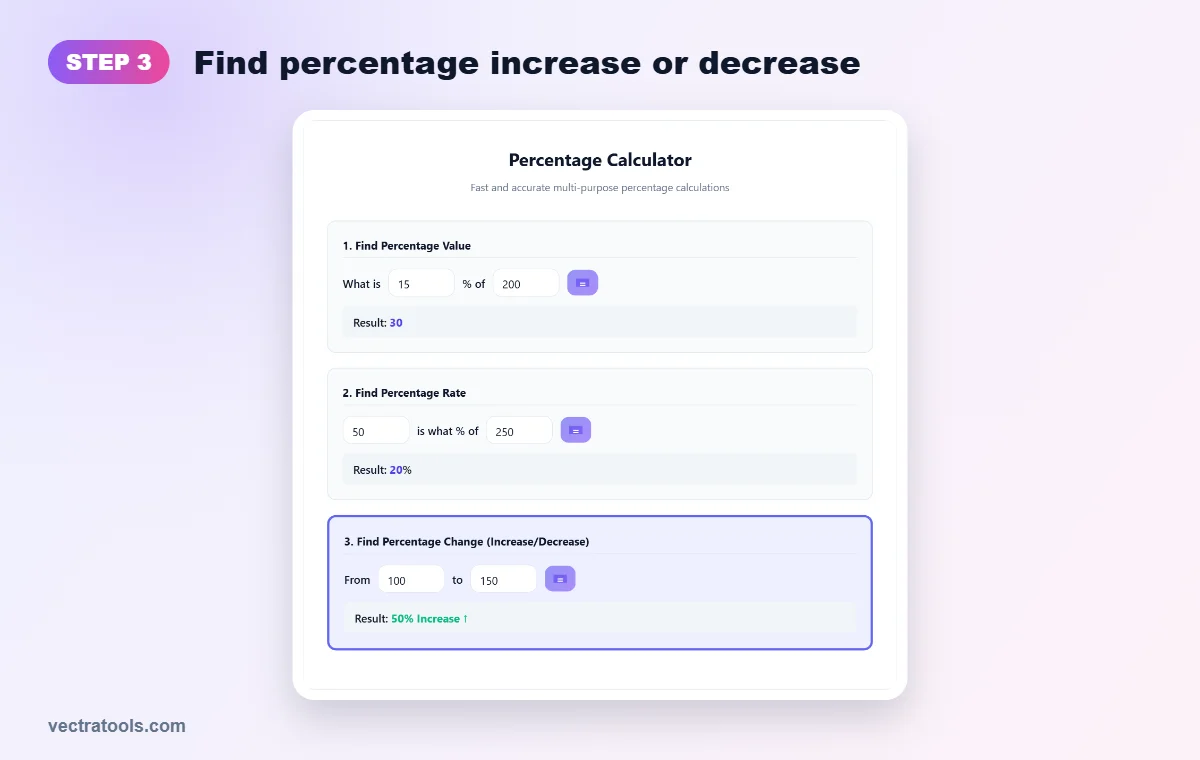
Step 3: Find the Percentage Increase or Decrease
In section 3. Find Percentage Change, enter the original value in From and the new value in To. Going from 100 to 150 gives a 50% increase; going from 150 to 120 gives a 20% decrease.
Step 4: Read Your Results
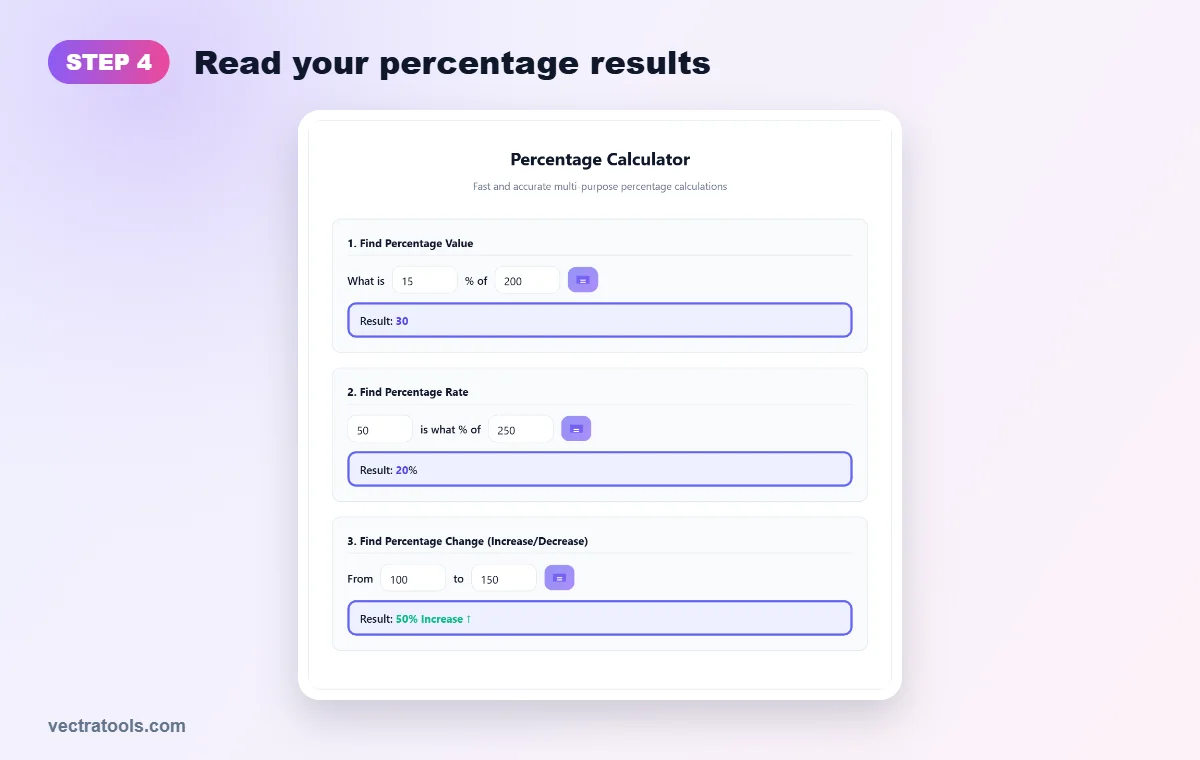
Each result appears directly under its section, with an arrow showing whether a change is an increase or a decrease. You can change any number and press the button again to recalculate.
Percentage Formulas With Worked Examples
- Percentage of a number: 15% of 200 = 15 ÷ 100 × 200 = 0.15 × 200 = 30.
- Percentage rate: 50 out of 250 = 50 ÷ 250 × 100 = 0.2 × 100 = 20%.
- Percentage increase: 100 to 150 = (150 − 100) ÷ 100 × 100 = 50% increase.
- Percentage decrease: 150 to 120 = (120 − 150) ÷ 150 × 100 = −20%, a 20% decrease.
Common Percentage Examples
| Question | Calculation | Answer |
|---|---|---|
| What is 10% of 500? | 0.10 × 500 | 50 |
| What is 25% of 80? | 0.25 × 80 | 20 |
| What is 18% of 1,200? | 0.18 × 1,200 | 216 |
| 45 is what % of 60? | 45 ÷ 60 × 100 | 75% |
| Price rises from 800 to 1,000 | 200 ÷ 800 × 100 | 25% increase |
| Weight falls from 90 to 81 | 9 ÷ 90 × 100 | 10% decrease |
Quick Mental Math Tricks for Percentages
- 10%: move the decimal point one place left. 10% of 340 = 34.
- 5%: half of 10%. 5% of 340 = 17.
- 1%: move the decimal two places left. 1% of 340 = 3.4.
- Swap trick: X% of Y equals Y% of X. 8% of 50 is the same as 50% of 8 = 4.
- 50%, 25%, 20%: divide by 2, 4 and 5.
Where Percentages Are Used
- Shopping: sale discounts and coupon savings. Try our Discount Calculator.
- Exams: converting marks into a percentage score.
- Money: interest rates, tax, GST and salary increments.
- Business: profit margins, growth rates and conversion rates.
- Health and fitness: body fat percentage and weight-loss progress.
Common Percentage Mistakes to Avoid
- Using the wrong base: percentage change is always divided by the original value, not the new one.
- Adding percentages in a row: a 10% rise followed by a 10% fall does not return to the start. 100 → 110 → 99.
- Percent vs percentage points: a rate moving from 5% to 7% is a 2 percentage point rise, but a 40% increase.
Who Uses a Percentage Calculator?
Students use a percentage calculator to turn test marks into a percent score and to check maths homework. Shoppers use it to see how much a sale really saves, while employees use it to work out a pay rise or a bonus.
Business owners rely on a percentage calculator for profit margins, monthly growth and tax amounts, and teachers use it to grade papers quickly. Because this percentage calculator has three tools on one screen, you can answer almost any percent question without switching pages or reaching for a spreadsheet.
If you need a percentage calculator on your phone, just bookmark this page. It loads fast, works offline once opened and gives the same accurate results on mobile, tablet and desktop.
Frequently Asked Questions
How do I calculate a percentage of a number?
Divide the percentage by 100 and multiply by the number. For example, 15% of 200 = 0.15 × 200 = 30.
How do I calculate my exam percentage?
Divide the marks you scored by the total marks and multiply by 100. If you scored 425 out of 500, your percentage is 425 ÷ 500 × 100 = 85%.
How do I calculate percentage increase?
Subtract the old value from the new value, divide by the old value and multiply by 100. From 100 to 150 is (50 ÷ 100) × 100 = a 50% increase.
How do I calculate percentage decrease?
Subtract the new value from the old value, divide by the old value and multiply by 100. From 150 to 120 is (30 ÷ 150) × 100 = a 20% decrease.
How do I convert a fraction to a percentage?
Divide the top number by the bottom number and multiply by 100. For example, 3/8 = 0.375 × 100 = 37.5%.
Is this percentage calculator free?
Yes. The percentage calculator is completely free, needs no sign-up and works on phone, tablet and computer.