Quick answer: To work out how to calculate a calorie deficit, first estimate your BMR (calories your body burns at rest), multiply it by your activity level to get your TDEE (total daily calories burned), then eat about 300–500 calories less than your TDEE. Example: a TDEE of 2,000 calories minus 500 gives a daily target of 1,500 calories. Our free Calorie Deficit Calculator does all three steps for you.
A calorie deficit simply means burning more energy than you eat. It is the foundation of every fat-loss plan, whether you count calories, follow keto or try intermittent fasting. The hard part is not the idea – it is finding the right number. Below is a clear step-by-step method on how to calculate calorie deficit targets, with a worked example, a size guide and the mistakes that stall progress.
What Is a Calorie Deficit?
Your body burns calories in three main ways: keeping you alive at rest (your basal metabolic rate, or BMR), digesting food, and moving. Together these make your total daily energy expenditure (TDEE). When you eat fewer calories than your TDEE, your body makes up the gap from stored energy – mostly fat – and your weight gradually drops.
How to Calculate Calorie Deficit in 3 Steps
Step 1: Calculate your BMR
The Mifflin-St Jeor equation is the formula most dietitians use today. It is described alongside the older Harris–Benedict equation:
- Men: BMR = (10 × weight in kg) + (6.25 × height in cm) − (5 × age) + 5
- Women: BMR = (10 × weight in kg) + (6.25 × height in cm) − (5 × age) − 161
Skip the maths with our BMR Calculator.
Step 2: Multiply by your activity level to get TDEE
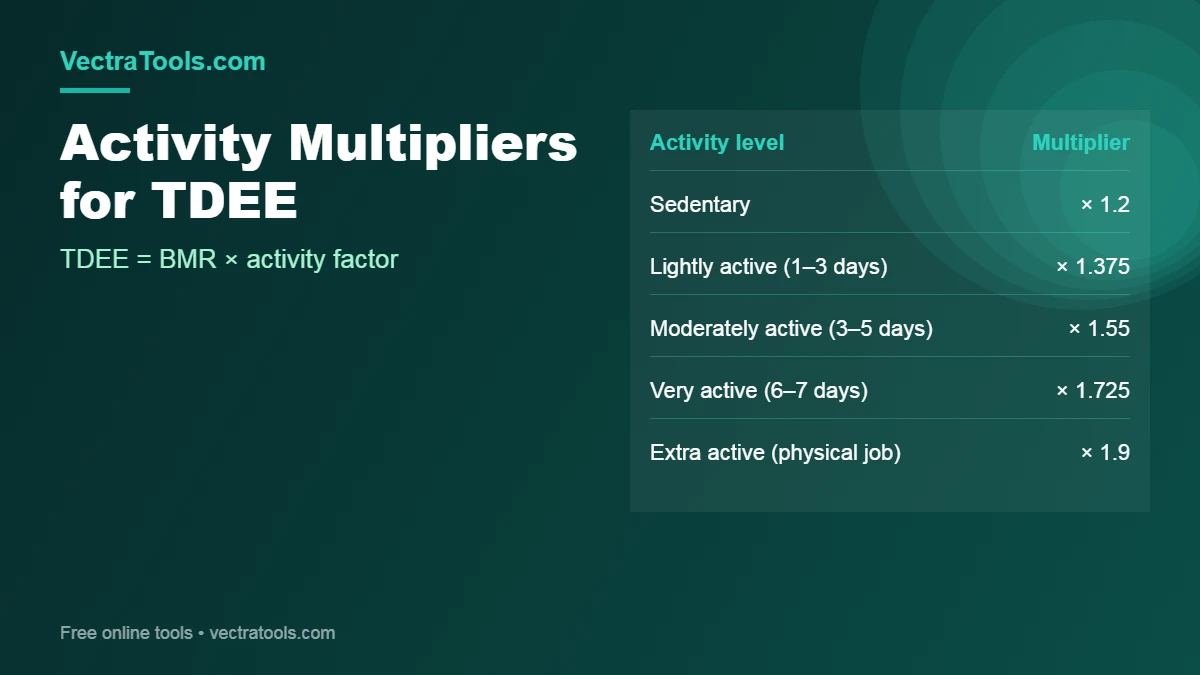
| Activity level | Description | Multiplier |
|---|---|---|
| Sedentary | Desk job, little exercise | 1.2 |
| Lightly active | Exercise 1–3 days/week | 1.375 |
| Moderately active | Exercise 3–5 days/week | 1.55 |
| Very active | Hard exercise 6–7 days/week | 1.725 |
| Extra active | Physical job plus training | 1.9 |
Be honest here – most people overestimate their activity. If unsure, pick the lower level. Our Calorie Calculator shows your maintenance calories at every level side by side.
Step 3: Subtract your deficit
Subtract 300–500 calories from your TDEE for steady, sustainable fat loss. That number is your daily calorie target.
Worked Example: How to Calculate Calorie Deficit for a Real Person
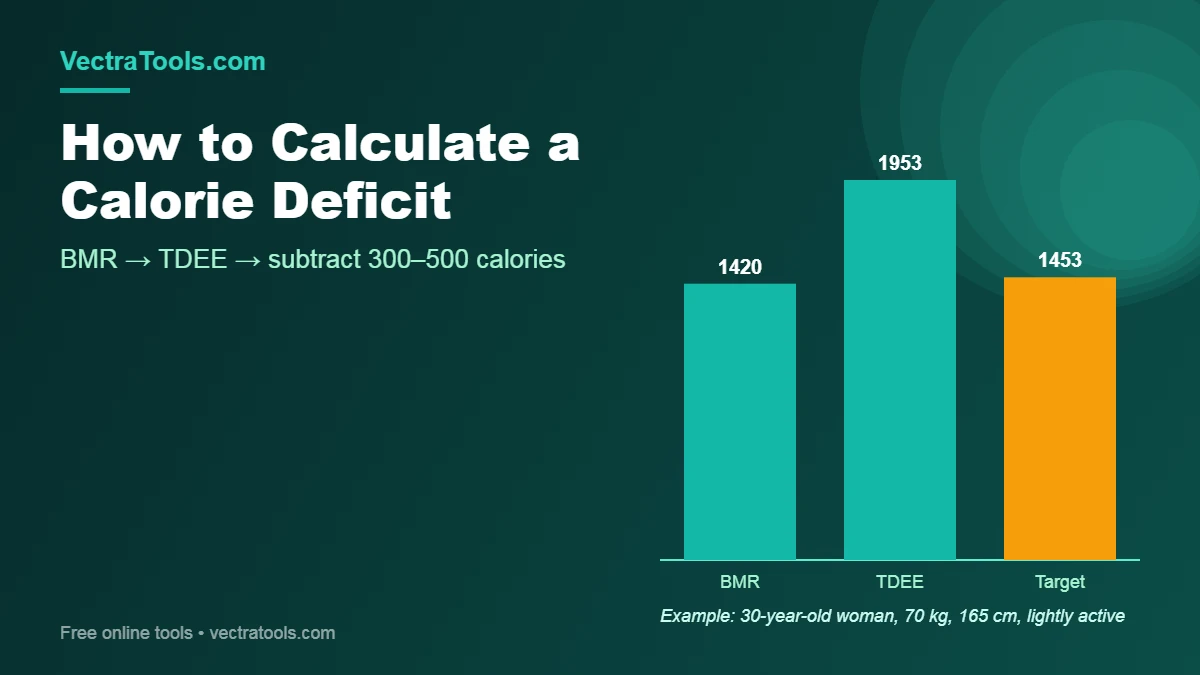
A 30-year-old woman, 70 kg, 165 cm tall, who exercises two or three times a week:
- BMR = (10 × 70) + (6.25 × 165) − (5 × 30) − 161 = 700 + 1,031 − 150 − 161 ≈ 1,420 calories
- TDEE = 1,420 × 1.375 (lightly active) ≈ 1,953 calories
- Daily target = 1,953 − 500 ≈ 1,450 calories
At that deficit she can expect to lose roughly 0.5 kg (about 1 lb) per week at first, with progress slowing over time as her body adapts.
How Big Should Your Calorie Deficit Be?
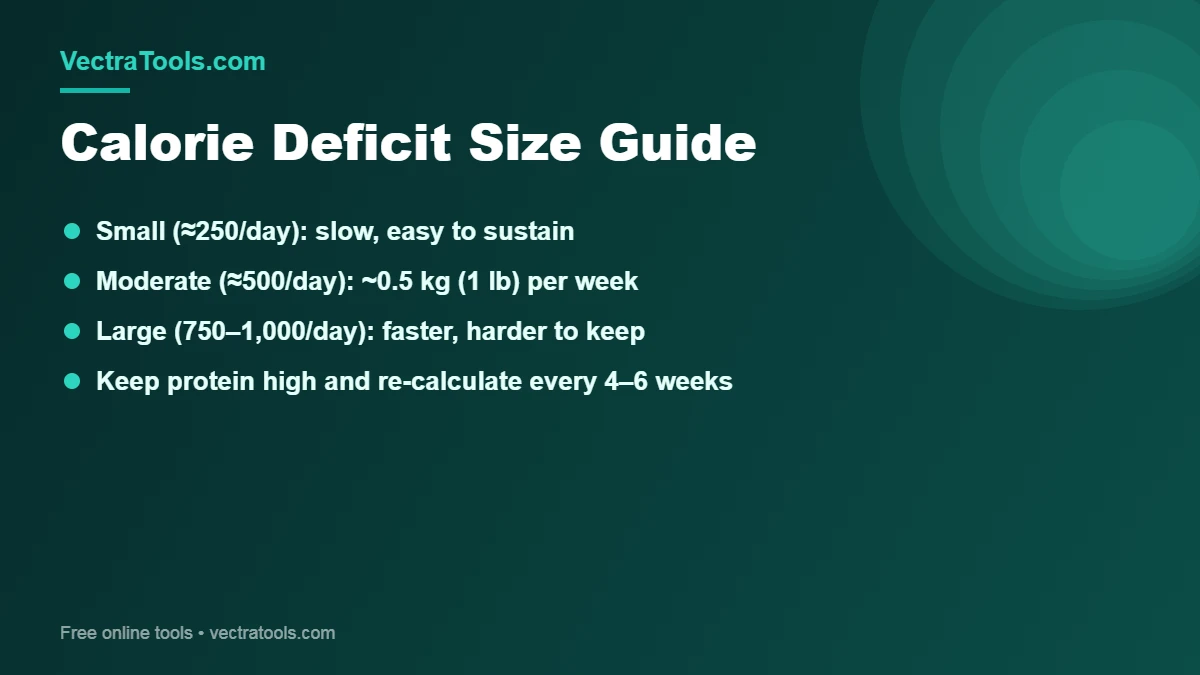
| Deficit size | Daily deficit | Typical pace | Best for |
|---|---|---|---|
| Small | ~250 kcal | ~0.25 kg / 0.5 lb per week | Lean people, slow and steady |
| Moderate | ~500 kcal | ~0.5 kg / 1 lb per week | Most people |
| Large | 750–1,000 kcal | ~0.75–1 kg / 1.5–2 lb per week | Higher body weight, short term, ideally with guidance |
The old "3,500 calories = 1 pound" rule is a useful rough guide, but research shows it overestimates long-term loss because metabolism slows as you lose weight. Re-calculate your numbers every 4–6 weeks or after every 4–5 kg lost.
How to Make a Calorie Deficit Easier to Stick To
- Prioritise protein. It keeps you full and protects muscle. Find your target with our Protein Intake Calculator.
- Balance your macros. Split calories into protein, carbs and fat using the Macro Calculator.
- Move more, not just eat less. Daily steps and training raise TDEE. Estimate workout burn with our Calories Burned Calculator.
- Eat high-volume foods. Vegetables, fruit, soups and lean protein fill you up for fewer calories.
- Track trends, not single days. Weigh in a few times a week and watch the weekly average.
- Sleep 7–9 hours. Poor sleep increases hunger and cravings.
Common Calorie Deficit Mistakes
- Cutting too hard. Very low intakes cause fatigue, muscle loss and rebound eating. Many guidelines advise not going below about 1,200 kcal (women) or 1,500 kcal (men) without medical supervision.
- Overestimating exercise burn. Fitness trackers often overcount; do not "eat back" every calorie.
- Forgetting liquid calories. Sugary drinks, coffee add-ins and juices add up fast.
- Never updating the numbers. A smaller body burns fewer calories – your deficit shrinks unless you re-calculate.
- Ignoring body composition. Check progress with more than the scale; our BMI Calculator is a quick general reference.
Planning your money as carefully as your meals? The 50/30/20 budget rule uses the same simple "set a target and track it" idea.
Frequently Asked Questions
How do I calculate my calorie deficit?
Calculate your BMR with the Mifflin-St Jeor equation, multiply by your activity factor to get TDEE, then subtract 300–500 calories. The result is your daily calorie target.
Is a 500 calorie deficit good?
For most adults, yes. A 500-calorie daily deficit typically leads to about 0.5 kg (1 lb) of weight loss per week at the start.
Can I lose weight without counting calories?
Yes, if habits like more protein, more vegetables and fewer processed foods create a deficit. Counting simply makes the deficit measurable.
Why am I not losing weight in a calorie deficit?
The most common reasons are underestimated food intake, overestimated activity, water retention or not updating your numbers after losing weight.
How often should I recalculate my calorie deficit?
Every 4–6 weeks, or after losing about 4–5 kg, because your TDEE drops as your weight drops.
This article is for general information only and is not medical advice. Talk to a doctor or registered dietitian before starting a diet, especially if you are pregnant, under 18 or have a health condition.