

Parallel and Perpendicular Line Finder – Easy Line Equations in 2 Steps
Parallel & Perpendicular Lines
Free parallel and perpendicular line finder – find the equations of lines passing through a target point, relative to an original line's slope.
1. Original Line Slope
2. Target Point (x, y)
Use this free parallel and perpendicular line finder to get both line equations through any point in one click.
Quick answer
Parallel lines have the same slope; perpendicular lines have the negative reciprocal slope (m₂ = −1/m₁). Use point-slope form y − y₁ = m(x − x₁) and rearrange to y = mx + b. Example: through (3, 4) with original slope 2, the parallel line is y = 2x − 2 and the perpendicular line is y = −0.5x + 5.5. This perpendicular line finder also handles horizontal and vertical lines.
Table of Contents
Finding parallel and perpendicular lines is a core skill in coordinate geometry, from school homework to CAD drawings and game development. The steps are short, but sign mistakes with the negative reciprocal or the y-intercept are very common.
Our free parallel and perpendicular line finder does it instantly. Choose a standard, horizontal or vertical original line, enter its slope and the target point, and get both equations with their slopes.
Parallel and Perpendicular Line Formulas
| Line | Slope rule | Equation through (x₁, y₁) |
|---|---|---|
| Parallel | m₂ = m₁ | y − y₁ = m₁(x − x₁) |
| Perpendicular | m₂ = −1 / m₁ | y − y₁ = (−1/m₁)(x − x₁) |
| Original horizontal (m = 0) | Parallel: horizontal; perpendicular: vertical | y = y₁ and x = x₁ |
| Original vertical (undefined) | Parallel: vertical; perpendicular: horizontal | x = x₁ and y = y₁ |
Worked Examples
Example 1: slope 2 through (3, 4)
Parallel: b = 4 − 2·3 = −2, so y = 2x − 2. Perpendicular slope = −1/2: b = 4 − (−0.5)(3) = 5.5, so y = −0.5x + 5.5.
Example 2: slope 3 through (3, 4)
Parallel: y = 3x − 5. Perpendicular slope = −1/3: b = 4 + 1 = 5, so y = −(1/3)x + 5 (the tool shows −0.3333).
Example 3: slope −0.5 through (−2, 1)
Parallel: b = 1 − (−0.5)(−2) = 0, so y = −0.5x. Perpendicular slope = 2: b = 1 − 2(−2) = 5, so y = 2x + 5.
How to Use the Perpendicular Line Finder
Get both equations in two steps.
Step 1: Enter the Original Slope and Target Point
Choose the Original Line Type: Standard (has slope), Horizontal (slope 0) or Vertical (undefined slope). For a standard line, enter its slope m. Then enter the Target X and Target Y of the point the new lines must pass through, and click Calculate Equations.
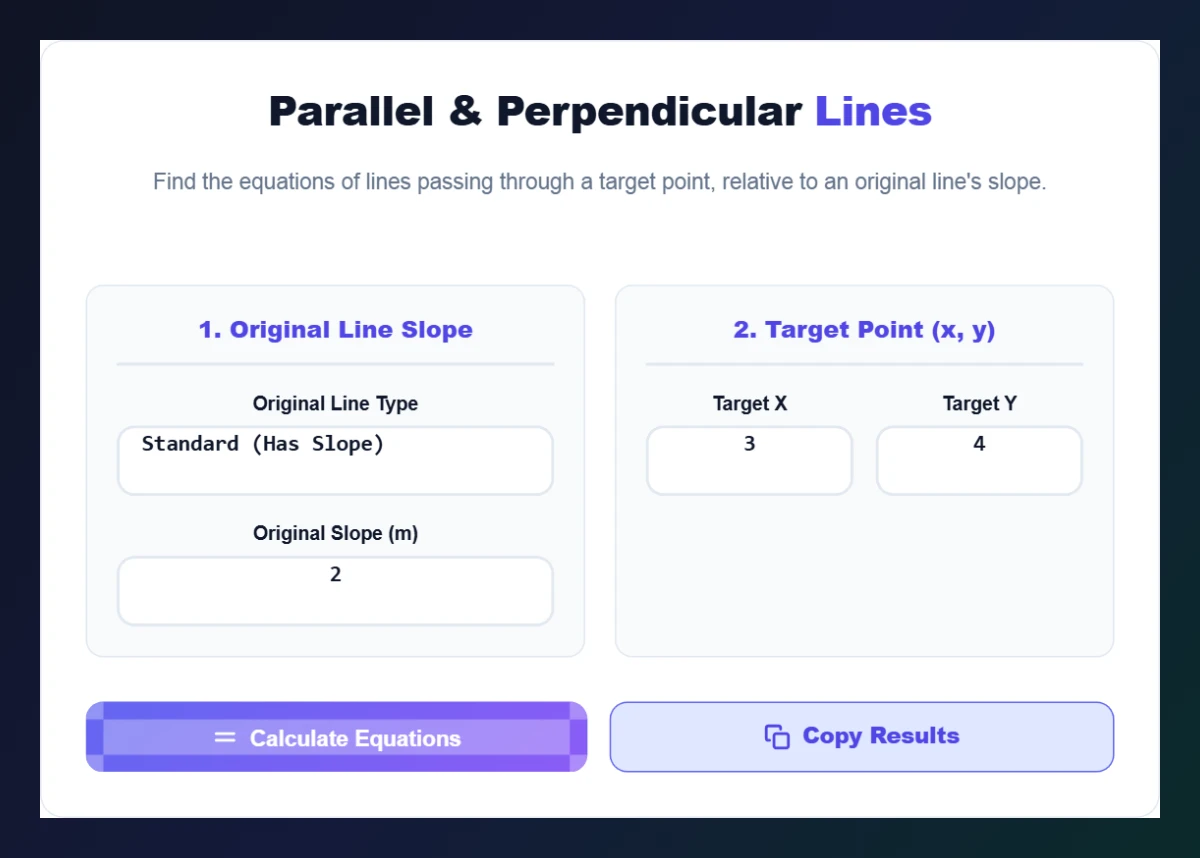
Step 2: Read and Copy the Equations
The Line Equations Report shows the parallel line equation and the perpendicular line equation, each with its slope. Click Copy Results to paste them into your notes or homework.

How to Check if Two Lines Are Perpendicular
Multiply their slopes: if m₁ × m₂ = −1, the lines are perpendicular (for example 2 × −0.5 = −1). A horizontal line (m = 0) is always perpendicular to a vertical line. Parallel lines have equal slopes and different intercepts.
Converting Between Line Forms
| Form | General shape | Example (perpendicular line above) |
|---|---|---|
| Slope-intercept | y = mx + b | y = −0.5x + 5.5 |
| Point-slope | y − y₁ = m(x − x₁) | y − 4 = −0.5(x − 3) |
| Standard | Ax + By = C | x + 2y = 11 |
Teachers often ask for the answer in standard form. Multiply y = −0.5x + 5.5 by 2 to clear the decimal (2y = −x + 11) and move x to the left: x + 2y = 11. The perpendicular line finder gives slope-intercept form, which you can convert in one step like this.
Where Parallel and Perpendicular Lines Are Used
- Architecture and CAD: walls, beams and layouts at right angles.
- Computer graphics and games: normals, collision lines and reflections.
- Surveying and maps: perpendicular distance from a point to a road or boundary.
- Physics: forces resolved into perpendicular components.
In all of these, a quick perpendicular line finder saves time and avoids sign errors.
Common Mistakes
- Using the reciprocal without changing the sign (1/m instead of −1/m).
- Forgetting to use the target point when finding b.
- Writing “y = …” for a vertical line – vertical lines are written x = constant.
- Rounding too early; keep fractions until the end.
Work with lines further using the Slope Calculator (y = mx + b) and the Midpoint & Endpoint Calculator.
Perpendicular Line Finder for Homework and Exams
Use the perpendicular line finder to check answers after you solve a problem by hand – not instead of learning the method. Work out the slope, find b, then compare with the tool. If your answer differs, look first at the sign of the reciprocal and the arithmetic for the y-intercept.
- Write the original slope and the point.
- Flip and change the sign of the slope for the perpendicular line.
- Substitute the point to find b.
- Check with the perpendicular line finder and correct any slip.
Frequently Asked Questions
How do you find a line perpendicular to another line?
Take the negative reciprocal of the original slope (−1/m) and use point-slope form with your point to find the equation.
How do you find a parallel line through a point?
Keep the same slope and calculate b = y₁ − m·x₁, then write y = mx + b.
What is perpendicular to a horizontal line?
A vertical line, written x = constant, through the given point.
How can I tell if two lines are perpendicular?
Their slopes multiply to −1, or one is horizontal and the other vertical.
Why does the tool show decimals like −0.3333?
Perpendicular slopes are often fractions; −0.3333 means −1/3.
Is the perpendicular line finder free?
Yes. It is free, runs in your browser and needs no sign-up.