

Mass Flow Rate Converter – kg/h to lb/s in 3 Easy Steps
Mass Flow Rate Converter
Use this mass flow rate converter: type a value into any field to instantly convert across all mass flow measurements.
Use this free mass flow rate converter to switch between kilograms per hour (kg/h), kilograms per second (kg/s), pounds per hour (lb/h) and pounds per second (lb/s). Type a value into any box and the other three update instantly.
Quick answer
1 kg/s = 3,600 kg/h, 1 lb/s = 3,600 lb/h and 1 kg = 2.20462 lb. So 1,000 kg/h = 0.2778 kg/s = 2,204.6 lb/h = 0.6124 lb/s, and 5,000 lb/h = 2,268 kg/h = 0.63 kg/s.
Table of Contents
Mass flow rate measures how much mass passes a point every second or hour. Steam boilers, compressors, burners, chemical plants and food lines all specify flow in mass units, because mass does not change with temperature or pressure the way volume does.
This mass flow rate converter switches between metric and imperial units in both hours and seconds, which is useful when combining equipment from different suppliers.
Mass Flow Rate Formulas
- kg/s = kg/h ÷ 3,600
- lb/h = kg/h × 2.20462
- lb/s = lb/h ÷ 3,600
- kg/h = lb/h ÷ 2.20462
- From volume flow: mass flow = volume flow × density
Mass Flow Rate Conversion Table
| kg/h | kg/s | lb/h | lb/s |
|---|---|---|---|
| 100 | 0.0278 | 220.5 | 0.0612 |
| 500 | 0.1389 | 1,102.3 | 0.3062 |
| 1,000 | 0.2778 | 2,204.6 | 0.6124 |
| 3,600 | 1.0 | 7,936.6 | 2.2046 |
| 10,000 | 2.7778 | 22,046.2 | 6.1240 |
How to Use the Mass Flow Rate Converter
Step 1: Enter a Value in kg/h
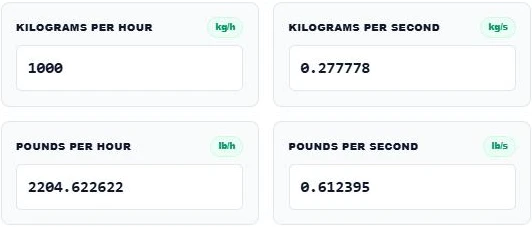
Type the flow in Kilograms per Hour. For 1,000 kg/h, the converter shows 0.277778 kg/s, 2,204.62 lb/h and 0.612395 lb/s.
Step 2: Convert an Imperial Rating
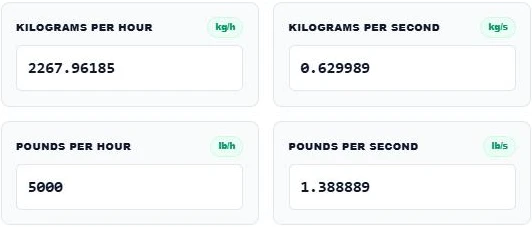
Type a US or UK rating in Pounds per Hour. A boiler producing 5,000 lb/h of steam is 2,267.96 kg/h, 0.63 kg/s and 1.389 lb/s.
Step 3: Check the Reference Matrix
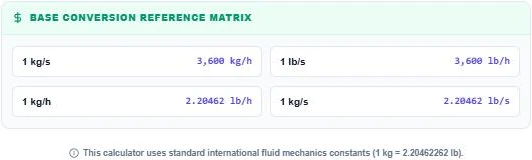
The Base Conversion Reference Matrix lists the key factors: 1 kg/s = 3,600 kg/h, 1 lb/s = 3,600 lb/h and 1 kg/h = 2.20462 lb/h. Press Clear Fields to reset.
Mass Flow vs Volume Flow
Volume flow (m³/h, L/min, gallons per minute) changes with temperature and pressure because fluids expand and compress. Mass flow does not. To convert, multiply volume flow by density: 10 m³/h of water at about 1,000 kg/m³ is 10,000 kg/h. For gases, use the density at the actual operating conditions.
Worked Example: Heating Water
Heating 1,000 kg/h of water by 40 °C needs Q = mass flow × specific heat × ΔT. In SI units: 0.2778 kg/s × 4.186 kJ/(kg·°C) × 40 °C ≈ 46.5 kW. Converting to kg/s with the mass flow rate converter first keeps the units consistent.
Steam Boiler Ratings
Boilers are often sized by the steam they can produce per hour. A rule of thumb in the US is that one boiler horsepower makes about 34.5 lb/h of steam from and at 212 °F, so a 100 BHP boiler produces roughly 3,450 lb/h, or about 1,565 kg/h. Use the mass flow rate converter to compare boiler data from US and European manufacturers.
Measuring Mass Flow
Coriolis meters measure mass flow directly and are common in chemical dosing and fuel systems. Thermal mass flow meters are used for gases. Other meters measure velocity or volume and calculate mass flow from density, so the result depends on accurate temperature and pressure readings.
Where Mass Flow Rate Is Used
- Steam boiler and turbine ratings.
- Fuel and gas flow for burners and engines.
- Compressed air and refrigerant systems.
- Chemical dosing and process control.
- Food, pharmaceutical and bulk solids handling.
Tips for Accurate Conversions
- Check whether a rating is per hour or per second; the factor of 3,600 is easy to miss.
- Use pounds-mass (lb), not pounds-force, for flow rates.
- Keep at least four significant figures when results feed into heat or energy balances.
More engineering tools: the Kinematic Viscosity Converter, the Thermal Conductivity Converter and the Bar to PSI Converter.
Frequently Asked Questions
How do I convert kg/h to kg/s?
Divide by 3,600. 1,000 kg/h = 0.2778 kg/s.
How do I convert kg/h to lb/h?
Multiply by 2.20462. 1,000 kg/h = 2,204.6 lb/h.
What is 5,000 lb/h in kg/h?
5,000 lb/h is about 2,268 kg/h.
How do I get mass flow from volume flow?
Multiply volume flow by density. 10 m³/h of water ≈ 10,000 kg/h.
Why do engineers use mass flow?
Mass stays the same when temperature and pressure change, so energy and material balances are simpler.
Is my data stored?
No. The mass flow rate converter runs in your browser and nothing is saved.