

Thermal Conductivity Converter – W/mK to BTU in 3 Easy Steps
Thermal Conductivity Converter
Use this thermal conductivity converter: type a value into any field to instantly convert across all heat transfer measurements.
Use this free thermal conductivity converter to switch between W/(m·K), BTU/(h·ft·°F), kcal/(h·m·°C) and cal/(s·cm·°C). Type a value into any box and the other three update instantly, so you can compare material data from SI, US and older metric sources.
Quick answer
1 W/(m·K) = 0.5778 BTU/(h·ft·°F) = 0.8598 kcal/(h·m·°C) = 0.002388 cal/(s·cm·°C). Going the other way, 1 BTU/(h·ft·°F) = 1.7307 W/(m·K) and 1 cal/(s·cm·°C) = 418.68 W/(m·K). Copper at 401 W/(m·K) is about 231.7 BTU/(h·ft·°F).
Table of Contents
Thermal conductivity, often written k or λ, tells you how easily heat flows through a material. High values mean good conductors, like copper and aluminium. Low values mean good insulators, like mineral wool and still air.
This thermal conductivity converter turns any data sheet value into the unit your heat-loss calculation uses, without hunting for conversion factors.
Thermal Conductivity Conversion Formulas
- BTU/(h·ft·°F) = W/(m·K) × 0.5778
- kcal/(h·m·°C) = W/(m·K) × 0.8598
- cal/(s·cm·°C) = W/(m·K) ÷ 418.68
- W/(m·K) = BTU/(h·ft·°F) × 1.7307
- Heat flow through a wall: Q = k × A × ΔT ÷ thickness
Thermal Conductivity of Common Materials
| Material | W/(m·K) | BTU/(h·ft·°F) |
|---|---|---|
| Copper | ≈ 401 | ≈ 231.7 |
| Aluminium | ≈ 237 | ≈ 136.9 |
| Carbon steel | ≈ 50 | ≈ 28.9 |
| Concrete | ≈ 1.7 | ≈ 0.98 |
| Glass | ≈ 1.0 | ≈ 0.58 |
| Water | ≈ 0.6 | ≈ 0.35 |
| Softwood | ≈ 0.13 | ≈ 0.075 |
| Mineral wool | ≈ 0.04 | ≈ 0.023 |
| Still air | ≈ 0.026 | ≈ 0.015 |
Values are typical at room temperature and vary with grade, moisture and temperature.
How to Use the Thermal Conductivity Converter
Step 1: Enter a Value in W/(m·K)
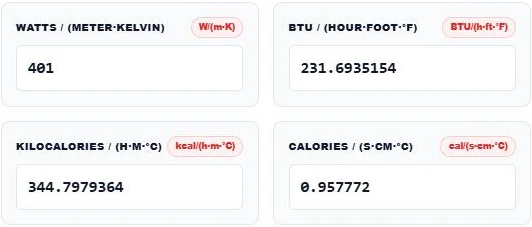
Type the SI value in Watts / (Meter·Kelvin). For copper at 401 W/(m·K), the converter shows 231.69 BTU/(h·ft·°F), 344.80 kcal/(h·m·°C) and 0.958 cal/(s·cm·°C).
Step 2: Convert a US Insulation Value
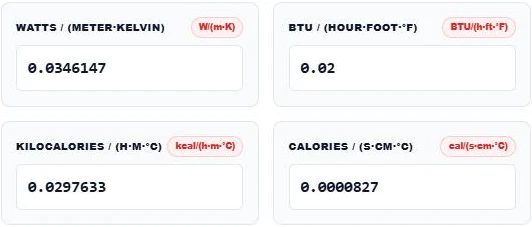
Type an imperial value in BTU / (Hour·Foot·°F). An insulation rated at 0.02 BTU/(h·ft·°F) equals 0.0346 W/(m·K) and 0.0298 kcal/(h·m·°C).
Step 3: Check the Reference Matrix
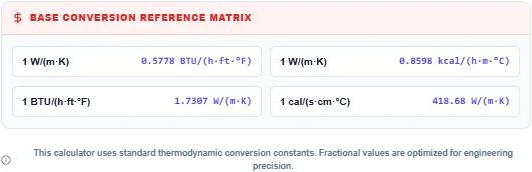
The Base Conversion Reference Matrix keeps the four key factors in view: 0.5778, 0.8598, 1.7307 and 418.68. Press Clear Fields to reset.
Worked Example: Heat Loss Through a Wall
A 10 m² brick wall, 0.2 m thick, with k = 0.7 W/(m·K) and a 20 °C difference between inside and outside loses Q = 0.7 × 10 × 20 ÷ 0.2 = 700 W. Adding 0.1 m of mineral wool (k = 0.04) cuts the loss dramatically, because heat must pass through both layers.
Thermal Conductivity vs R-Value and U-Value
- Thermal conductivity (k) is a property of the material.
- R-value = thickness ÷ k, the resistance of a specific layer. Higher is better insulation.
- U-value = 1 ÷ total R of a wall or window, the heat flow per square metre per degree. Lower is better.
Why Units Differ Between Sources
European and scientific data use W/(m·K). Older US building guides use BTU/(h·ft·°F), and some still quote BTU·in/(h·ft²·°F), which is 12 times larger. Russian and older European handbooks often use kcal/(h·m·°C), and classic physics tables use cal/(s·cm·°C). The thermal conductivity converter puts them all on the same scale so you can compare materials fairly.
Tips for Accurate Comparisons
- Check the test temperature; conductivity of insulation rises as it gets warmer.
- Use dry values for building materials unless the data states otherwise; moisture can raise conductivity sharply.
- For composite products, use the declared lambda value from the manufacturer.
- Watch for per-inch units in US insulation data and divide by 12 to get per-foot values.
Where Thermal Conductivity Is Used
- Building insulation design and energy ratings.
- Heat sinks and thermal pads for electronics.
- Heat exchanger and pipe insulation sizing.
- Cookware and industrial process design.
More engineering tools: the Kinematic Viscosity Converter, the Mass Flow Rate Converter and the Gas Mark to Celsius Converter.
Frequently Asked Questions
How do I convert W/(m·K) to BTU/(h·ft·°F)?
Multiply by 0.5778. 401 W/(m·K) = 231.7 BTU/(h·ft·°F).
What is the SI unit of thermal conductivity?
Watts per metre-kelvin, W/(m·K). W/(m·°C) has the same value.
What has the highest thermal conductivity?
Among common metals, silver and copper are highest. Diamond and graphene are even higher.
What is a good insulation thermal conductivity?
Most building insulation is between about 0.02 and 0.04 W/(m·K). Lower is better.
How is thermal conductivity different from R-value?
Thermal conductivity is a material property. R-value depends on thickness: R = thickness ÷ k.
Is my data stored?
No. The thermal conductivity converter runs in your browser and nothing is saved.