

Kinematic Viscosity Converter – Stokes to m²/s in 3 Easy Steps
Kinematic Viscosity Converter
Use this kinematic viscosity converter: type a value into any field to instantly convert across all fluid flow resistance measurements.
Use this free kinematic viscosity converter to switch between square metres per second (m²/s), stokes (St), centistokes (cSt) and square millimetres per second (mm²/s). Type a value into any box and the other three update instantly.
Quick answer
1 stokes = 100 centistokes = 0.0001 m²/s, and 1 cSt = 1 mm²/s = 10⁻⁶ m²/s. So an ISO VG 46 hydraulic oil at 46 cSt is 0.46 St, 46 mm²/s and 0.000046 m²/s. Water at about 20 °C is close to 1 cSt.
Table of Contents
Kinematic viscosity tells you how easily a fluid flows under gravity. Lubricant data sheets usually list it in centistokes, physics and CFD software expect m²/s, and older references use stokes.
This kinematic viscosity converter keeps all four units in step, so you can move between a data sheet and your calculation without counting decimal places.
Kinematic Viscosity Conversion Formulas
- cSt = St × 100
- m²/s = St × 0.0001
- m²/s = cSt × 0.000001
- mm²/s = cSt (they are identical)
- From dynamic viscosity: ν (cSt) = μ (cP) ÷ density (g/cm³)
Kinematic Viscosity Conversion Table
| cSt (mm²/s) | Stokes | m²/s | Example fluid |
|---|---|---|---|
| 1 | 0.01 | 0.000001 | Water at about 20 °C |
| 2–4.5 | 0.02–0.045 | 2–4.5 × 10⁻⁶ | Diesel fuel at 40 °C |
| 32 | 0.32 | 0.000032 | ISO VG 32 hydraulic oil at 40 °C |
| 46 | 0.46 | 0.000046 | ISO VG 46 hydraulic oil at 40 °C |
| 100 | 1 | 0.0001 | ISO VG 100 gear oil at 40 °C |
| 1,000 | 10 | 0.001 | Heavy gear oil or syrup |
How to Use the Kinematic Viscosity Converter
Step 1: Enter a Value in Stokes
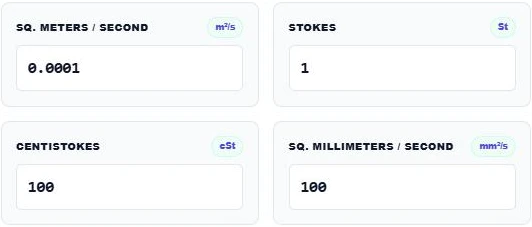
Type the viscosity in Stokes (St). For 1 St, the converter shows 0.0001 m²/s, 100 cSt and 100 mm²/s.
Step 2: Convert a Centistokes Rating
Type an oil grade in Centistokes (cSt). An ISO VG 46 oil at 46 cSt equals 0.46 St, 46 mm²/s and 0.000046 m²/s, ready for an engineering formula.

Step 3: Check the Reference Matrix
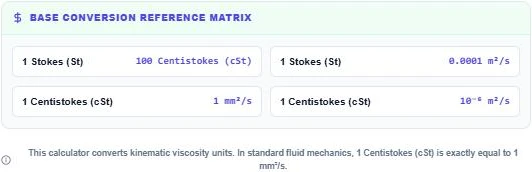
The Base Conversion Reference Matrix lists the key factors: 1 St = 100 cSt, 1 St = 0.0001 m²/s, 1 cSt = 1 mm²/s and 1 cSt = 10⁻⁶ m²/s. Press Clear Fields to reset.
Kinematic vs Dynamic Viscosity
Dynamic (absolute) viscosity μ measures a fluid’s internal resistance to shear, in pascal-seconds or centipoise. Kinematic viscosity ν is dynamic viscosity divided by density. For example, an oil with μ = 40 cP and a density of 0.87 g/cm³ has ν = 40 ÷ 0.87 ≈ 46 cSt. Use our dynamic viscosity converter if your data is in poise or Pa·s.
Why Temperature Matters
Viscosity drops sharply as a fluid warms. A lubricant that is 46 cSt at 40 °C may be under 7 cSt at 100 °C. Always note the test temperature when comparing values. ISO viscosity grades (VG) are defined at 40 °C, while engine oil grades also consider 100 °C and cold-start performance.
Reynolds Number Example
Water at 20 °C (about 1 cSt, or 0.000001 m²/s) flowing at 1 m/s through a 0.05 m pipe has a Reynolds number of 1 × 0.05 ÷ 0.000001 = 50,000, which is turbulent flow. The same pipe carrying ISO VG 46 oil at 40 °C (0.000046 m²/s) gives about 1,087, which is laminar. Converting to m²/s with the kinematic viscosity converter first keeps the units consistent.
Where Kinematic Viscosity Is Used
- Selecting hydraulic, gear and turbine oils by ISO VG grade.
- Calculating Reynolds number (Re = velocity × length ÷ ν) for pipe and channel flow.
- Fuel specifications for diesel and heating oil.
- CFD simulations and fluid mechanics coursework.
More fluid and flow tools: the Dynamic Viscosity Converter, the Mass Flow Rate Converter and the Thermal Conductivity Converter.
Frequently Asked Questions
How many centistokes are in a stokes?
One stokes equals 100 centistokes.
Is cSt the same as mm²/s?
Yes. 1 centistokes equals exactly 1 square millimetre per second.
How do I convert cSt to m²/s?
Multiply by 0.000001. 46 cSt = 0.000046 m²/s.
What is the kinematic viscosity of water?
About 1.0 cSt at 20 °C, falling to about 0.66 cSt at 40 °C.
How do I convert centipoise to centistokes?
Divide centipoise by the fluid density in g/cm³. 40 cP at 0.87 g/cm³ ≈ 46 cSt.
Is my data stored?
No. The kinematic viscosity converter runs in your browser and nothing is saved.