

Dynamic Viscosity Converter – Poise to Pa·s in 3 Easy Steps
Dynamic Viscosity Converter
Use this dynamic viscosity converter: type a value into any field to instantly convert across all fluid resistance measurements.
Use this free dynamic viscosity converter to switch between pascal-seconds (Pa·s), poise (P), centipoise (cP) and millipascal-seconds (mPa·s). Type a value into any box and the other three update instantly.
Quick answer
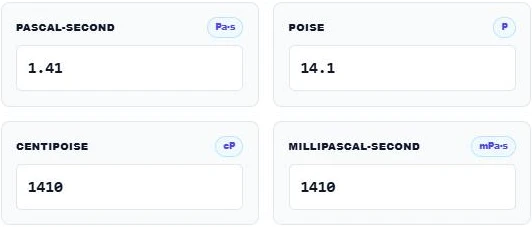
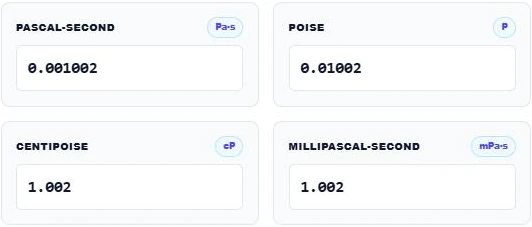
1 Pa·s = 10 poise = 1,000 centipoise = 1,000 mPa·s, and 1 cP = 1 mPa·s exactly. So water at 20 °C, about 1.002 cP, is 0.001002 Pa·s, and glycerin at about 1.41 Pa·s is 14.1 P or 1,410 cP.
Table of Contents
Dynamic (absolute) viscosity describes how strongly a fluid resists flow and shear. Lab reports and paint, food and cosmetics specs usually quote centipoise, while SI engineering calculations need pascal-seconds.
This dynamic viscosity converter keeps every unit in sync so you can move from a product data sheet to a formula without errors.
Dynamic Viscosity Conversion Formulas
- Poise = Pa·s × 10
- cP = Pa·s × 1,000
- mPa·s = cP (identical)
- Pa·s = cP ÷ 1,000
- To kinematic viscosity: ν (cSt) = μ (cP) ÷ density (g/cm³)
Typical Dynamic Viscosities
| Fluid (about 20 °C) | cP (mPa·s) | Pa·s |
|---|---|---|
| Air | 0.018 | 0.000018 |
| Water | 1.0 | 0.001 |
| Blood (37 °C) | 3–4 | 0.003–0.004 |
| Olive oil | ~80 | ~0.08 |
| Glycerin | ~1,410 | ~1.41 |
| Honey | 2,000–10,000 | 2–10 |
| Ketchup (at rest) | 50,000+ | 50+ |
How to Use the Dynamic Viscosity Converter
Step 1: Enter a Value in Pascal-Seconds
Type the viscosity in Pascal-Second (Pa·s). For glycerin at about 1.41 Pa·s, the converter shows 14.1 P, 1,410 cP and 1,410 mPa·s.
Step 2: Convert a Centipoise Value
Type a value in Centipoise (cP). Water at 20 °C, about 1.002 cP, equals 0.001002 Pa·s, 0.01002 P and 1.002 mPa·s.
Step 3: Check the Reference Matrix
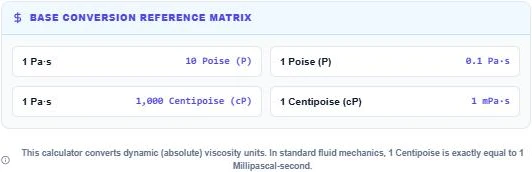
The Base Conversion Reference Matrix lists the key factors: 1 Pa·s = 10 P, 1 P = 0.1 Pa·s, 1 Pa·s = 1,000 cP and 1 cP = 1 mPa·s. Press Clear Fields to reset.
Dynamic vs Kinematic Viscosity
Dynamic viscosity is the fluid’s resistance to shear. Kinematic viscosity is dynamic viscosity divided by density, and shows how fast a fluid flows under its own weight. Glycerin at 1,410 cP with a density of 1.26 g/cm³ has a kinematic viscosity of about 1,119 cSt. Use our kinematic viscosity converter for stokes and centistokes.
Temperature and Shear
- Liquids get thinner as they warm up. Water drops from about 1.8 cP at 0 °C to 0.28 cP at 100 °C.
- Gases do the opposite and become slightly more viscous when hot.
- Non-Newtonian fluids such as paint, ketchup and blood change viscosity with shear rate, so always note the test method and speed.
Measuring Dynamic Viscosity
- Rotational viscometers spin a spindle in the sample and measure the torque. They report cP or mPa·s directly.
- Falling-ball viscometers time how long a ball takes to drop through the fluid.
- Capillary viscometers measure flow time through a thin tube and give kinematic viscosity, which you then multiply by density.
- Rheometers test non-Newtonian fluids across a range of shear rates.
Whatever the instrument, the dynamic viscosity converter turns the reading into the unit your report or formula needs.
Why the Poise Still Appears
The poise comes from the old CGS system and is named after the French physician Jean Léonard Marie Poiseuille, who studied blood flow. The centipoise survived because water is conveniently close to 1 cP, so many industries never switched to Pa·s. Engineering software, though, usually expects SI units.
Where Dynamic Viscosity Is Used
- Pump and pipe sizing in process engineering.
- Paint, ink, adhesive and coating specifications.
- Food texture testing for sauces, syrups and dairy.
- Medical research on blood and plasma.
- Lubrication and bearing design.
More fluid tools: the Kinematic Viscosity Converter, the Mass Flow Rate Converter and the Specific Gravity to Brix Converter.
Frequently Asked Questions
How many centipoise are in a pascal-second?
One pascal-second equals 1,000 centipoise.
Is centipoise the same as mPa·s?
Yes. 1 cP equals exactly 1 mPa·s.
How do I convert poise to Pa·s?
Divide by 10. 14.1 P = 1.41 Pa·s.
What is the viscosity of water?
About 1.0 cP (0.001 Pa·s) at 20 °C.
How do I convert cP to cSt?
Divide cP by the fluid’s density in g/cm³. For water, 1 cP ≈ 1 cSt.
Is my data stored?
No. The dynamic viscosity converter runs in your browser and nothing is saved.