

Gas Pressure Bar to PSI Converter – Bar and PSI in 3 Easy Steps
Gas Pressure Converter
Use this gas pressure bar to PSI converter to change Bar to Pounds per Square Inch (PSI) or vice versa for automotive, HVAC, and industrial use.
Use this free gas pressure bar to PSI converter to switch between bar and pounds per square inch in either direction. Type a value in one box and the other updates instantly, with the formula shown underneath, so you can check tyre pressure, compressor settings or gas cylinder ratings in seconds.
Quick answer
1 bar = 14.5038 PSI, and 1 PSI = 0.0689 bar. To convert bar to PSI, multiply by 14.5038. To convert PSI to bar, divide by 14.5038. So 2.2 bar is 31.91 PSI, and 35 PSI is 2.413 bar.
Table of Contents
Bar and PSI measure the same thing: how hard a gas or liquid pushes on each unit of area. Europe and most of Asia print bar on gauges, while the United States uses PSI. If your car manual says 2.3 bar and your pump reads PSI, you need a quick, exact conversion.
This gas pressure bar to PSI converter gives that answer with three decimal places and copy buttons, so there is no mental maths at the pump or the workbench.
Bar to PSI Formula
- PSI = bar × 14.5037738
- Bar = PSI ÷ 14.5037738 (or PSI × 0.0689476)
- 1 bar is defined as exactly 100,000 pascals.
- 1 PSI is about 6,894.76 pascals.
A quick mental shortcut is to multiply bar by 14.5. It is accurate enough for tyres, but use the full factor for gas cylinders, hydraulics and anything safety related.
Bar to PSI Conversion Chart
| Bar | PSI | Typical use |
|---|---|---|
| 0.5 | 7.25 | Low pressure gas line |
| 1 | 14.50 | About sea level air pressure |
| 2.0 | 29.01 | Small car tyre |
| 2.2 | 31.91 | Car tyre |
| 2.5 | 36.26 | SUV tyre |
| 3 | 43.51 | Light truck tyre |
| 8 | 116.03 | Air compressor |
| 10 | 145.04 | Industrial line |
| 200 | 2,900.75 | Scuba or gas cylinder |
| 232 | 3,364.88 | Scuba cylinder |
| 300 | 4,351.13 | High pressure cylinder |
PSI to Bar Conversion Chart
| PSI | Bar |
|---|---|
| 30 | 2.068 |
| 32 | 2.206 |
| 35 | 2.413 |
| 40 | 2.758 |
| 100 | 6.895 |
| 125 | 8.618 |
| 150 | 10.342 |
| 3,000 | 206.843 |
How to Use the Gas Pressure Bar to PSI Converter
Step 1: Enter a Value in Bar
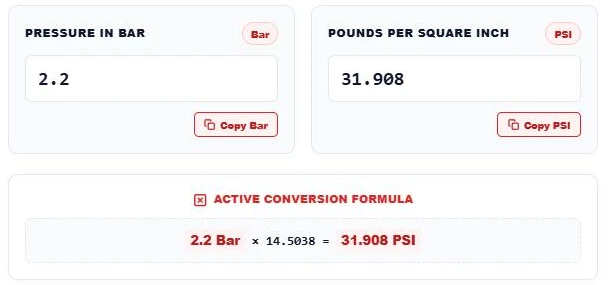
Type the pressure in the Pressure in Bar box. The PSI box fills in straight away. For 2.2 bar, the converter shows 31.908 PSI, and the formula panel reads 2.2 Bar × 14.5038 = 31.908 PSI.
Step 2: Convert PSI Back to Bar
Type in the Pounds per Square Inch box instead and the bar value updates. Entering 35 PSI gives 2.413 bar. Use the Copy Bar or Copy PSI buttons to paste the result into a note, spec sheet or message.

Step 3: Check Common Pressure Values
The common pressure applications panel lists ready-made conversions for car and SUV tyres, bike tyres, compressors, industrial lines and 200 bar gas cylinders. Press Clear Fields to start a new conversion.

Gauge Pressure vs Absolute Pressure
Most tyre and cylinder gauges show gauge pressure, written as barg or PSIG. It is the pressure above the surrounding air. Absolute pressure, written as bara or PSIA, adds atmospheric pressure, which is about 1.013 bar or 14.7 PSI at sea level.
- Absolute = gauge + atmospheric
- 2.2 barg is about 3.2 bara.
- 32 PSIG is about 46.7 PSIA.
- The converter changes units only. It does not add or remove atmospheric pressure, so convert gauge to gauge and absolute to absolute.
Where Bar and PSI Are Used
- Car and bike tyres: door-jamb stickers often list both bar and PSI, and pumps may show only one.
- Air compressors and tools: nail guns and spray guns list working pressure in bar or PSI.
- Gas cylinders: scuba, welding and industrial cylinders are usually rated around 200 to 300 bar.
- HVAC and plumbing: boiler, water and refrigerant pressures are read in bar in many countries and PSI in the US.
- Coffee machines: espresso is usually brewed at about 9 bar, which is roughly 130.5 PSI.
Pressure Safety Tips
- Always follow the maximum pressure printed on the tyre, hose, regulator or cylinder.
- Check tyre pressure when tyres are cold, before driving.
- Use a regulator rated for the gas and pressure you are working with.
- Never exceed a cylinder’s test or working pressure, even by a small margin.
Working with other units? Try the Wind Speed Converter, the Gas Mark to Celsius Converter or the Specific Gravity to Brix Converter.
Frequently Asked Questions
How many PSI is 1 bar?
1 bar is 14.5038 PSI. Multiply any bar value by 14.5038 to get PSI.
How do I convert PSI to bar?
Divide the PSI value by 14.5038, or multiply it by 0.0689. For example, 32 PSI is 2.206 bar.
What is 2.2 bar in PSI?
2.2 bar is 31.91 PSI, a common car tyre pressure.
What is 200 bar in PSI?
200 bar is 2,900.75 PSI, a typical rating for scuba and industrial gas cylinders.
Is bar the same as atmosphere?
Close, but not the same. 1 standard atmosphere is 1.01325 bar, or about 14.7 PSI.
Does the converter handle PSIG and PSIA?
It converts units only. Convert gauge pressure to gauge pressure and absolute to absolute, then add about 14.7 PSI (1.013 bar) if you need to switch from gauge to absolute.