Quick answer: In the compound interest vs simple interest debate, the difference is what the rate is applied to. Simple interest is calculated only on the original principal, so it grows in a straight line. Compound interest is calculated on the principal plus interest already earned, so it grows faster every year. On $10,000 at 8% for 20 years, simple interest gives $26,000 while annual compounding gives about $46,610. Run your own numbers with our Compound Interest Calculator and Simple Interest Calculator.
Whether you are saving, investing or borrowing, the type of interest decides how much money you end up with – or how much you end up paying. This guide explains both formulas in plain language, walks through worked examples, and covers the 5 key differences that matter in real life.
What Is Simple Interest?
Simple interest is earned or charged only on the principal. The interest amount is the same every period.
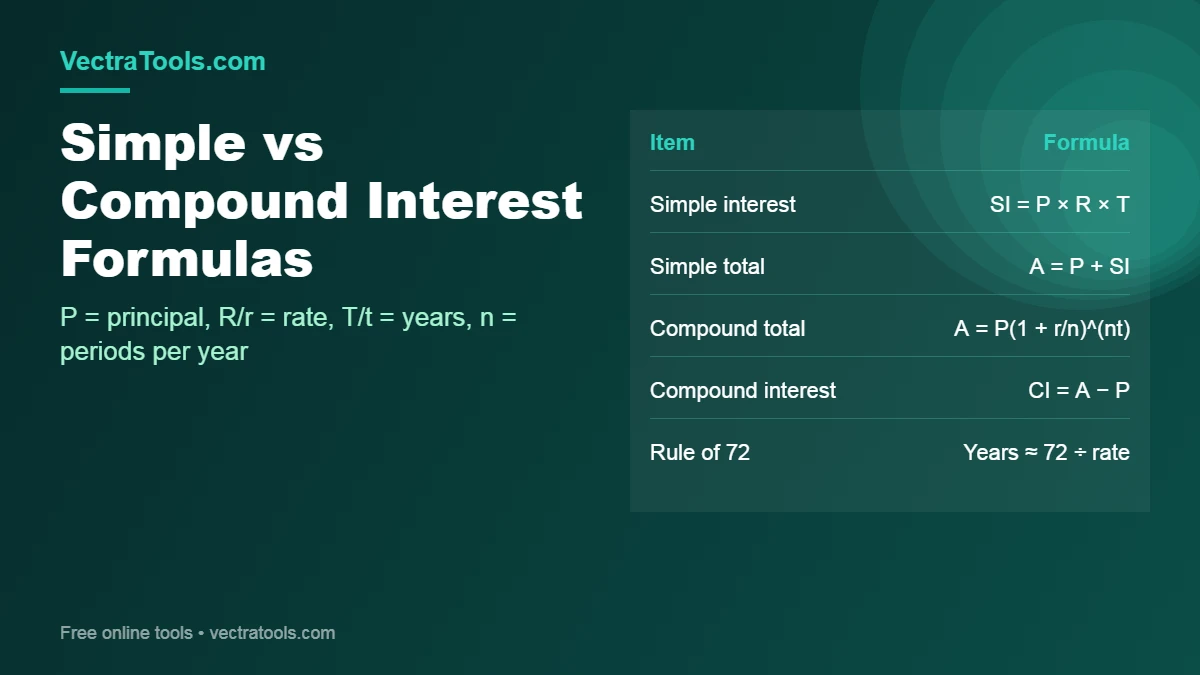
Formula: SI = P × R × T, where P is the principal, R is the annual rate as a decimal and T is time in years.
Example: You lend $5,000 at 6% simple interest for 3 years. Interest = 5,000 × 0.06 × 3 = $900. Total repaid: $5,900.
Simple interest shows up in short-term personal loans, some auto loans, bonds that pay out coupons instead of reinvesting them, and many school maths problems.
What Is Compound Interest?
With compound interest, interest is added back to the balance and the next period's interest is calculated on that larger balance. You earn "interest on interest."
Formula: A = P × (1 + r/n)n×t, where A is the final amount, r is the annual rate, n is compounding periods per year and t is years. Compound interest earned = A − P.
Example: $5,000 at 6% compounded monthly for 3 years: A = 5,000 × (1 + 0.06/12)36 ≈ $5,983.40. That is $83 more than simple interest – and the gap grows dramatically over longer periods.
Compound Interest vs Simple Interest: 5 Key Differences
| Feature | Simple interest | Compound interest |
|---|---|---|
| 1. Calculated on | Principal only | Principal + accumulated interest |
| 2. Growth pattern | Linear (straight line) | Exponential (curve) |
| 3. Best for savers? | No | Yes |
| 4. Best for borrowers? | Yes – cheaper | No – costs more |
| 5. Common uses | Short-term loans, some auto loans | Savings, investments, credit cards, mortgages |
Compound Interest vs Simple Interest Over 30 Years
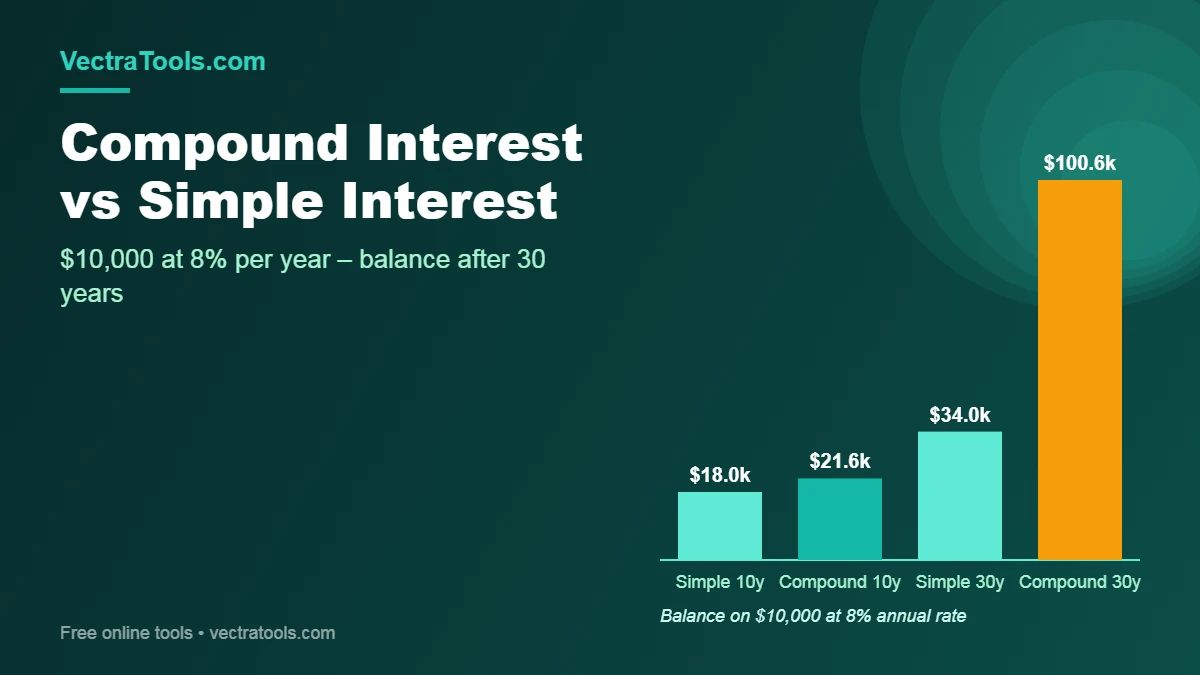
Here is $10,000 at 8% per year, with compound interest calculated annually:
| Year | Simple interest balance | Compound interest balance | Difference |
|---|---|---|---|
| 1 | $10,800 | $10,800 | $0 |
| 5 | $14,000 | $14,693 | $693 |
| 10 | $18,000 | $21,589 | $3,589 |
| 20 | $26,000 | $46,610 | $20,610 |
| 30 | $34,000 | $100,627 | $66,627 |
In year one the two are identical. By year 30, compounding has produced roughly three times the money. That is why time in the market usually matters more than picking the perfect investment.
How Compounding Frequency Changes the Result
The more often interest compounds, the more you earn. $10,000 at 6% for 10 years becomes:
| Compounding | Balance after 10 years |
|---|---|
| None (simple interest) | $16,000 |
| Annually | $17,908 |
| Quarterly | $18,140 |
| Monthly | $18,194 |
| Daily | $18,221 |
Monthly vs daily is a small difference; compounding vs not compounding is the big one. Banks show this as APY (annual percentage yield), which already includes the effect of compounding.
The Rule of 72: A Quick Mental Shortcut
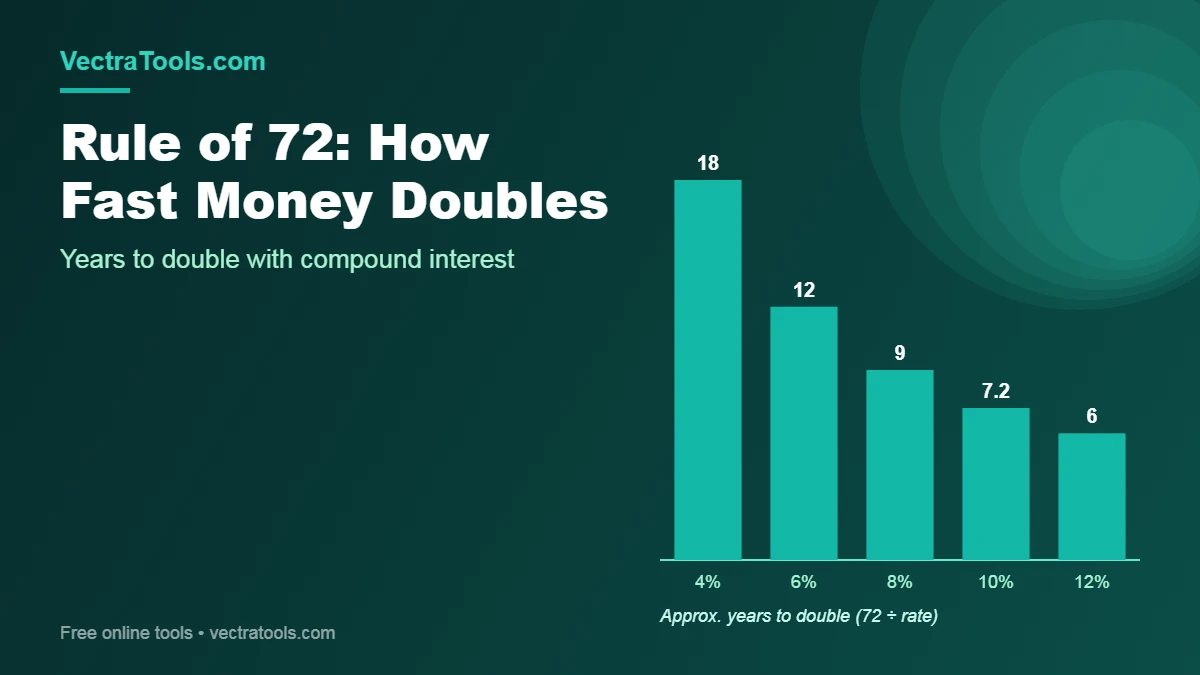
To estimate how long money takes to double with compound interest, divide 72 by the annual rate. At 8%, money doubles in about 72 ÷ 8 = 9 years; at 6%, about 12 years. The Rule of 72 is an approximation, but it is accurate enough for quick decisions.
When Compound Interest Works Against You
Compounding is great when you are the saver and painful when you are the borrower. Credit card balances typically compound daily, so an unpaid balance can snowball fast. Amortised loans such as home loans also build compounding into their schedules. Before you borrow, check your monthly installment with our EMI Calculator or Mortgage Calculator to see the total interest over the full term.
How to Make Compound Interest Work for You
- Start early. Ten extra years of compounding often matter more than larger contributions later.
- Reinvest returns. Reinvested dividends keep compounding – model it with our Compound Interest & Dividend Calculator.
- Add regular contributions. Small monthly deposits compound over time.
- Pay off high-interest debt first. Clearing a card charging 20%+ is a guaranteed "return" few investments match.
- Budget for saving. A simple system like the 50/30/20 rule makes saving automatic.
Building better daily habits? See our guide to the average typing speed and how to beat it.
Frequently Asked Questions
What is the main difference in compound interest vs simple interest?
Simple interest is calculated only on the principal. Compound interest is calculated on the principal plus previously earned interest, so it grows faster.
Which is better, simple or compound interest?
For savers and investors, compound interest is better. For borrowers, simple interest is cheaper because you never pay interest on interest.
Do banks use simple or compound interest?
Most savings accounts, fixed deposits and investments use compound interest. Some short-term personal and auto loans use simple interest.
How do I calculate compound interest monthly?
Use A = P(1 + r/12)^(12t). For example, $1,000 at 5% for 2 years gives about $1,104.94.
What is the difference between APR and APY?
APR is the yearly rate without compounding. APY includes compounding, so it shows what you actually earn or pay in a year.
This article is for educational purposes only and is not financial advice. Rates and terms vary by lender and country.