

Unit Price Comparison Calculator – Find the Better Deal in 3 Easy Steps
Unit Price Comparison
Use this unit price comparison calculator: enter the price and quantity of two products to see which one is actually the better deal.
Use this free unit price comparison calculator to see which of two products is really the better deal. Enter the total price and the quantity or weight of each item, and the tool works out the price per unit, names the cheaper option and shows how much you save per unit in percent.
Quick answer
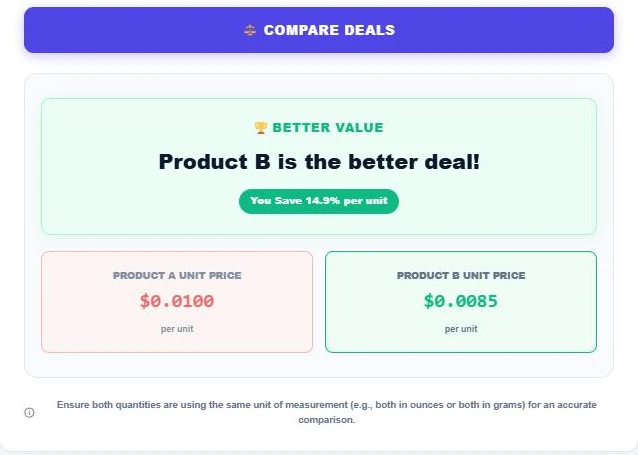
Unit price = total price ÷ quantity. Compare the unit prices, and the lower one is the better value. For example, a 500 g pack at $4.99 costs about $0.0100 per gram, while a 1,000 g pack at $8.49 costs about $0.0085 per gram, so the larger pack is 14.9% cheaper per gram. Always use the same unit, such as grams, millilitres or pieces, for both products.
Table of Contents
Supermarkets love multi-buys, family packs and "bigger is better" labels, but the bigger pack is not always cheaper per gram. Sizes like 375 g versus 500 g, or a 6-pack versus a 10-pack, make mental maths hard, especially in a busy aisle.
This unit price comparison calculator does the division for you and highlights the winner, so you can shop smarter on groceries, household items, pet food or bulk office supplies.
What Is Unit Price?
Unit price is the cost of one standard unit of a product, such as one gram, one litre, one sheet or one tablet. It strips away pack size so you can compare items fairly. Many stores print unit prices on shelf labels, but they are easy to miss, sometimes use different units for similar products, and do not cover online shops or market stalls.
Unit Price Formulas
- Unit price = total price ÷ total quantity
- Saving per unit (%) = (higher unit price − lower unit price) ÷ higher unit price × 100
- Price for the same quantity = unit price × quantity you need
How to Use the Unit Price Comparison Calculator
Step 1: Enter Price and Quantity for Both Products
Type the total shelf price and the total quantity or weight of Product A and Product B. Make sure both quantities use the same unit. In this example, Product A is 500 g for $4.99 and Product B is 1,000 g for $8.49.

Step 2: Compare the Deals
Press Compare Deals. Product A costs $0.0100 per gram and Product B costs $0.0085 per gram, so Product B is the better deal and saves you 14.9% on every gram.
Step 3: Check When the Smaller Pack Wins
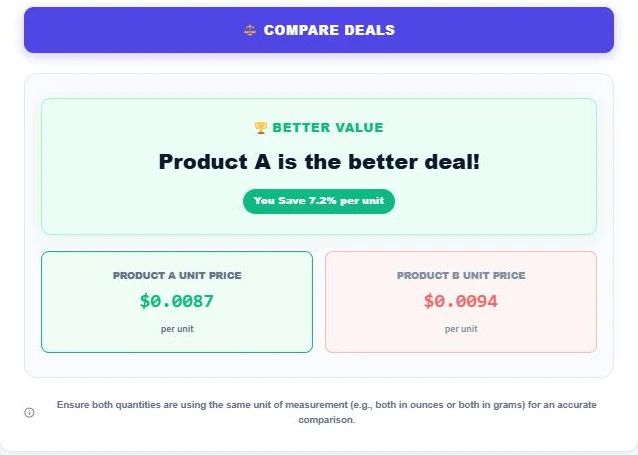
Bigger packs are not always cheaper. A 400 g pack at $3.49 works out to $0.0087 per gram, while an 850 g pack at $7.99 costs $0.0094 per gram. Here the smaller Product A is 7.2% cheaper per gram.
Unit Price Examples
| Product A | Product B | Unit price A | Unit price B | Better deal |
|---|---|---|---|---|
| 500 g for $4.99 | 1,000 g for $8.49 | $0.0100/g | $0.0085/g | B, 14.9% cheaper |
| 400 g for $3.49 | 850 g for $7.99 | $0.0087/g | $0.0094/g | A, 7.2% cheaper |
| 6 rolls for $5.40 | 9 rolls for $7.20 | $0.90/roll | $0.80/roll | B, 11.1% cheaper |
| 1.5 L for $2.25 | 2 L for $3.20 | $1.50/L | $1.60/L | A, 6.3% cheaper |
Converting Units Before You Compare
If one label shows ounces and the other grams, convert first. 1 ounce is about 28.35 grams, 1 pound is about 453.6 grams, and 1 litre is 1,000 millilitres. For items sold by count, such as nappies or dishwasher tablets, compare the price per piece. For toilet paper and kitchen rolls, sheet counts are more reliable than roll counts, since roll sizes vary.
Smart Shopping Tips
- Check unit prices on promotions; a "3 for 2" deal can still cost more per unit than a plain bulk pack.
- Only buy the bigger pack if you will use it before it spoils or expires.
- Compare own-brand and branded products by unit price, not by pack price.
- Watch for shrinkflation: packs that get smaller while the price stays the same.
- Factor in delivery fees when comparing online shops.
Why Unit Pricing Matters
Small differences add up. Saving 10% on everyday items you buy every week can cut a household grocery bill noticeably over a year. A quick check with the unit price comparison calculator before you reach for the "value" pack makes those savings automatic.
Selling instead of buying? Work out discount pricing with the Markdown Calculator, or see how rising prices affect your budget with the Inflation Purchasing Power Calculator.
Frequently Asked Questions
How do I calculate unit price?
Divide the total price by the quantity. $8.49 for 1,000 g is $0.0085 per gram.
Is the bigger pack always cheaper?
No. Bulk packs are often cheaper per unit, but not always. Promotions on smaller packs can make them the better deal.
What if the products use different units?
Convert them to the same unit first, for example ounces to grams or litres to millilitres, then enter the quantities.
What does the savings percentage mean?
It shows how much cheaper the better deal is per unit, compared with the more expensive option.
Can I use it for items sold by count?
Yes. Enter the number of pieces, rolls, tablets or sheets as the quantity.
Is my data saved?
No. The calculator runs in your browser and nothing is stored.