

Inflation Purchasing Power Calculator – Real Value of Money in 3 Easy Steps
Inflation Depreciation Calculator
Use this inflation purchasing power calculator to discover how much value your savings will lose over time due to inflation.
Use this free inflation purchasing power calculator to see how much your money will really be worth in the future. Enter an amount, an average yearly inflation rate and a number of years, and the tool shows the future purchasing power of that cash and how much value inflation takes away.
Quick answer
Purchasing power after inflation = amount ÷ (1 + inflation rate)years. At 3% average inflation, $10,000 kept as cash for 10 years will buy only what about $7,440.94 buys today, a loss of $2,559.06 in real value. Higher inflation or longer periods shrink savings much faster.
Table of Contents
Prices rise a little every year, so the same note in your wallet buys less over time. That slow loss is easy to ignore month to month, but over 10 or 20 years it can cut the real value of savings in half.
This inflation purchasing power calculator turns that hidden loss into a clear number, so you can plan savings, salaries and retirement with today’s money in mind.
What Is Purchasing Power?
Purchasing power is the amount of goods and services a unit of money can buy. When inflation is 3%, a basket that cost $100 last year costs $103 now, so each dollar buys about 3% less. Your savings balance stays the same, but its purchasing power falls.
Inflation Purchasing Power Formula
- Future purchasing power = amount ÷ (1 + r)n
- Value lost = amount − future purchasing power
- Future price of today’s goods = price × (1 + r)n
- Where r is the average yearly inflation rate as a decimal and n is the number of years.
Inflation compounds like interest in reverse, so each year’s rise is applied to prices that are already higher.
How Inflation Erodes $10,000
| Inflation rate | Years | Purchasing power | Value lost |
|---|---|---|---|
| 2% | 10 | $8,203.48 | $1,796.52 |
| 3% | 10 | $7,440.94 | $2,559.06 |
| 8% | 10 | $4,631.93 | $5,368.07 |
| 10% | 5 | $6,209.21 | $3,790.79 |
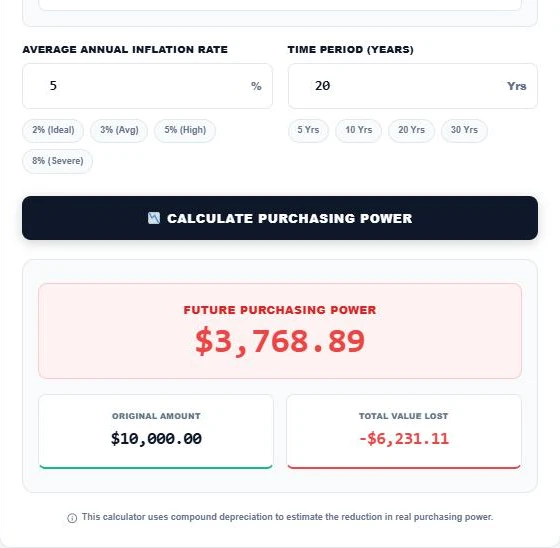
| 5% | 20 | $3,768.89 | $6,231.11 |
With $100,000 at 3% for 30 years, the purchasing power falls to about $41,199, less than half of what you started with.
How to Use the Inflation Purchasing Power Calculator
Step 1: Enter Amount, Inflation Rate and Years
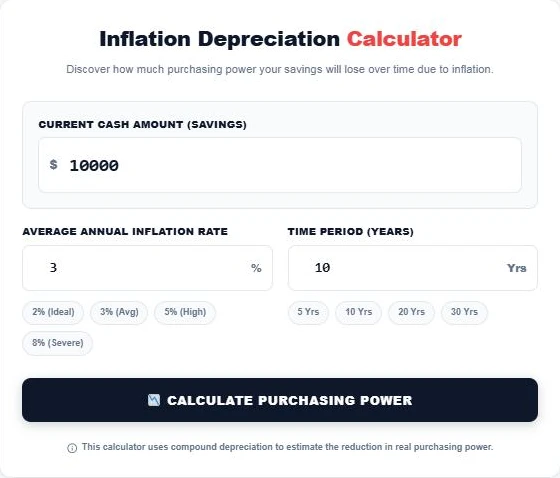
Type the cash amount, the average yearly inflation rate and the time period. Use the quick buttons for common rates (2%, 3%, 5%, 8%) and periods (5, 10, 20 and 30 years).
Step 2: See Your Future Purchasing Power
Press Calculate Purchasing Power. For $10,000 at 3% over 10 years, the future purchasing power is $7,440.94, and the total value lost to inflation is $2,559.06.

Step 3: Compare Higher Inflation Scenarios
Change the rate or period to test a tougher scenario. At 5% for 20 years, the same $10,000 keeps only $3,768.89 of buying power. Comparing scenarios shows why long-term savings need to earn more than inflation.
What Causes Inflation?
Inflation usually comes from one or more of three forces. Knowing which one is behind rising prices helps you judge how long high inflation might last.
- Demand-pull inflation: people and businesses want to buy more than the economy can produce, so sellers raise prices.
- Cost-push inflation: costs such as fuel, wages or imported materials rise, and businesses pass them on to customers.
- Built-in inflation: workers expect prices to rise and ask for higher pay, which pushes costs and prices up again.
Central banks try to keep inflation low and steady, often around a 2% target, mainly by raising or lowering interest rates. When inflation runs well above that target, the inflation purchasing power calculator shows how quickly idle cash loses value, which is a useful reminder to review where your savings are kept.
Real Return: Beating Inflation
Your real return is roughly the interest or investment return minus inflation. A savings account paying 4% when inflation is 3% gives a real return of about 1%. If the account pays 2% while inflation is 3%, your money is shrinking by about 1% a year in real terms, even though the balance grows.
The Rule of 70
A quick way to estimate how fast inflation halves your money is to divide 70 by the inflation rate. At 2% inflation, purchasing power halves in about 35 years. At 7%, it halves in about 10 years.
How to Protect Your Savings From Inflation
- Keep only an emergency fund in cash and invest longer-term money.
- Compare savings and fixed deposit rates with inflation, and look at the real return after tax.
- Spread investments across assets that have historically beaten inflation over long periods, such as diversified stock funds.
- Review your salary each year; a raise below inflation is a real pay cut.
- Plan retirement income in future money, not today’s prices.
To see how savings can grow instead, try the PPF Maturity Calculator or the NPS Calculator. Weighing up a home? Use the Rent vs Buy Calculator.
Frequently Asked Questions
How do I calculate purchasing power after inflation?
Divide the amount by (1 + inflation rate) raised to the number of years. $10,000 at 3% for 10 years is $10,000 ÷ 1.03¹⁰ = about $7,441.
What inflation rate should I use?
Use your country’s recent average inflation or a central bank target. Many central banks target around 2%, but actual inflation is often higher in some years and countries.
Why does my money lose value if the balance stays the same?
Because prices rise. The number in your account does not change, but each unit of money buys fewer goods and services.
What is the difference between nominal and real value?
Nominal value is the face amount of money. Real value adjusts for inflation and shows what that money can actually buy.
How long does it take inflation to halve my money?
Divide 70 by the inflation rate. At 3.5% inflation it takes about 20 years.
Is my data saved?
No. The inflation purchasing power calculator runs in your browser and nothing is stored.