

NPS Calculator
NPS Calculator
Determine your pension wealth distribution and lump-sum maturity allocation

Quick answer
An NPS calculator projects your National Pension System corpus at age 60 from your monthly contribution and expected return, then splits it into a lump sum and an annuity that pays a monthly pension. For example, investing ₹5,000 a month from age 30 at an expected 10% builds a corpus of about ₹1,13,96,627. Putting 40% into an annuity at 6% gives a pension of about ₹22,793 a month, plus a lump sum of about ₹68,37,976.
Our free NPS calculator estimates your total retirement corpus, the amount you invest, the growth from compounding, your lump-sum withdrawal and your monthly pension. Enter your monthly contribution, expected return, current age, the share of the corpus you will use to buy an annuity and the expected annuity rate, and the NPS calculator does the rest.
It is built for India's National Pension System but also supports other currencies for general pension planning. All calculations happen privately in your browser.
What Is NPS?
The National Pension System (NPS) is a voluntary, market-linked retirement savings scheme regulated by the Pension Fund Regulatory and Development Authority (PFRDA). You contribute regularly during your working life, your money is invested in equity, corporate bonds and government securities, and at 60 you take part as a lump sum and use the rest to buy an annuity that pays a lifelong pension. Read more about the National Pension System.
NPS Exit Rules at 60 (2026)
| Rule | Non-government subscribers | Government subscribers |
|---|---|---|
| Minimum annuity purchase | 20% of corpus | 40% of corpus |
| Maximum lump sum | Up to 80% | Up to 60% |
| Tax-free lump sum | Up to 60% of the corpus | Up to 60% of the corpus |
| Small corpus (up to ₹8 lakh) | Full withdrawal allowed | Full withdrawal allowed |
These exit rules reflect PFRDA's amendments of December 2025. Note that the income tax exemption still covers up to 60% of the corpus, so any lump sum above 60% may be taxable. Always confirm the latest rules with your NPS provider before you exit.
Corpus = P × [(1 + i)n − 1] ÷ i × (1 + i)
Monthly pension = Corpus × Annuity% × Annuity rate ÷ 12
P = monthly contribution, i = expected annual return ÷ 12 ÷ 100, n = months until age 60
How to Use the NPS Calculator
Follow these five quick steps:
Step 1: Select Your Currency
Keep India (INR - ₹) selected for NPS, or pick another currency for general pension planning.

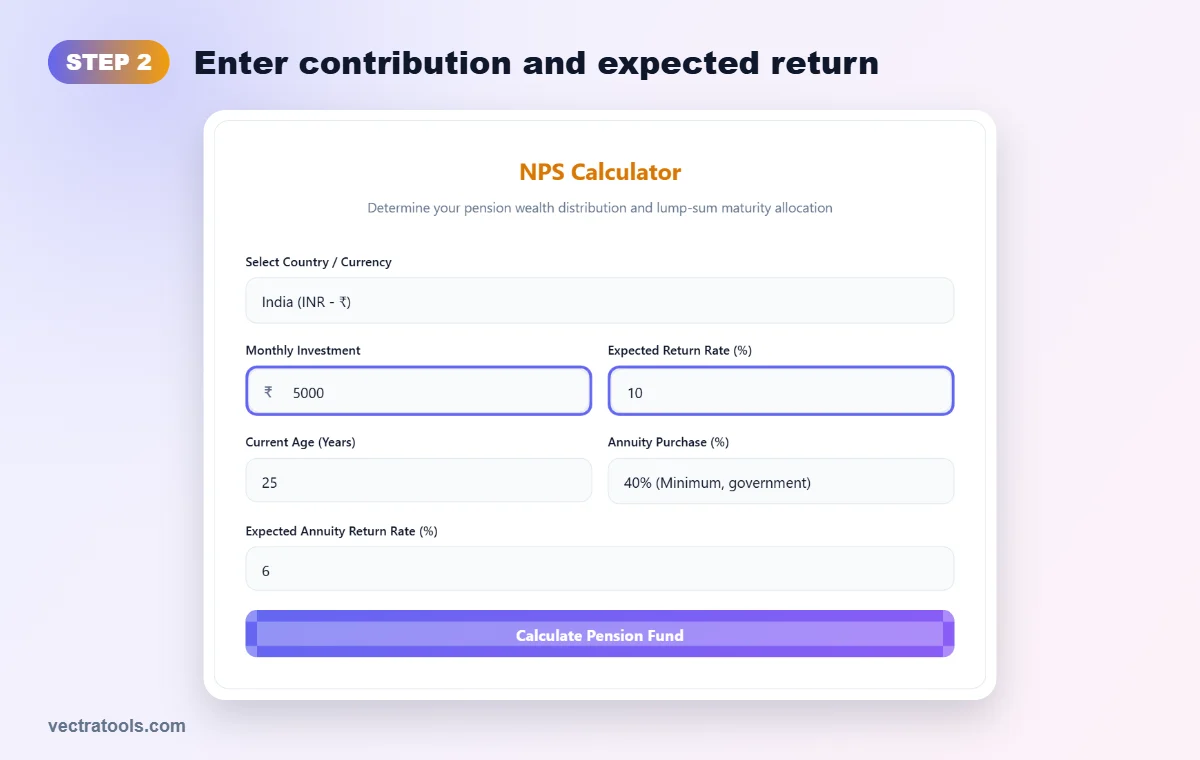
Step 2: Enter Your Monthly Contribution and Expected Return
Type how much you will invest each month, for example ₹5,000, and a realistic long-term return, for example 10%.
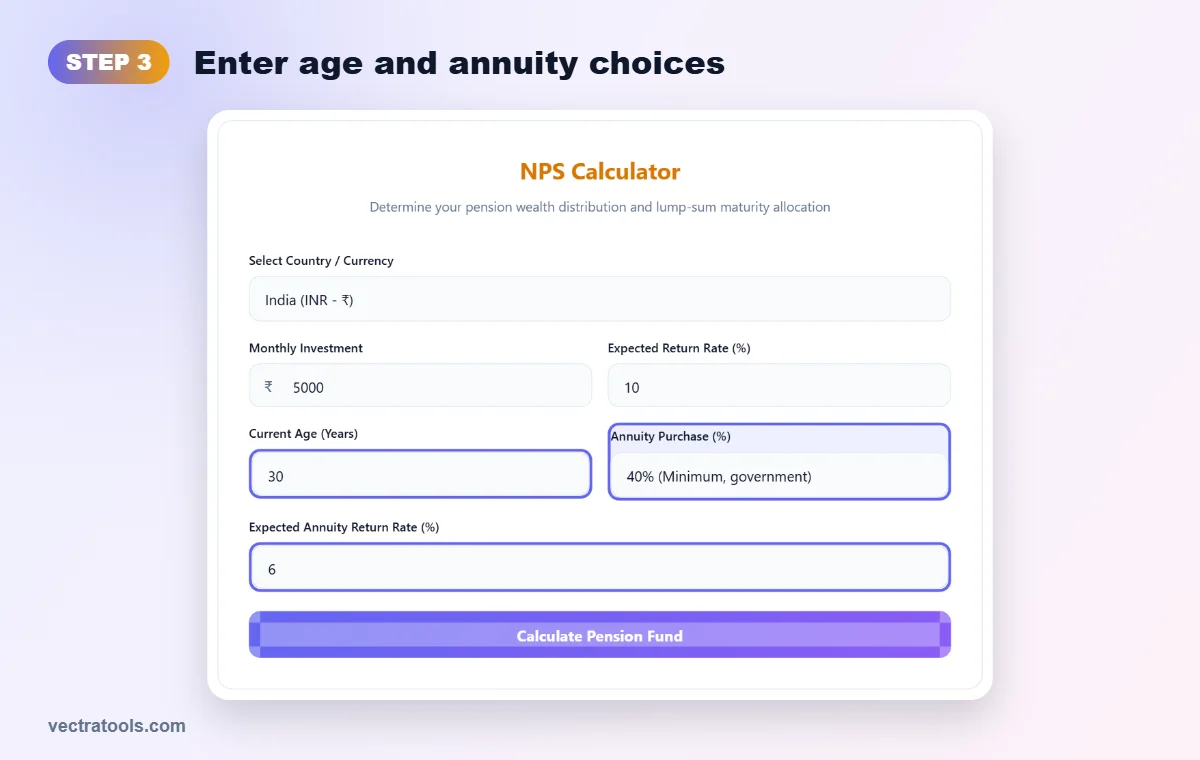
Step 3: Enter Your Age and Annuity Choices
Enter your current age; the NPS calculator assumes you invest until 60. Then choose the annuity purchase % (minimum 20% for non-government and 40% for government subscribers) and an expected annuity rate, for example 6%.
Step 4: Click Calculate Pension Fund
Press Calculate Pension Fund to see your projection.

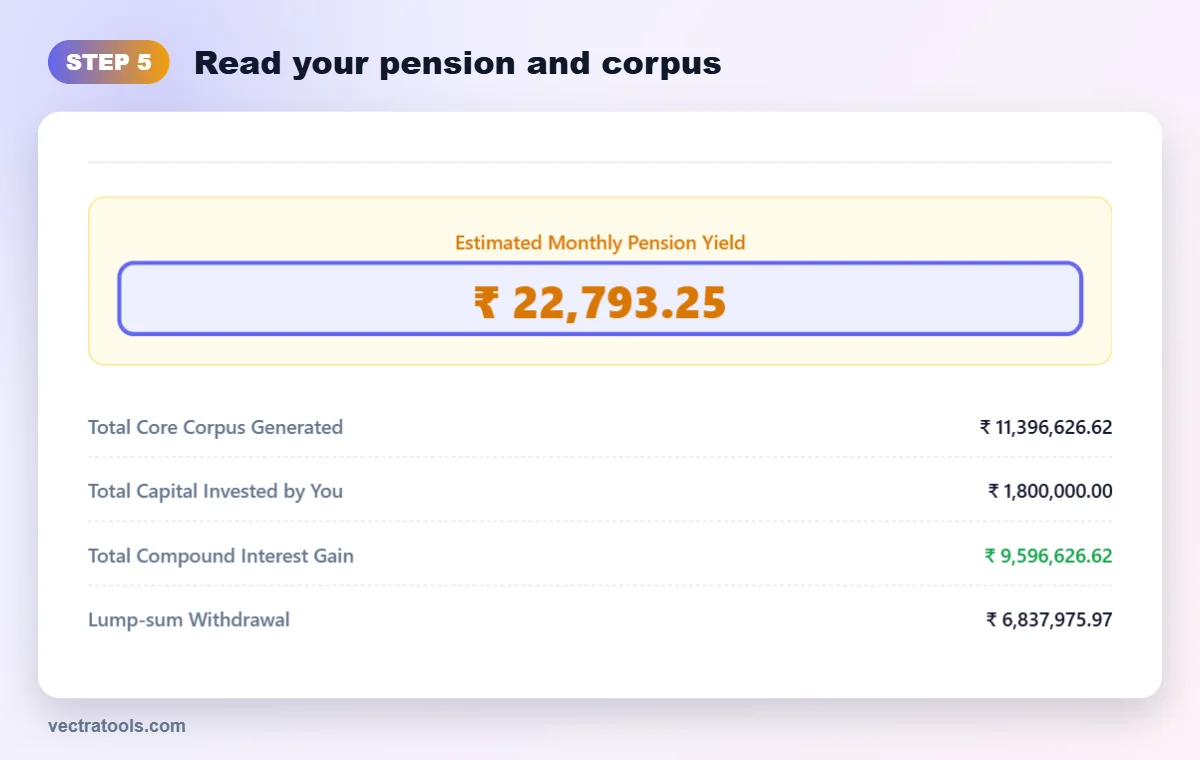
Step 5: Read Your Pension and Corpus
You will see your Estimated Monthly Pension, the Total Corpus at 60, the Total Capital Invested, the Compound Interest Gain and the Lump-sum Withdrawal.
NPS Calculation Example
- Inputs: ₹5,000 a month from age 30 to 60 (360 months) at 10%.
- Total invested: ₹5,000 × 360 = ₹18,00,000.
- Corpus at 60: about ₹1,13,96,627.
- Annuity (40%): ₹45,58,651 buys a pension of ₹45,58,651 × 6% ÷ 12 ≈ ₹22,793 a month.
- Lump sum (60%): about ₹68,37,976, tax-free.
Lump Sum vs Pension: Choosing Your Annuity Share
For the same corpus of ₹1,13,96,627 and a 6% annuity rate:
| Annuity share | Lump sum | Annuity amount | Monthly pension |
|---|---|---|---|
| 20% | ₹91,17,301 | ₹22,79,325 | ₹11,397 |
| 40% | ₹68,37,976 | ₹45,58,651 | ₹22,793 |
| 60% | ₹45,58,651 | ₹68,37,976 | ₹34,190 |
| 100% | ₹0 | ₹1,13,96,627 | ₹56,983 |
NPS Calculator Examples (10% Return, 40% Annuity at 6%)
| Start age | Monthly contribution | Total invested | Corpus at 60 | Monthly pension |
|---|---|---|---|---|
| 25 | ₹5,000 | ₹21,00,000 | ₹1,91,41,384 | ₹38,283 |
| 30 | ₹5,000 | ₹18,00,000 | ₹1,13,96,627 | ₹22,793 |
| 35 | ₹10,000 | ₹30,00,000 | ₹1,33,78,903 | ₹26,758 |
| 40 | ₹10,000 | ₹24,00,000 | ₹76,56,969 | ₹15,314 |
| 45 | ₹20,000 | ₹36,00,000 | ₹83,58,485 | ₹16,717 |
NPS Tax Benefits
- Section 80CCD(1B): an extra deduction of up to ₹50,000 a year under the old tax regime.
- Employer contributions: deductible under Section 80CCD(2), including in the new tax regime, within limits.
- At exit: up to 60% of the corpus can be withdrawn tax-free; the annuity income is taxed as normal income.
Tips to Grow Your NPS Corpus
- Start early: a 25-year-old gets five more years of compounding than a 30-year-old.
- Choose your asset mix: higher equity allocation can raise long-term returns but adds volatility.
- Increase contributions as your salary grows.
- Compare options: use our PPF Calculator and Retirement Calculator.
Who Should Use an NPS Calculator?
Salaried employees use an NPS calculator to see how monthly contributions turn into a pension. Self-employed professionals use an NPS calculator to plan retirement without an employer pension, and anyone choosing between a larger lump sum and a higher pension can test both with the NPS calculator in seconds.
Disclaimer
NPS returns are market-linked and not guaranteed, and annuity rates vary by provider. Exit and tax rules can change. This NPS calculator gives estimates only and is not financial or tax advice.
Frequently Asked Questions
How is NPS pension calculated?
Your corpus at 60 is multiplied by the share you use to buy an annuity and by the annuity rate, then divided by 12. For a ₹1 crore corpus with 40% in an annuity at 6%, the pension is about ₹20,000 a month.
How much of my NPS can I withdraw at 60?
Under the rules amended in December 2025, non-government subscribers can withdraw up to 80% as a lump sum and government subscribers up to 60%. Up to 60% of the corpus is tax-free.
What return should I assume in the NPS calculator?
It depends on your asset mix. Equity-heavy choices have historically delivered higher long-term returns than debt-heavy ones, but returns are not guaranteed. Test a cautious and an optimistic rate.
Can I withdraw my whole NPS corpus?
Yes, if your total corpus is ₹8 lakh or less you can withdraw it fully without buying an annuity.
Is NPS better than PPF?
PPF offers a guaranteed, fully tax-free return, while NPS is market-linked with potential for higher returns and extra tax deductions. Many people use both.
Is this NPS calculator free?
Yes. It is free, needs no sign-up and works on phones, tablets and computers.