

Retirement Calculator
Retirement Calculator
Calculate your future nest egg wealth projection instantly
Quick answer
A retirement calculator projects your savings at retirement with FV = Savings × (1 + r)n + Monthly deposit × [(1 + r)n − 1] ÷ r, where r is the monthly return and n the number of months. For example, starting at 30 with 500,000 saved, investing 10,000 a month at 10% a year until 60 grows to about 32.52 million, of which only 4.1 million is your own money.
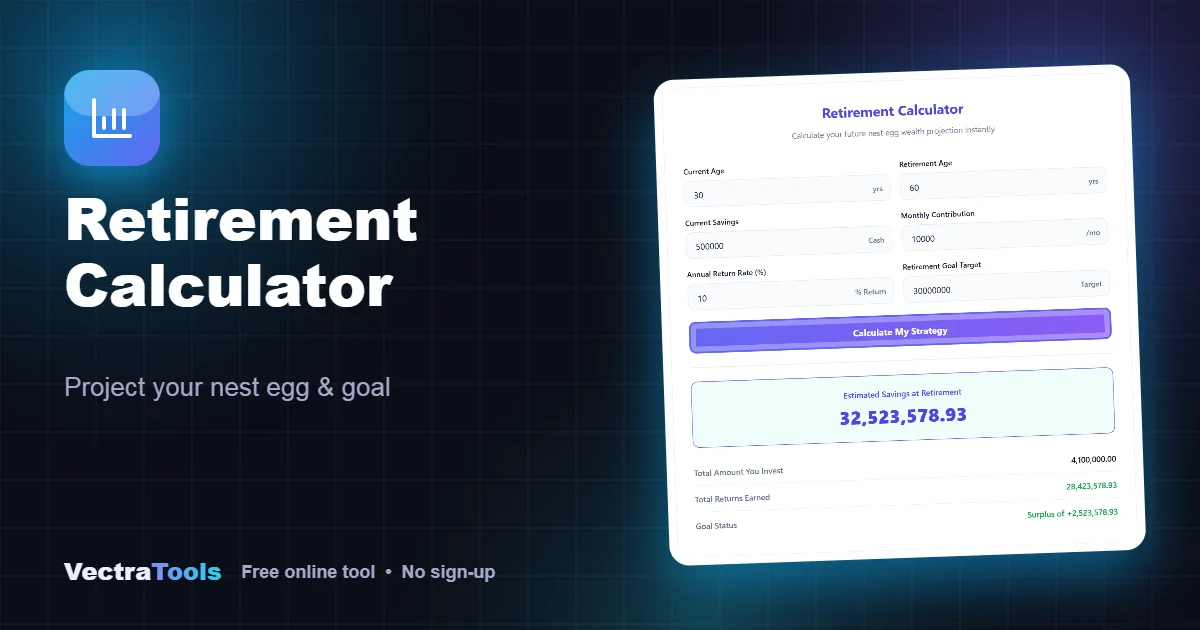
Our free retirement calculator shows how big your nest egg could be when you stop working. Enter your current age, retirement age, current savings, monthly contribution, expected annual return and your target amount, and the retirement calculator projects your total savings, how much you invested, how much came from compound returns and whether you are on track to hit your goal.
It works in any currency, whether you invest in a pension, provident fund, mutual funds, stocks or a savings plan. Everything runs privately in your browser.
What Is Retirement Planning?
Retirement planning means deciding how much money you will need to live on after you stop working, then building a savings and investment plan to get there. The earlier you start, the more time compound growth has to do the heavy lifting. Learn more about retirement planning and its key ideas.
FV = PV × (1 + r)n + PMT × [(1 + r)n − 1] ÷ r
PV = current savings, PMT = monthly contribution, r = annual return ÷ 12 ÷ 100, n = years to retirement × 12
How to Use the Retirement Calculator
Follow these five quick steps:
Step 1: Enter Your Current Age and Retirement Age
Type your age today and the age you plan to retire, for example 30 and 60. The gap is how many years your money has to grow.

Step 2: Enter Current Savings and Monthly Contribution
Add the amount you have already saved for retirement, for example 500,000, and how much you will invest every month, for example 10,000.

Step 3: Set Your Expected Return and Goal
Enter a realistic annual return rate, for example 10%, and your retirement goal target, for example 30,000,000. Use a lower return if you invest mainly in deposits or bonds.

Step 4: Click Calculate My Strategy
Press Calculate My Strategy. The retirement calculator compounds your savings month by month.

Step 5: Review Your Retirement Projection
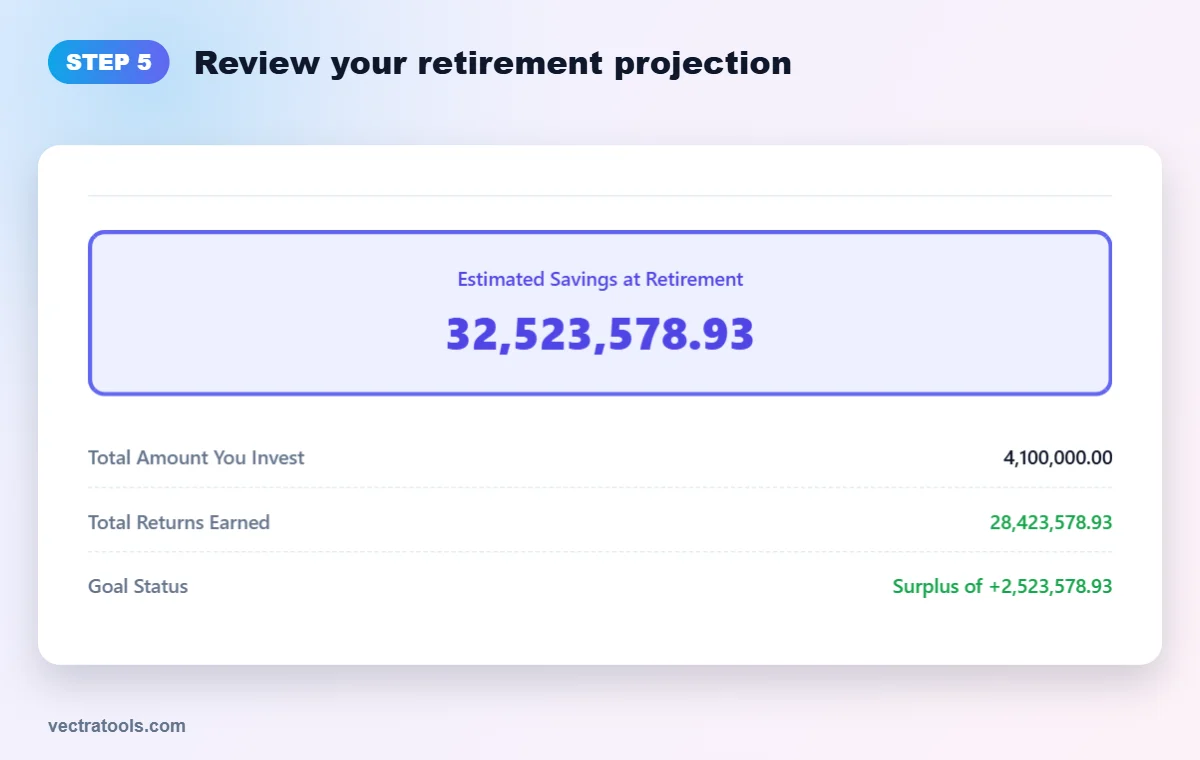
You will see your Estimated Savings at Retirement, the Total Amount You Invest, the Total Returns Earned and your Goal Status, showing a surplus or shortfall against your target.
Retirement Calculation Example
- Inputs: age 30, retire at 60 (360 months), savings 500,000, 10,000 a month, 10% a year.
- Growth of current savings: 500,000 × (1 + 0.10 ÷ 12)360 ≈ 9.92 million.
- Growth of monthly deposits: 10,000 × [(1.00833)360 − 1] ÷ 0.00833 ≈ 22.60 million.
- Total at 60: about 32,523,579.
- Your money in: 500,000 + 10,000 × 360 = 4,100,000, so returns add about 28.4 million.
- Against a 30 million goal: a surplus of about 2.52 million.
Retirement Calculator Examples
| Age range | Current savings | Monthly deposit | Return | Total invested | Savings at retirement |
|---|---|---|---|---|---|
| 25 to 60 | 0 | 5,000 | 10% | 2,100,000 | 18,983,190 |
| 30 to 60 | 500,000 | 10,000 | 10% | 4,100,000 | 32,523,579 |
| 35 to 60 | 1,000,000 | 15,000 | 8% | 5,500,000 | 21,605,572 |
| 40 to 60 | 2,000,000 | 20,000 | 12% | 6,800,000 | 41,570,215 |
| 45 to 60 | 0 | 25,000 | 8% | 4,500,000 | 8,650,956 |
The Cost of Waiting
Here is what investing 10,000 a month at 10% until age 60 grows to, depending on when you start:
| Start age | Total invested | Savings at 60 |
|---|---|---|
| 25 | 4,200,000 | 37,966,381 |
| 30 | 3,600,000 | 22,604,879 |
| 35 | 3,000,000 | 13,268,334 |
| 40 | 2,400,000 | 7,593,688 |
Starting just five years earlier can make a bigger difference than doubling your contributions later, because the earliest money compounds for the longest time.
How Much Do You Need to Retire?
- The 25× rule: aim for about 25 times your expected yearly spending in retirement.
- The 4% rule: a common US guideline suggests withdrawing about 4% of savings in the first year, adjusted for inflation after that.
- Inflation: prices rise over decades, so a target that looks large today will buy less in 30 years. Use a return rate after inflation for a more cautious plan.
- Other income: pensions, gratuity, rental income or social security reduce how much you need to save.
Tips to Boost Your Retirement Savings
- Start now: even small monthly amounts grow significantly over 25 to 35 years.
- Increase contributions yearly: raise your deposit whenever your salary rises.
- Keep costs low: high fund fees reduce returns over time.
- Review every year: rerun the retirement calculator as your income and goals change.
- See the power of compounding: try our Compound Interest Calculator and SIP Calculator.
Who Should Use a Retirement Calculator?
Young professionals use a retirement calculator to see how small monthly savings add up. Mid-career earners use a retirement calculator to check whether they are on track, and people close to retiring use it to test different retirement ages. Because this retirement calculator compares your result with a goal, it shows straight away whether you need to save more.
Disclaimer
This retirement calculator gives illustrations based on a constant rate of return. Real investment returns vary and can be negative, and results are before tax and inflation. It is not financial advice; consider speaking to a qualified financial adviser.
Frequently Asked Questions
How does a retirement calculator work?
It grows your current savings and every monthly contribution at your expected return rate, compounded monthly, until your retirement age. It then compares the total with your target.
What return rate should I use?
Use a rate that matches your investments. Diversified equity funds have historically earned more than bank deposits over long periods but with more ups and downs. If unsure, test a cautious and an optimistic rate.
Does the retirement calculator include inflation?
No. Results are in future money. To see the value in today's money, enter a real return, roughly your expected return minus expected inflation.
How much should I save each month for retirement?
Set your goal in the calculator and change the monthly contribution until the Goal Status shows a surplus. Many planners suggest saving at least 15% of income.
What if I have a shortfall?
You can save more each month, retire a few years later, aim for a higher but realistic return, or lower your target spending.
Is this retirement calculator free?
Yes. It is free, needs no sign-up and works on phones, tablets and computers.