

SIP Calculator
Global SIP Calculator
Estimate compounding growth value across 20+ major countries

Quick answer
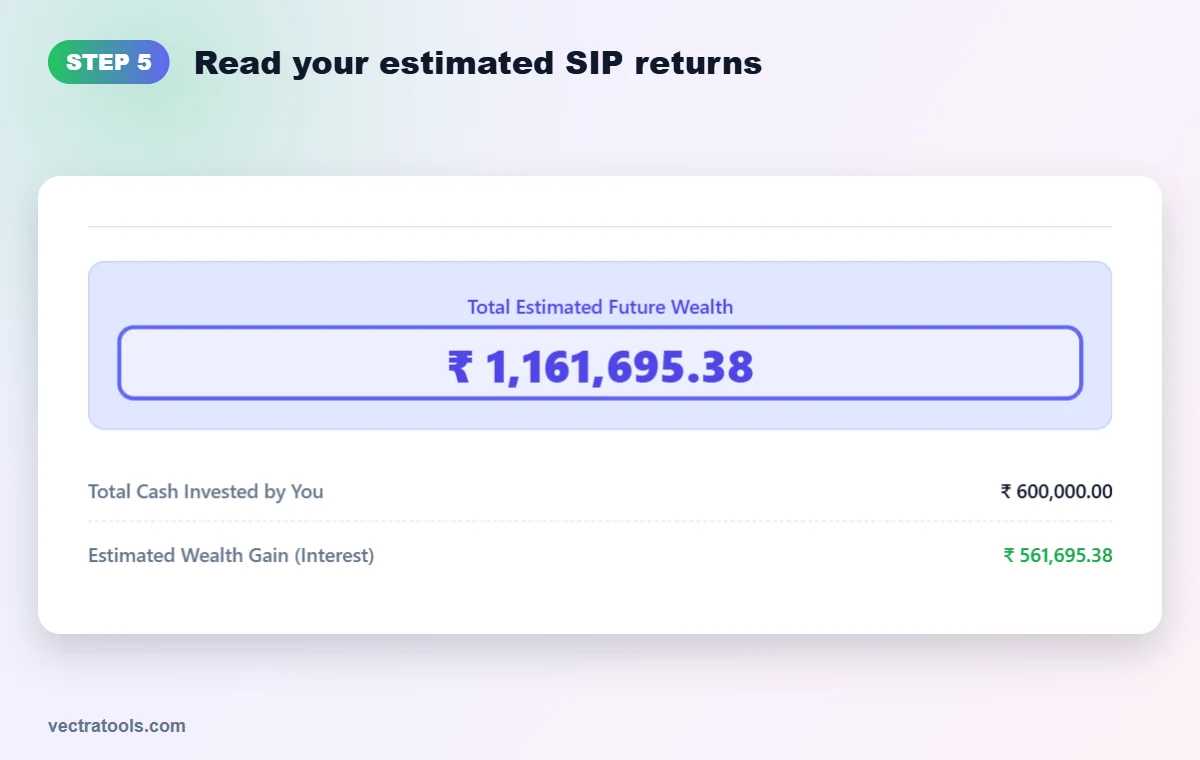
A SIP calculator estimates the future value of a monthly investment with FV = P × [(1 + i)n − 1] ÷ i × (1 + i), where P is the monthly amount, i the monthly return and n the number of months. For example, investing 5,000 a month for 10 years at an expected 12% a year grows to about 1,161,695: 600,000 invested plus 561,695 in estimated gains.
Our free SIP calculator shows how much your Systematic Investment Plan could be worth in the future. Pick your currency from more than 20 countries, enter your monthly investment, expected annual return and time period, and the SIP calculator shows the estimated future value, the total amount you invested and your estimated wealth gain.
It is ideal for planning mutual fund SIPs, monthly ETF or index fund investing, and long-term goals such as a child's education, a home deposit or retirement. All calculations happen in your browser.
What Is a SIP?
A Systematic Investment Plan (SIP) is a way of investing a fixed amount at regular intervals, usually monthly, into a mutual fund or similar investment. Instead of trying to time the market, you invest the same amount every month, which builds discipline and benefits from rupee cost averaging (or dollar cost averaging): you automatically buy more units when prices are low and fewer when they are high. Learn more about cost averaging.
FV = P × [(1 + i)n − 1] ÷ i × (1 + i)
P = monthly investment, i = annual return ÷ 12 ÷ 100, n = years × 12
The extra (1 + i) assumes you invest at the start of each month, as most SIPs do.
How to Use the SIP Calculator
Follow these five quick steps:
Step 1: Select Your Country or Currency
Choose your currency from the list, for example India (INR - ₹), Pakistan (PKR) or United States (USD). The SIP calculator shows results with that currency symbol.

Step 2: Enter Your Monthly Investment
Type how much you will invest each month, for example 5,000.

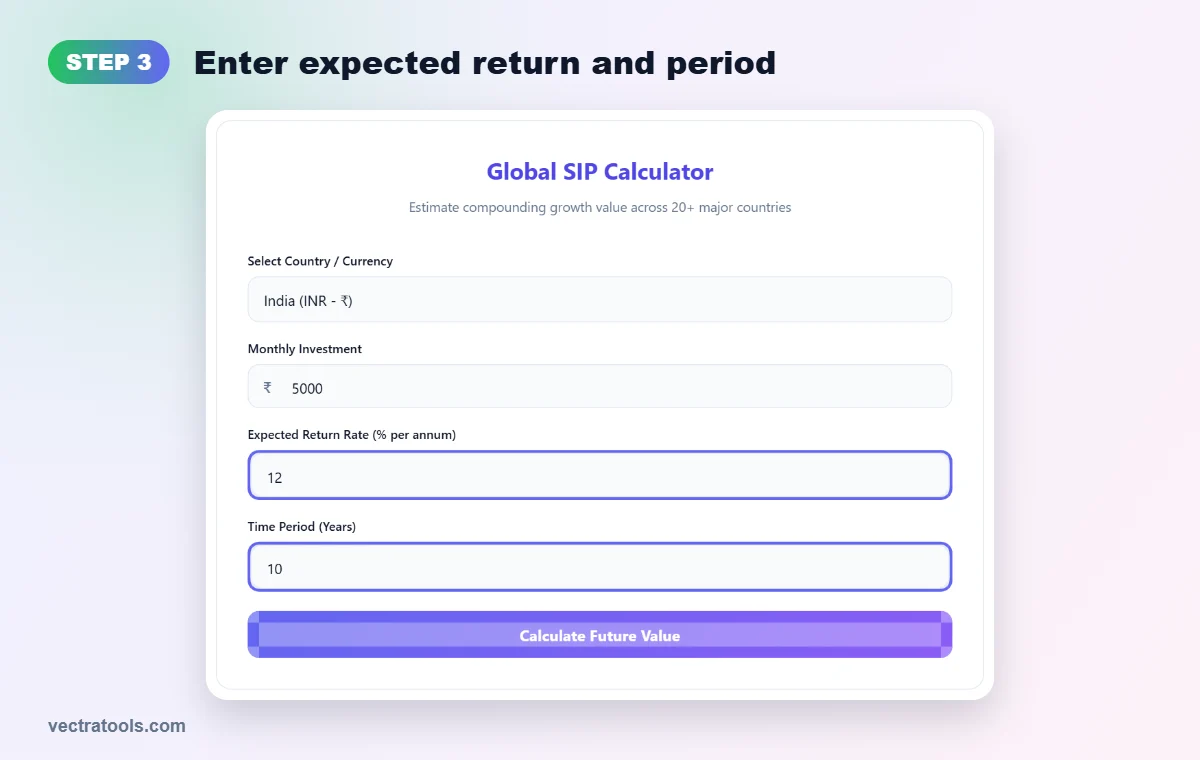
Step 3: Enter the Expected Return and Time Period
Add the expected annual return, for example 12%, and how many years you will keep investing, for example 10. Use a conservative return if you are unsure.
Step 4: Click Calculate Future Value
Press Calculate Future Value. The SIP calculator compounds every monthly instalment instantly.

Step 5: Read Your Estimated SIP Returns
You will see the estimated future value, the Total Cash Invested by You and the Estimated Wealth Gain, which is the growth from compounding.
SIP Calculation Example
- Inputs: 5,000 a month, 12% a year, 10 years.
- Monthly rate: i = 12 ÷ 12 ÷ 100 = 0.01; months: n = 120.
- Growth factor: [(1.01)120 − 1] ÷ 0.01 × 1.01 ≈ 232.34.
- Future value: 5,000 × 232.34 ≈ 1,161,695.
- Invested: 5,000 × 120 = 600,000, so the estimated gain is 561,695.
SIP Calculator Examples
| Monthly SIP | Return | Period | Invested | Est. gain | Future value |
|---|---|---|---|---|---|
| 1,000 | 12% | 10 years | 120,000 | 112,339 | 232,339 |
| 5,000 | 12% | 10 years | 600,000 | 561,695 | 1,161,695 |
| 5,000 | 12% | 20 years | 1,200,000 | 3,795,740 | 4,995,740 |
| 10,000 | 10% | 15 years | 1,800,000 | 2,379,243 | 4,179,243 |
| 10,000 | 12% | 25 years | 3,000,000 | 15,976,351 | 18,976,351 |
| 25,000 | 12% | 30 years | 9,000,000 | 79,247,844 | 88,247,844 |
Notice how the gains grow much faster in the later years. Doubling the time from 10 to 20 years more than quadruples the future value of a 5,000 SIP.
SIP vs Lump Sum
A lump sum puts all your money to work at once, while a SIP spreads it over time. Over the same period, a lump sum invested at the start can earn more if markets rise steadily, but a SIP reduces the risk of investing everything at a market peak and fits a monthly salary. For example, 100,000 invested once at 12% for 10 years grows to about 330,039. Compare different scenarios with our Compound Interest Calculator.
Tips to Get More From Your SIP
- Start early: time in the market matters more than the amount.
- Step up yearly: increase your SIP by 5 to 10% each year as your income grows.
- Stay invested: stopping during market dips locks in losses and misses the recovery.
- Match the fund to the goal: equity funds for long goals, debt funds for shorter ones.
- Plan for retirement: use our Retirement Calculator to set a target.
Who Should Use a SIP Calculator?
New investors use a SIP calculator to see what a small monthly amount can become. Experienced investors use a SIP calculator to compare return assumptions and time horizons, and parents use it to plan for school and university fees. Because this SIP calculator supports many currencies, it works for investors worldwide.
Disclaimer
The SIP calculator shows estimates based on a constant annual return. Mutual fund and market returns are not guaranteed, can vary from year to year and may be negative. Results are before tax and fees and are not financial advice.
Frequently Asked Questions
How does a SIP calculator work?
It treats each monthly instalment as a separate investment that compounds until the end of the period, using FV = P × [(1 + i)^n − 1] ÷ i × (1 + i).
What return should I enter in the SIP calculator?
Use a realistic long-term estimate for your type of fund. Equity funds have historically returned more than debt funds over long periods, but returns are never guaranteed. Try a few rates to see a range.
Is a SIP better than a fixed deposit?
A SIP in equity funds has the potential for higher long-term returns but carries market risk. A fixed deposit gives a guaranteed rate with lower growth. Many people use both.
Can I change or stop my SIP?
Most fund houses let you increase, pause or stop a SIP at any time. Exit loads or tax may apply if you redeem early.
Does this SIP calculator include inflation or tax?
No. Results are before tax and in future money. Subtract expected inflation from the return rate to estimate the value in today's money.
Is the SIP calculator free?
Yes. It is free, supports more than 20 currencies, needs no sign-up and works on any device.