

Packing Cube Planner – Easy Space Efficiency Calculator in 3 Steps
Travel Packing Cube Space Efficiency Grid
Free packing cube planner – calculate your luggage volume requirements based on your clothing items and optimize your packing cube layout to prevent over-packing.
1. Packing Cube Inventory
Enter the number of cubes you have and their estimated capacity in Liters (L).
2. Clothing & Item Manifest
Enter the quantity of each item. We use standard volumetric estimates for calculation.
Space Utilization Efficiency
Enter your inventory and items to calculate efficiency.
Total Cube Capacity
Available space
Required Item Volume
Space needed
Remaining / Overflow
Free space or excess
Total Items Count
Pieces of clothing
Volumetric Estimates & Packing Logic
Assumed Item Volumes (Liters)
- T-Shirts / Tops: ~0.5L per item
- Pants / Jeans: ~1.5L per item
- Underwear & Socks: ~0.2L per pair/set
- Sweaters / Jackets: ~2.5L per item
- Shorts / Skirts: ~0.6L per item
- Misc Gear: ~1.0L per bundle
Efficiency Benchmarks
- Over 100% (Red): You are over-packing. Items will wrinkle heavily, zippers may break, or it simply won't fit.
- 80% - 100% (Green): Optimal packing. Items are compressed enough to prevent shifting, saving space.
- Under 80% (Yellow): Loose packing. Items will shift and wrinkle. Consider using fewer or smaller cubes.
Use this free packing cube planner to see if your clothes will fit – before you start stuffing your suitcase.
Quick answer
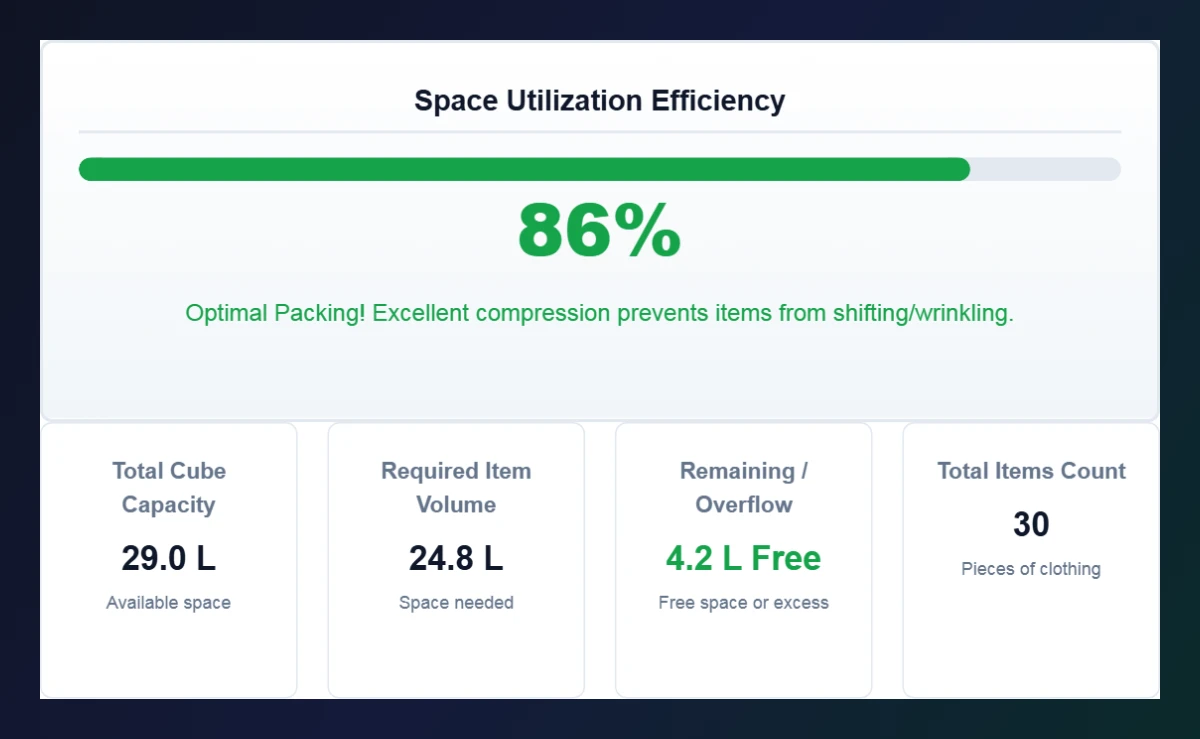
This packing cube planner adds up the capacity of your cubes in liters and compares it with the estimated volume of your clothes. 80–100% usage is optimal, under 80% is loose and over 100% means it will not fit. Example: 29 L of cubes with 30 items needing 24.8 L gives 86% – optimal packing with 4.2 L to spare.
Table of Contents
Packing cubes keep a suitcase organised, but it is easy to buy the wrong set or overstuff them until the zips strain. The question is simple: how much space do my clothes actually need, and do my cubes have enough room?
Our free packing cube planner answers it with numbers. Enter how many small, medium and large cubes you have and their volume, list your clothes, and the tool shows total capacity, required volume, remaining space and a clear efficiency rating.
How the Packing Cube Calculator Works
Each type of clothing is given a typical folded or rolled volume. The tool multiplies those by your quantities and compares the total with your cube capacity.
| Item | Estimated volume |
|---|---|
| T-shirt / top | ~0.5 L |
| Pants / jeans | ~1.5 L |
| Underwear / socks (per pair or set) | ~0.2 L |
| Sweater / hoodie / jacket | ~2.5 L |
| Shorts / skirt | ~0.6 L |
| Misc bundle (swimwear, gear) | ~1.0 L |
Efficiency ratings
| Usage | Meaning |
|---|---|
| Under 80% | Loose – items shift and wrinkle; use fewer or smaller cubes |
| 80% – 100% | Optimal – firm, organised and easy to close |
| Over 100% | Over-packed – remove items or add a cube |
Common packing cube sizes
Brands vary, but small cubes are often 2–4 L, medium 5–8 L and large 10–15 L. Check the label or measure length × width × height in cm and divide by 1,000 to get liters.
How to Use the Packing Cube Planner
Plan your packing in three quick steps.
Step 1: Enter Your Cubes and Clothing
Under Packing Cube Inventory, enter the quantity and volume (L) of your small, medium and large cubes – e.g. 2 × 2.5 L, 2 × 6 L and 1 × 12 L = 29 L. Under Clothing & Item Manifest, type how many tops, pants, underwear, sweaters, shorts and misc items you are taking. Click Calculate Efficiency.

Step 2: Read Your Space Efficiency
The result shows your Space Utilization Efficiency and a rating. In our example – 7 tops, 3 pants, 10 underwear, 4 sweaters, 3 shorts and 3 misc items – the clothes need 24.8 L of the 29 L available: 86%, Optimal Packing, with 4.2 L free and 30 items in total.
Step 3: Check the Volume Estimates
Scroll to Volumetric Estimates & Packing Logic to see the liters used for each item and the efficiency benchmarks. Use Export Packing Manifest (JSON) to save your list, or Reset Grid to plan another trip.

Packing Cube Tips From Frequent Travellers
- Roll soft items, fold structured ones. T-shirts and underwear roll tightly; shirts and trousers crease less when folded.
- One category per cube. Tops in one, bottoms in another, underwear in a small cube – you find things without unpacking everything.
- Wear your bulkiest items (jacket, boots) on travel days to save 3–5 L.
- Leave 10–15% free on the outbound trip for souvenirs.
- Use compression cubes for bulky sweaters – they can save up to a third of the space.
Packing Cubes and Airline Size Limits
Efficient cubes help, but your suitcase still has to meet airline rules. After planning your cubes, check the outside dimensions with our Linear Inches Luggage Checker – most carry-ons must stay around 45 linear inches (22 × 14 × 9 in).
Travelling soon? Plan your connection with the Airport Transit Calculator and save key phrases with the Language Phrasebook.
Frequently Asked Questions
How many packing cubes do I need?
For a week, most people use 3–4 cubes: one large for tops, one medium for bottoms and one or two small for underwear and accessories.
What size packing cube fits a carry-on?
A typical 35–40 L carry-on fits about 25–30 L of packing cubes, for example one large, two medium and one small cube.
Do packing cubes really save space?
They mainly organise and compress. Compression cubes save the most – often 20–30% for bulky clothes.
What is a good packing efficiency?
80–100% of cube capacity is ideal: the cube is firm, items do not shift and the zip closes easily.
How are clothing volumes estimated?
The tool uses typical folded volumes, such as 0.5 L per T-shirt and 2.5 L per sweater. Thick or very large items may need more space.
Is the packing cube planner free?
Yes. It is free, needs no sign-up and runs in your browser.