

Linear Inches Calculator – Check Luggage Size in 3 Easy Steps
Luggage Dimension Linear Inches Checker
Free linear inches checker – calculate the total linear size (Length + Width + Height) of your suitcase to ensure it complies with airline baggage policies and avoid hefty oversized fees.
1. Enter Bag Dimensions
2. Select Target Limit
Total Linear Size (L+W+H)
Enter dimensions to check limits.
Target Limit
Maximum allowed
Remaining Allowance
Space left
Baggage Size Rules & Industry Standards
What are "Linear Inches"?
- The Formula: Linear inches are calculated by simply adding the Length + Width + Height of your luggage together. (e.g., 28" + 20" + 12" = 60 Linear Inches).
- Wheels & Handles: Airlines strictly require you to include wheels, handles, and bulging pockets in your measurements. Always measure from the widest protruding points.
Common Airline Benchmarks
- Standard Checked Bag: 62 linear inches (157.5 cm) is the universal standard for almost all major airlines (Delta, United, American, etc.).
- Standard Carry-On: Usually bounded at 45 linear inches (often specified as 22" x 14" x 9").
- Oversized Fees: If your bag exceeds 62", you will typically be charged an oversized baggage fee, which can range from $100 to $200+ per flight.
Use this free linear inches checker to find out in seconds whether your suitcase fits airline size limits.
Quick answer
Linear inches = Length + Width + Height of your bag, including wheels and handles. Most airlines allow 62 linear inches (157.5 cm) for checked bags and around 45 inches (114.3 cm) for carry-ons. Example: a 22" × 14" × 9" carry-on = 45 inches – exactly at the usual carry-on limit.
Table of Contents
Airlines rarely ask “how big is your suitcase?” in one number – but their rules do. Most checked-bag policies set a maximum total size in linear inches, and going even an inch over can trigger an oversized-bag fee at the counter.
Our free linear inches checker adds the three dimensions for you, converts between inches and centimetres, and compares the total with standard limits for checked bags, carry-ons, personal items, oversized allowances or a custom number from your airline.
How to Calculate Linear Inches
The formula is simple: total size = L + W + H. Measure from the outermost points, including wheels, handles and expanded pockets.
| Bag | Dimensions | Linear size | Fits |
|---|---|---|---|
| Typical carry-on | 22 × 14 × 9 in | 45 in (114.3 cm) | Carry-on limit (45") |
| Medium checked bag | 26 × 18 × 11 in | 55 in (139.7 cm) | Checked limit (62") |
| Large checked bag | 29 × 20 × 12 in | 61 in (154.9 cm) | Checked limit (62") |
| Extra-large bag | 31 × 21 × 13 in | 65 in (165.1 cm) | Over 62" – oversized fee |
| Personal item | 16 × 12 × 8 in | 36 in (91.4 cm) | Under-seat limit (39") |
Linear inches to centimetres
Multiply by 2.54. So 62 inches = 157.48 cm and 45 inches = 114.3 cm. The checker shows both units automatically.
How to Use the Linear Inches Checker
Check your bag size in three easy steps.
Step 1: Enter Your Bag Dimensions
Pick Inches or Centimeters, then type the Length, Width and Height of your bag – for example 22, 14 and 9 inches. Choose a Target Limit: checked bag (62"), carry-on (45"), personal item (39"), oversized (80") or a custom airline limit. Click Calculate Linear Size.
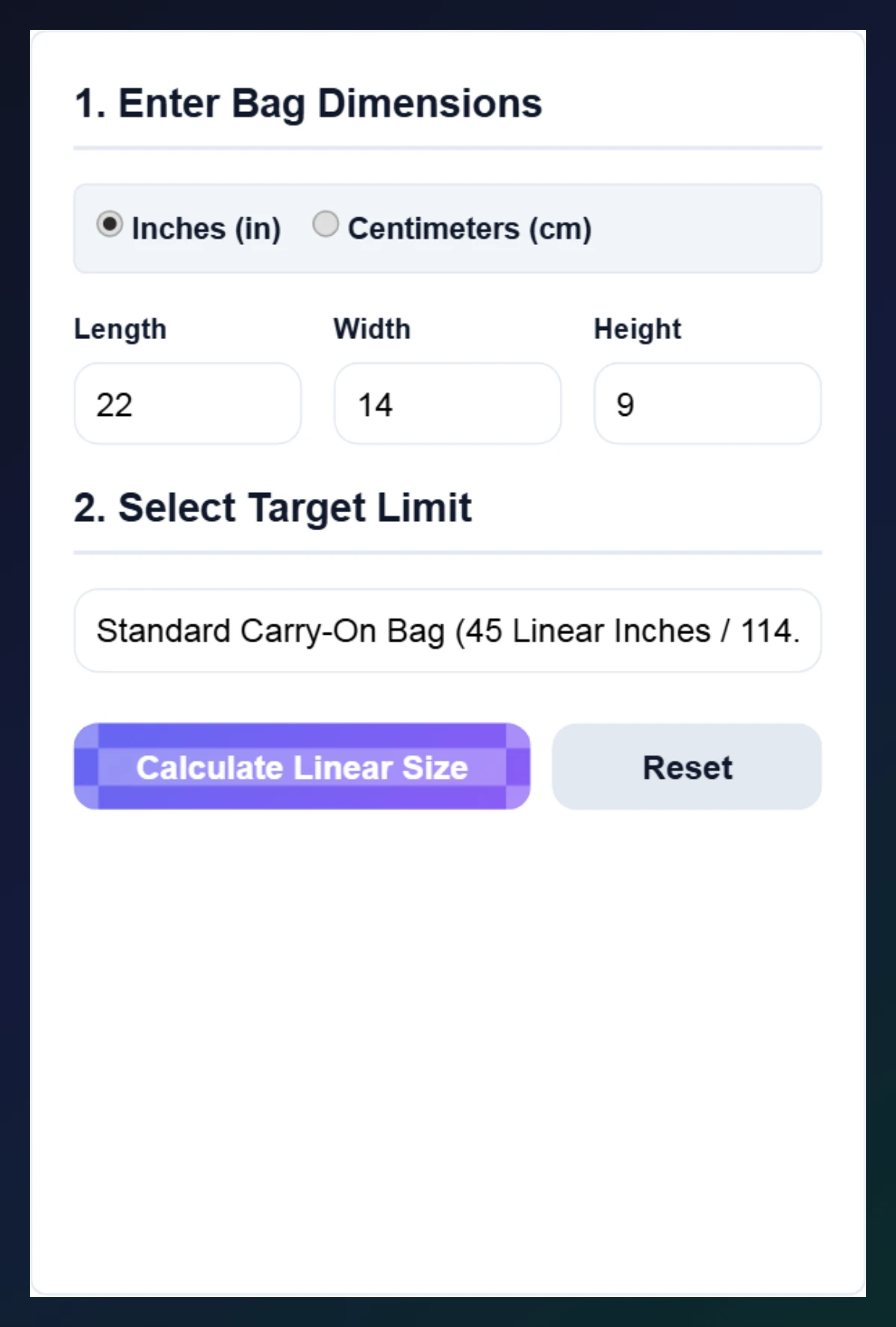
Step 2: Read the Total and Remaining Allowance
The result shows the total linear size in inches and centimetres, a status message and how much allowance remains. A 22 × 14 × 9 bag gives 45.0" (114.3 cm) – exactly at the carry-on limit with 0.0" to spare. If your bag is too big, the tool shows how far over you are.

Step 3: Check the Airline Size Rules
Scroll to Baggage Size Rules & Industry Standards for the formula, measuring tips and common airline benchmarks. Use Export Dimension Report (JSON) to save the result.

Common Airline Linear Inches Limits
| Bag type | Typical limit | Notes |
|---|---|---|
| Checked bag | 62 in / 157.5 cm | Standard for most major US and international airlines |
| Carry-on | About 45 in / 114 cm | Often given as 22 × 14 × 9 in (56 × 36 × 23 cm) |
| Personal item | Around 36–40 in | Must fit under the seat in front |
| Oversized bag | Over 62 in, up to ~80 in | Extra fee; above ~80–115 in may need cargo |
How to Measure Your Suitcase Correctly
- Stand the bag upright on a flat floor with the handle fully retracted.
- Measure height from the floor to the top of the handle housing, including the wheels.
- Measure width across the widest point, including side handles and feet.
- Measure depth (front to back) at the deepest point, with pockets as full as you plan to pack them.
- Round each number up to the next half inch or full centimetre – airline sizers are strict.
Carry-On Size Rules Around the World
| Region / airline type | Typical carry-on dimensions |
|---|---|
| US full-service airlines | 22 × 14 × 9 in (56 × 36 × 23 cm) |
| Many European airlines | 55 × 40 × 20 cm or 55 × 40 × 23 cm |
| Low-cost European carriers | Often 40 × 30 × 20 cm free, larger bag paid |
| Gulf and Asian full-service airlines | Around 55 × 40 × 20 cm, weight 7 kg common |
Low-cost carriers are usually the strictest, so check the exact allowance on your booking before travelling. Weight limits also apply – a small bag can still fail check-in if it is too heavy.
Limits vary by airline and fare type. Always confirm on your airline’s website before you fly.
Tips to Avoid Oversized Baggage Fees
- Measure the bag yourself – manufacturer sizes often exclude wheels and handles.
- Do not overpack expandable zips; bulging pockets add inches.
- Soft-sided bags are easier to fit into sizers than hard shells.
- Weigh the bag too: most economy checked bags are limited to 23 kg (50 lb).
- Use packing cubes to compress clothing – try our Packing Cube Planner.
Planning a connection as well? Check your timing with the Airport Transit Calculator.
Frequently Asked Questions
How do you calculate linear inches?
Add the length, width and height of your bag in inches. For example, 28 + 20 + 12 = 60 inches in total.
What is 62 inches in cm?
62 inches in total is about 157.5 cm. Multiply inches by 2.54 to convert.
Do wheels and handles count?
Yes. Airlines measure the outer dimensions, including wheels, handles and pockets.
What size is a 45-inch carry-on?
A common carry-on of 22 × 14 × 9 inches adds up to exactly 45 inches in total.
What happens if my bag is over 62 inches?
Most airlines charge an oversized-bag fee, often around $100–$200 per flight, and very large items may not be accepted.
Is the inches checker free?
Yes. It is completely free and works on any device without sign-up.