

Language Phrasebook – 17 Easy Travel Phrases in 5 Languages
Language Phrasebook Essential Categories Grid
Free language phrasebook – select your destination language to instantly generate a grid of survival phrases categorized for travel, dining, and emergencies.
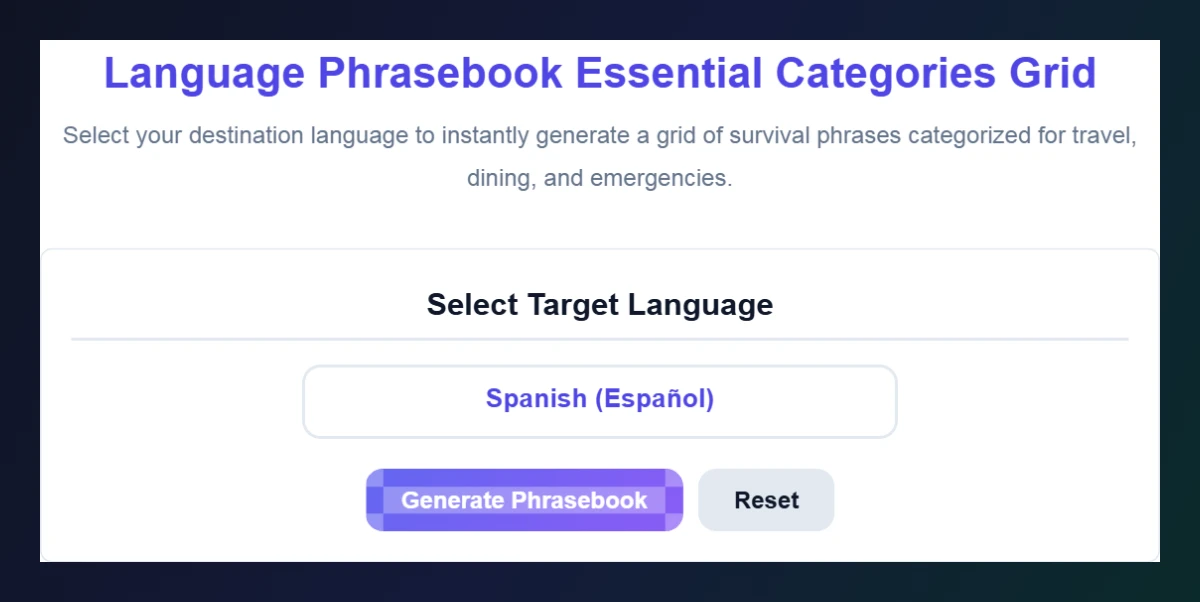
Select Target Language
Essential Survival Grid: Spanish
Use the grid below for quick reference during your travels.
Total Phrases
Categories
Export & Print
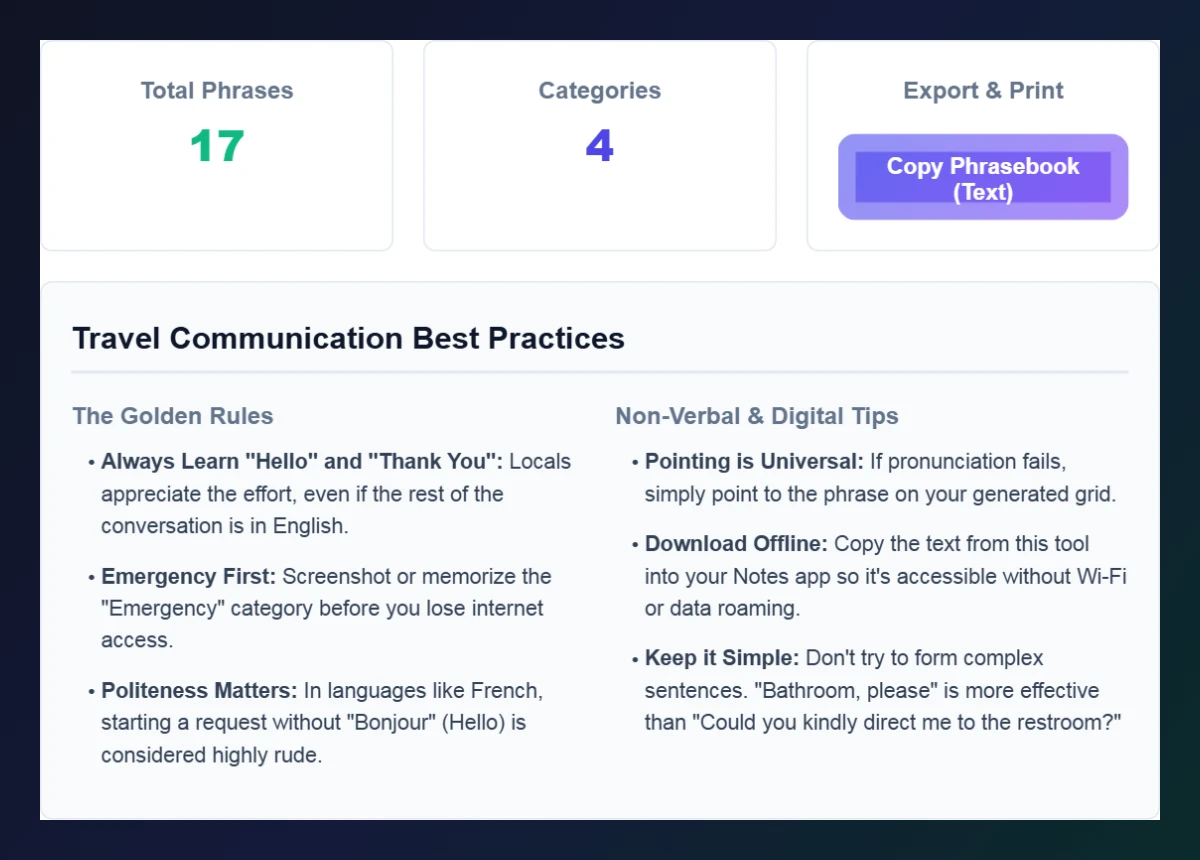
Travel Communication Best Practices
The Golden Rules
- Always Learn "Hello" and "Thank You": Locals appreciate the effort, even if the rest of the conversation is in English.
- Emergency First: Screenshot or memorize the "Emergency" category before you lose internet access.
- Politeness Matters: In languages like French, starting a request without "Bonjour" (Hello) is considered highly rude.
Non-Verbal & Digital Tips
- Pointing is Universal: If pronunciation fails, simply point to the phrase on your generated grid.
- Download Offline: Copy the text from this tool into your Notes app so it's accessible without Wi-Fi or data roaming.
- Keep it Simple: Don't try to form complex sentences. "Bathroom, please" is more effective than "Could you kindly direct me to the restroom?"
Use this free language phrasebook to get the travel phrases you actually need in Spanish, French, Italian, German or Japanese.
Quick answer
This language phrasebook generates a one-page grid of 17 essential travel phrases in Spanish, French, Italian, German or Japanese (in Romaji with Japanese script). Phrases are grouped into four categories – Greetings, Emergencies, Directions and Dining – so you can find “Where is the hospital?” or “The bill, please” in seconds and copy the whole list to your phone.
Table of Contents
You do not need to be fluent to travel well. A handful of polite, practical phrases – hello, thank you, where is the bathroom, I need a doctor – covers most real situations and makes locals far more willing to help.
Our free language phrasebook builds that short list for you. Pick a language, and the tool lays out 17 high-value phrases in a clean grid you can screenshot, print or copy into your notes for offline use.
What the Language Phrasebook Includes
| Category | Example phrases | Spanish example |
|---|---|---|
| Greetings & Basics | Hello, please, thank you, yes/no, do you speak English? | Hola, por favor, gracias |
| Emergencies | Help!, I need a doctor, call the police, where is the hospital? | ¡Ayuda!, Necesito un médico |
| Navigation & Directions | Where is the bathroom?, left/right/straight, airport/train station | ¿Dónde está el baño? |
| Dining & Commerce | How much is this?, the bill please, water please, I am allergic to… | La cuenta, por favor |
Supported languages
- Spanish – Spain and Latin America
- French – France, Belgium, Switzerland, Canada (Québec)
- Italian – Italy and parts of Switzerland
- German – Germany, Austria, Switzerland
- Japanese – shown in Romaji with the original Japanese script
How to Use the Language Phrasebook
Create your phrase sheet in three quick steps.
Step 1: Select Your Target Language
Choose a language from Select Target Language – for example Spanish (Español) – and click Generate Phrasebook.
Step 2: Browse the Essential Survival Grid
The grid shows the English phrase on top and the translation underneath, split into four categories. Japanese phrases include Romaji for pronunciation plus the Japanese script you can show to someone.

Step 3: Copy or Print Your Phrasebook
Check the totals (17 phrases, 4 categories), then click Copy Phrasebook (Text) to paste it into your notes app for offline use. The tips section below covers simple travel communication rules.
Tips for Using Travel Phrases
- Always start with a greeting. In France especially, beginning with “Bonjour” before a question is expected.
- Keep it short. “Bathroom, please?” works better than a long, complex sentence.
- Point if needed. Show the phrase on your screen if pronunciation fails.
- Save emergencies offline. Copy the Emergency category before you lose data roaming.
- Learn the numbers you need. Pair this sheet with our Local Emergency Numbers Lookup.
Quick Pronunciation Tips for Each Language
| Language | Tip | Example |
|---|---|---|
| Spanish | Every letter is pronounced; the “h” is silent | Hola = “OH-lah” |
| French | Final consonants are usually silent | Merci = “mair-SEE” |
| Italian | Double consonants are held slightly longer | Grazie = “GRAHT-see-eh” |
| German | “W” sounds like an English “V” | Wasser = “VAH-ser” |
| Japanese | Each syllable gets equal weight; “u” is often soft | Arigatou = “ah-ree-gah-toh” |
Use these tips together with the language phrasebook grid: read the phrase, say it slowly once, then use it. Locals almost always appreciate the effort, even if the accent is not perfect.
Who Is This Language Phrasebook For?
- First-time travellers who want confidence for the basics.
- Business travellers who need polite phrases for taxis, hotels and restaurants.
- Students and exchange visitors preparing for a semester abroad.
- Families who want an emergency phrase sheet in every phone.
Language Phrasebook vs Translation Apps
Translation apps are great with a stable connection, but they can be slow, need data and sometimes produce awkward sentences. A small language phrasebook of tested phrases works offline, is instant, and helps you remember the words after a few uses. Many travellers use both: the phrasebook for everyday moments and an app for longer conversations.
Polite Etiquette That Goes With Your Phrases
Spain and Latin America
Greet shop staff with “Hola” or “Buenos días” and use “usted” (the formal you) with older people. Dinner is late in Spain, often after 9 pm, so “La cuenta, por favor” may be needed later than you expect.
France
Say “Bonjour, monsieur/madame” before any question – in a shop, café or at a ticket window. Skipping the greeting is the most common reason visitors feel French service is cold.
Italy
“Ciao” is informal; with strangers use “Buongiorno” in the morning and “Buonasera” from late afternoon. Ask for the bill – waiters rarely bring it before you do.
Germany
Germans value directness and punctuality. A simple “Entschuldigung” (excuse me) before a question, and “Danke schön” afterwards, goes a long way.
Japan
A small bow with “Sumimasen” (excuse me) opens almost any conversation. Tipping is not expected, and speaking quietly on public transport is appreciated.
Combining these habits with the language phrasebook makes even short exchanges feel friendly and confident.
Getting ready to fly? Use the Layover Calculator to plan connections and the Packing Cube Planner to pack smarter.
Frequently Asked Questions
Which languages does the phrasebook support?
Spanish, French, Italian, German and Japanese. Japanese phrases are shown in Romaji with the Japanese script.
How many phrases are included?
Each language phrasebook includes 17 essential phrases grouped into 4 categories.
Can I use the phrasebook offline?
Yes. Click Copy Phrasebook (Text) and paste it into your notes app, or take a screenshot before you travel.
Is “Derecho” correct for straight ahead in Spanish?
Yes, “derecho” is common in Latin America. In Spain you will often hear “todo recto”.
Do I need to sign up?
No. The language phrasebook is free and runs in your browser without an account.