

Airport Transit Calculator – Check Your Layover in 3 Easy Steps
Layover Airport Transit Transfer Calculator
Free layover & airport transit calculator – determine the safe recommended layover time for your itinerary based on Minimum Connection Time (MCT) logic, customs clearance, and terminal logistics.
1. Flight Connection Details
2. Logistics & Passenger Details
3. Your Scheduled Layover
Enter the time between your scheduled arrival and departure to check if it's safe.
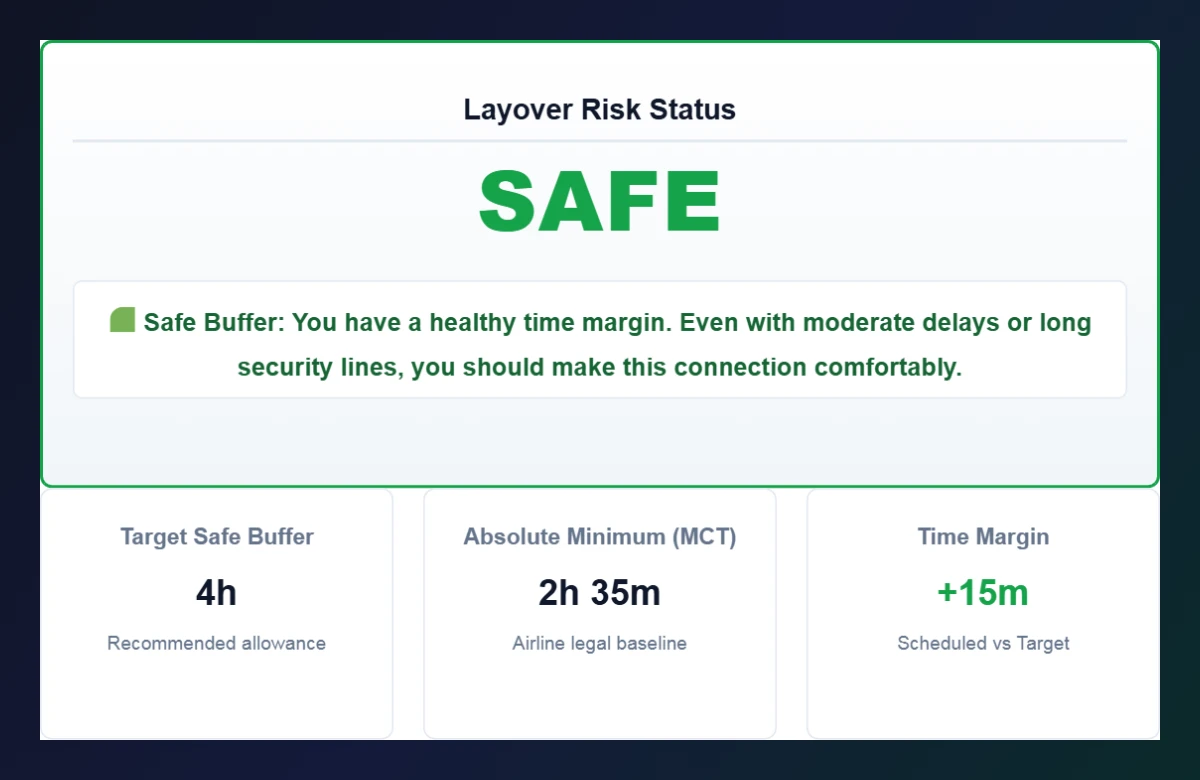
Layover Risk Status
Calculate to see if your connection time is viable.
Target Safe Buffer
Recommended allowance
Absolute Minimum (MCT)
Airline legal baseline
Time Margin
Scheduled vs Target
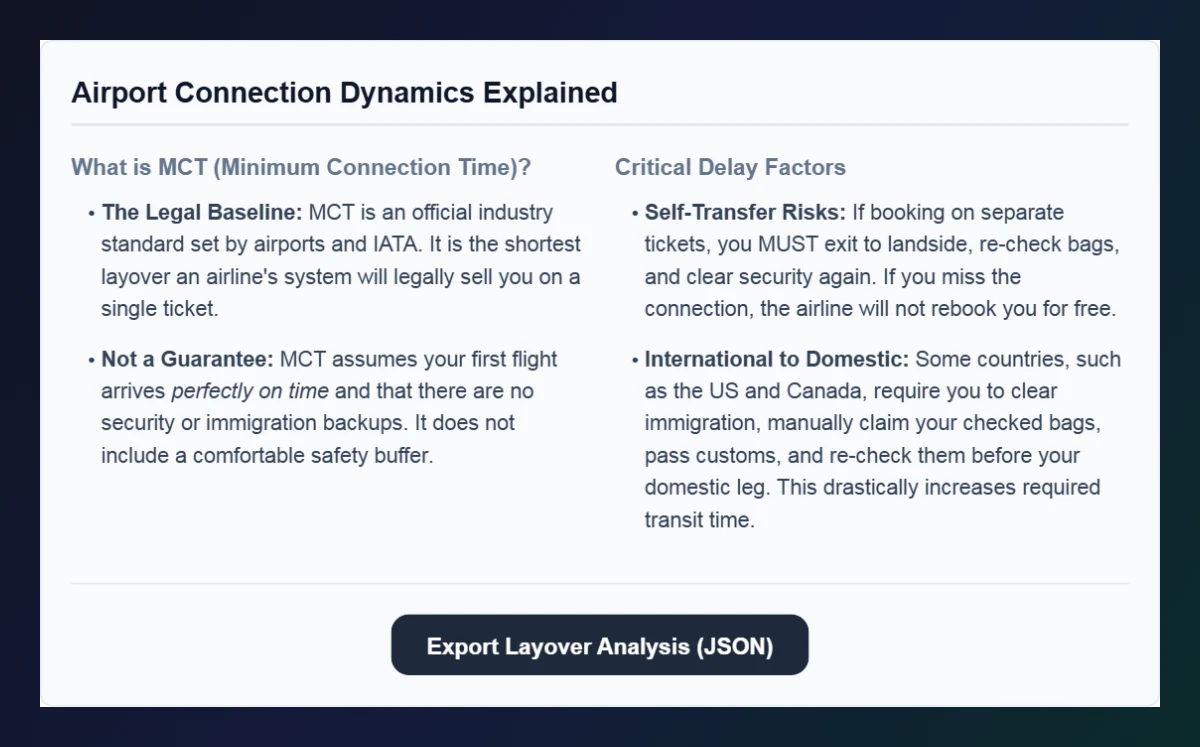
Airport Connection Dynamics Explained
What is MCT (Minimum Connection Time)?
- The Legal Baseline: MCT is an official industry standard set by airports and IATA. It is the shortest layover an airline's system will legally sell you on a single ticket.
- Not a Guarantee: MCT assumes your first flight arrives perfectly on time and that there are no security or immigration backups. It does not include a comfortable safety buffer.
Critical Delay Factors
- Self-Transfer Risks: If booking on separate tickets, you MUST exit to landside, re-check bags, and clear security again. If you miss the connection, the airline will not rebook you for free.
- International to Domestic: Some countries, such as the US and Canada, require you to clear immigration, manually claim your checked bags, pass customs, and re-check them before your domestic leg. This drastically increases required transit time.
Use this free layover & airport transit calculator to check whether the time between your flights is safe, tight or too risky.
Quick answer
A layover & airport transit calculator compares your scheduled connection with an estimated minimum connection time (MCT) and a safer target buffer. As a rule of thumb, allow at least 1 hour for domestic and 2–3 hours for international connections, and 3+ hours on separate tickets. Example: an international-to-domestic connection at a large hub with a terminal change and checked bags needs about 2h 35m minimum and a 4h safe target in this tool.
Table of Contents
Booking a cheaper flight with a short layover is tempting – until your first flight lands late and you are sprinting through a huge airport. The right connection time depends on much more than the clock: immigration, re-checking bags, changing terminals, airport size and whether both flights are on one ticket.
Our free layover & airport transit calculator weighs all of these factors. It estimates a minimum connection time, recommends a comfortable buffer, and tells you whether your scheduled layover is Safe, Tight or High Risk.
What the Layover & Airport Transit Calculator Considers
| Factor | Why it matters |
|---|---|
| Domestic or international flights | International arrivals often mean passport control and customs |
| Terminal change | Moving between terminals can take 15–45 minutes at big hubs |
| Airport size | Large hubs like JFK, LHR or DXB have long walks and queues |
| Ticket type | On separate tickets you must re-check bags and clear security again |
| Checked bags | Some connections require you to collect and re-drop your bags |
| Travel pace | Children, seniors and groups move more slowly |
Minimum Connection Time (MCT) Explained
MCT is the shortest connection an airline will sell on a single ticket at a given airport. It assumes everything runs on time, so it is a legal floor, not a comfortable target. If you book one ticket and miss a legal connection, the airline normally rebooks you. On self-transfer (separate tickets) you are usually on your own, which is why the layover & airport transit calculator recommends a much bigger buffer.
The tool gives an estimate for planning. Exact MCTs differ by airport and airline, so check with your airline for tight itineraries.
How to Use the Layover & Airport Transit Calculator
Check your connection in three simple steps.
Step 1: Enter Your Flight and Passenger Details
Choose whether your inbound and outbound flights are Domestic or International, whether you change terminals, the airport size, your ticket type, baggage and travel pace. Then type your scheduled layover in hours and minutes and click Analyze Layover Safety.

Step 2: Read Your Layover Risk Status
The result shows Safe, Tight or High Risk, the Target Safe Buffer, the estimated Absolute Minimum (MCT) and your Time Margin. In our example – international to domestic, large hub, terminal change, checked bags – a 4h 15m layover is Safe with a +15m margin over the 4h target.
Step 3: Review the Delay Factors
Read Airport Connection Dynamics Explained to understand MCT and the biggest risks, such as self-transfers and customs on international-to-domestic connections. Use Export Layover Analysis (JSON) to save the result, or Reset to try another itinerary.
Recommended Layover Times at a Glance
| Connection type | Comfortable layover |
|---|---|
| Domestic, same terminal, carry-on | 1 – 1.5 hours |
| Domestic with terminal change | 1.5 – 2 hours |
| International to international (transit) | 2 – 3 hours |
| International to domestic (customs + bags) | 3 – 4 hours |
| Separate tickets / self-transfer | 4+ hours |
| Travelling with kids or reduced mobility | Add 30 – 60 minutes |
These are general guidelines. The layover & airport transit calculator adjusts them to your exact combination of factors.
Tips to Make Your Connection
- Sit near the front of the plane so you exit quickly.
- Check your arrival and departure terminals in the airline app before landing.
- Travel carry-on only when connections are tight.
- On separate tickets, buy flexible fares or travel insurance that covers missed connections.
- If a delay threatens your connection on one ticket, tell the cabin crew and the transfer desk early.
Also check your bag size with the Luggage Dimension Checker and save local help numbers with the Local Emergency Numbers Lookup.
Frequently Asked Questions
How long should a layover be?
Plan for at least 1 hour domestic and 2–3 hours international. Add more for terminal changes, customs, checked bags or separate tickets.
Is a 1 hour layover enough?
Often yes for a domestic connection in the same terminal with carry-on only. It is usually too short for international-to-domestic connections with customs.
What is minimum connection time (MCT)?
MCT is the shortest connection an airline will sell on one ticket at a specific airport. It assumes no delays, so it is not a comfortable target.
What happens if I miss a connection on separate tickets?
The second airline usually treats you as a no-show and does not rebook you for free. That is why self-transfers need a bigger buffer.
Is the layover & airport transit calculator accurate?
It gives a planning estimate based on common factors. Exact MCTs vary by airport and airline, so confirm tight connections with your airline.
Is the layover & airport transit calculator free?
Yes. It is free, needs no sign-up and runs in your browser.