

Stock Options Profit Calculator – Calls and Puts in 3 Easy Steps
Stock Options Profit Calculator
Use this stock options profit calculator to find profit/loss, ROI and break-even points for call and put options.
Use this free stock options profit calculator to see the profit or loss, return on investment and break-even price of a long call or long put at expiration. Enter the number of contracts, strike price, premium paid and the stock price at exit, and the result appears instantly.
Quick answer
For a long call, profit = (Stock price − Strike − Premium) × 100 × contracts, and break-even = Strike + Premium. For a long put, profit = (Strike − Stock price − Premium) × 100 × contracts, and break-even = Strike − Premium. The most you can lose when buying an option is the premium paid.
Table of Contents
Buying options gives you leverage. A small move in the stock can double your money, or wipe out the whole premium. Before you click buy, it helps to know exactly where the trade starts making money and what happens if the stock goes nowhere.
This stock options profit calculator works out the value at expiration for calls and puts, with the standard 100 shares per contract (you can change it for adjusted or mini contracts).
Options Profit Formulas
Long Call
- Total cost = Premium × Shares per contract × Contracts
- Value at expiry = max(0, Stock price − Strike) × shares
- Profit = Value − Total cost
- Break-even = Strike + Premium
Long Put
- Value at expiry = max(0, Strike − Stock price) × shares
- Profit = Value − Total cost
- Break-even = Strike − Premium
- ROI = Profit ÷ Total cost × 100
How to Use the Stock Options Profit Calculator
Step 1: Enter the Call Option Details
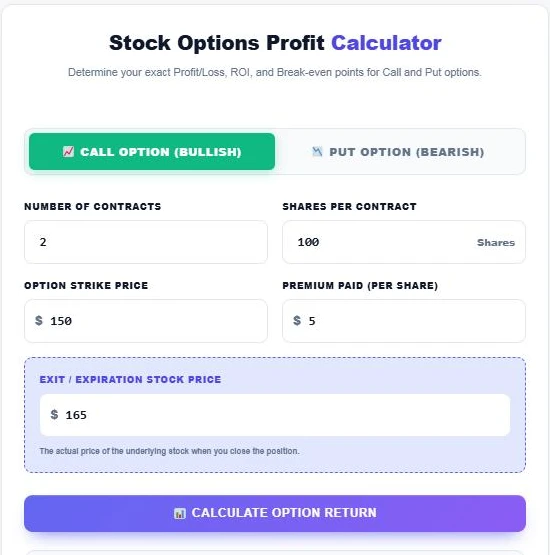
Select Call Option (Bullish). Enter 2 contracts, 100 shares per contract, a $150 strike and a $5 premium. Then type the expected stock price at exit, here $165.
Step 2: Read the Profit, ROI and Break-Even
Press Calculate Option Return. The total cost and maximum risk is $1,000, the net profit is +$2,000, ROI is +200% and the stock break-even price is $155.

Step 3: Test a Put Option
Switch to Put Option (Bearish). With 2 contracts, a $100 strike, a $4 premium and the stock falling to $90, the put costs $800 and returns a +$1,200 profit (+150% ROI). Break-even is $96.

Call Option Scenarios
2 contracts of a $150 call bought for $5 (total cost $1,000):
| Stock price at expiry | Option value | Profit / loss | ROI |
|---|---|---|---|
| $140 | $0 | −$1,000 | −100% |
| $150 | $0 | −$1,000 | −100% |
| $152 | $400 | −$600 | −60% |
| $155 | $1,000 | $0 | 0% |
| $160 | $2,000 | +$1,000 | +100% |
| $165 | $3,000 | +$2,000 | +200% |
Notice that the call can be in the money at $152 and still lose money. The stock has to clear the strike plus the premium before you profit.
Calls vs Puts
- Buy a call if you expect the stock to rise above the break-even before expiry. Profit potential is unlimited.
- Buy a put if you expect the stock to fall below the break-even. Profit is capped because the stock cannot fall below zero.
- In both cases the maximum loss is the premium you paid.
What This Calculator Does Not Include
- Time value: before expiry, an option is usually worth more than its intrinsic value. If you sell early, your real result may be better than shown.
- Commissions and fees: subtract your broker’s charges from the result.
- Taxes: short-term option gains are taxed differently in each country.
- Selling (writing) options: this tool models buying calls and puts, not short positions or spreads.
Tips for Options Traders
- Check the break-even before you buy. A cheap out-of-the-money option often needs a large move.
- Size positions so that losing the whole premium is acceptable.
- Remember that time decay works against option buyers, especially in the last 30 days.
- Watch implied volatility. Buying when it is very high makes options expensive.
This page explains how options payoffs work and is for education only, not financial advice. Options carry a high risk of losing the entire premium.
Stock Options Profit Calculator vs Buying Shares
With $1,000 you could buy about 6.7 shares of a $150 stock. If it rises to $165, you make about $100, a 10% return. The same $1,000 in two $150 calls at $5 makes $2,000 at $165, a 200% return.
The trade-off is risk. If the stock ends at $150, the shares lose nothing while the calls lose the full $1,000. Run both cases through the stock options profit calculator before deciding which suits you.
Related tools: the Stock Average Down Calculator, the Risk to Reward Calculator and the Pivot Point Calculator.
Frequently Asked Questions
How do I calculate profit on a call option?
Take the stock price minus the strike, subtract the premium, then multiply by 100 and the number of contracts. A $150 call bought for $5 with the stock at $165 makes ($15 − $5) × 100 = $1,000 per contract.
What is the break-even price of a call option?
Strike price plus the premium paid. A $150 call bought for $5 breaks even at $155.
What is the break-even price of a put option?
Strike price minus the premium paid. A $100 put bought for $4 breaks even at $96.
What is the maximum loss when buying an option?
The total premium paid, including all contracts.
Why does one contract equal 100 shares?
Standard US equity options cover 100 shares, so the quoted premium is multiplied by 100.
Is my data stored?
No. The stock options profit calculator runs in your browser and nothing is saved.