

PBN Footprint Checker – Score Link Network Risk in 2 Easy Steps
PBN Footprint Risk Scoring Calculator
Audit your Private Blog Network for toxic footprints. Select the matching criteria below to calculate your de-indexation risk.
Hosting & IP Footprints
Domain Registration
Tech Stack & Tracking Codes
Link Graph & Content
Use this free PBN footprint checker to see how many tell-tale patterns connect a group of websites, whether you are auditing a link vendor’s sites or reviewing a network you inherited.
Quick answer
A PBN footprint is a pattern that links supposedly independent websites to one owner, such as a shared IP address, the same Google Analytics or AdSense ID, matching WHOIS details or sites that all link to each other. Tick each footprint that applies and the calculator adds its weight, from +10% for identical plugins to +45% for a shared tracking ID, into a toxicity score capped at 100%. Example: same registration date (+10%) and same theme (+15%) give 25%, Moderate Risk.
Table of Contents
Private blog networks (PBNs) are groups of sites built mainly to pass links to a “money” site. Google’s spam policies treat this as link spam, and networks are found through the same patterns this calculator lists.
SEO agencies use footprint checks mostly in defence: to vet guest post vendors, to spot when a seller’s “different” sites are really one network, and to judge how risky a set of backlinks is before paying for them.
Footprint Weights Used by the Calculator
| Footprint | Weight |
|---|---|
| Shared Google Analytics / AdSense ID | +45% |
| Network cross-linking | +35% |
| Shared IP address | +30% |
| Identical custom nameservers | +25% |
| Sitewide footer or sidebar links | +25% |
| Matching public WHOIS data | +20% |
| Same C-class subnet | +15% |
| Exact same WordPress theme | +15% |
| No outbound authority links | +15% |
| Registered on the same date | +10% |
| Identical plugin stack | +10% |
Weights are added together and capped at 100%. They are VectraTools’ estimates of how strongly each pattern connects sites, not figures published by Google.
Example Scores
| Footprints ticked | Score | Result |
|---|---|---|
| Same registration date + same theme | 25% | Moderate risk |
| Above + same C-class subnet + cross-linking | 75% | High / toxic risk |
| Above + shared IP + shared Analytics ID | 100% | High / toxic risk (capped) |
How to Use the PBN Footprint Checker
Step 1: Tick the Footprints That Apply
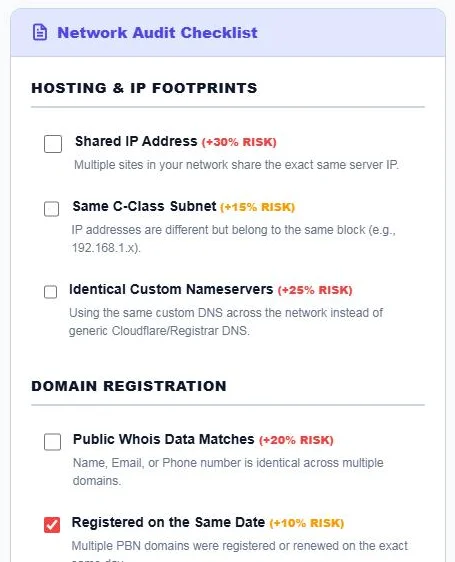
Go through the Network Audit Checklist and tick every pattern you find across the sites: Hosting & IP (shared IP, same C-class subnet, identical nameservers), Domain Registration (matching WHOIS, same registration date), Tech Stack & Tracking Codes (shared Analytics or AdSense ID, same theme, same plugins) and Link Graph & Content (cross-linking, sitewide footer links, no outbound links).
Step 2: Read the Toxicity Score
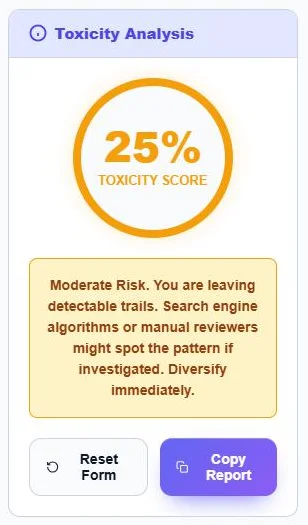
Toxicity Analysis shows the total score and a summary: no footprints, moderate risk or high/toxic risk. Click Copy Report to save the audit, or Reset Form to check another set of sites.
Using It to Vet Link Vendors
- Collect the list of sites a vendor offers.
- Check a sample with an IP or reverse IP lookup to see whether many sit on the same server.
- View page source to look for the same Analytics or AdSense ID.
- Look at outbound links: do the sites mostly link to each other or to the same few clients?
- Tick what you find and keep the copied report with your vendor notes.
A high score is a strong signal to avoid the vendor. Links from a detected network can be ignored by Google at best and lead to a manual action at worst.
The Safer Alternative
Hiding footprints only lowers the chance of detection; it does not make link schemes compliant with Google’s guidelines. Long-term, safer link building comes from real publications: guest posts on sites with their own audience, digital PR, original data, useful tools and partnerships. If you already have links from a toxic network, remove them where you can and consider a disavow file for the rest.
Frequently Asked Questions
What is a PBN footprint?
It is any shared pattern, such as an IP address, tracking code, WHOIS detail or linking habit, that reveals several websites belong to the same owner or network.
How is the toxicity score calculated?
Each ticked footprint adds a fixed weight, and the total is capped at 100%. A shared Analytics or AdSense ID carries the highest weight.
Are PBNs against Google’s rules?
Yes. Google’s spam policies treat networks built to manipulate rankings as link spam.
Can I use this to check guest post sellers?
Yes. Tick the patterns you find across a seller’s sites to judge whether they are likely to be one network.
What should I do if my backlinks come from a PBN?
Ask for removal where possible and add the remaining domains to a disavow file if they could harm your site.
Is the PBN footprint checker free?
Yes. It is free, runs in your browser and needs no sign-up.