

Mole Calculator – Convert Grams to Moles and Moles to Grams
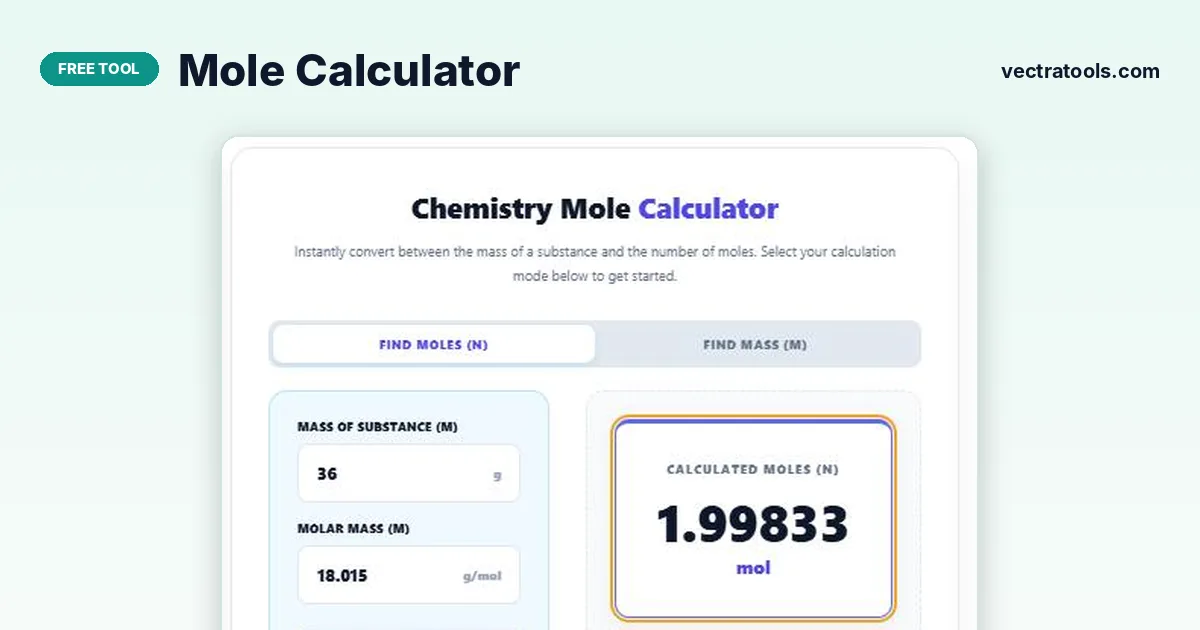
Chemistry Mole Calculator
Instantly convert between the mass of a substance and the number of moles. Select your calculation mode below to get started.
Quick answer
A mole calculator converts between the mass of a substance and the number of moles. Choose Find Moles to use n = m ÷ M, or Find Mass to use m = n × M, enter the values you know (mass or moles, plus the molar mass in g/mol) and click Calculate Result. For example, 36 g of water (M = 18.015 g/mol) is about 1.998 mol.
Our free mole calculator is made for chemistry students and teachers. It shows the formula it used, so you can copy the working into your notes and check each step.
You need the molar mass of the substance. Add up the atomic masses of all atoms in the formula using a periodic table, or use our molar mass calculator to work it out from a chemical formula.
Mole Formulas
| To find | Formula | Units |
|---|---|---|
| Moles (n) | n = m ÷ M | mol = g ÷ g/mol |
| Mass (m) | m = n × M | g = mol × g/mol |
| Molar mass (M) | M = m ÷ n | g/mol = g ÷ mol |
| Number of particles (N) | N = n × 6.022 × 10²³ | particles |
Worked Examples
- Water: 36 g ÷ 18.015 g/mol ≈ 1.998 mol.
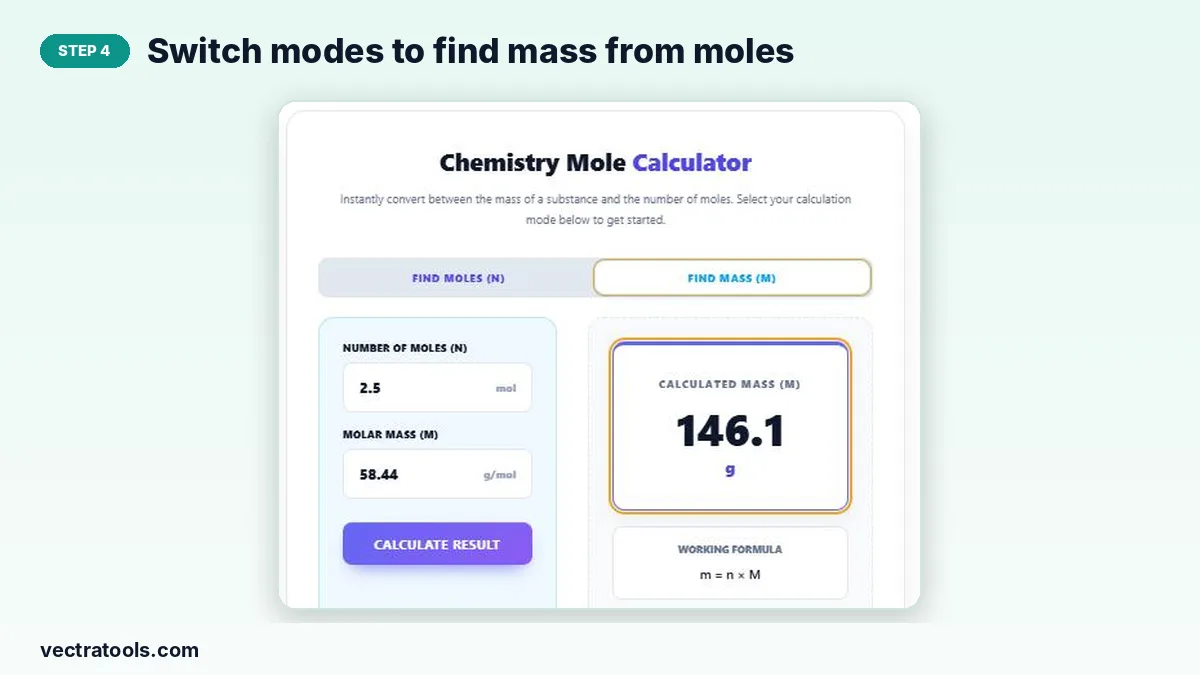
- Sodium chloride: 2.5 mol × 58.44 g/mol = 146.1 g.
- Carbon dioxide: 88 g ÷ 44.01 g/mol ≈ 2.0 mol.
How to Use the Mole Calculator
Use the mole calculator in four steps.
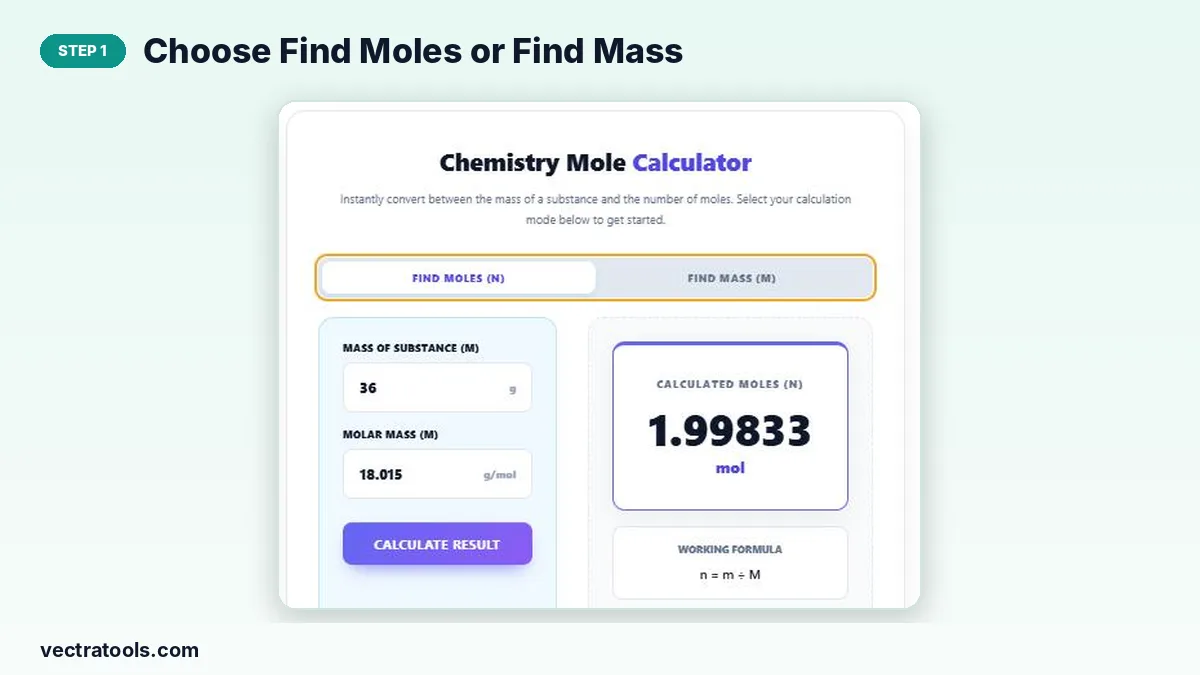
Step 1: Choose Find Moles or Find Mass
Select Find Moles (n) to convert grams to moles, or Find Mass (m) to convert moles to grams.
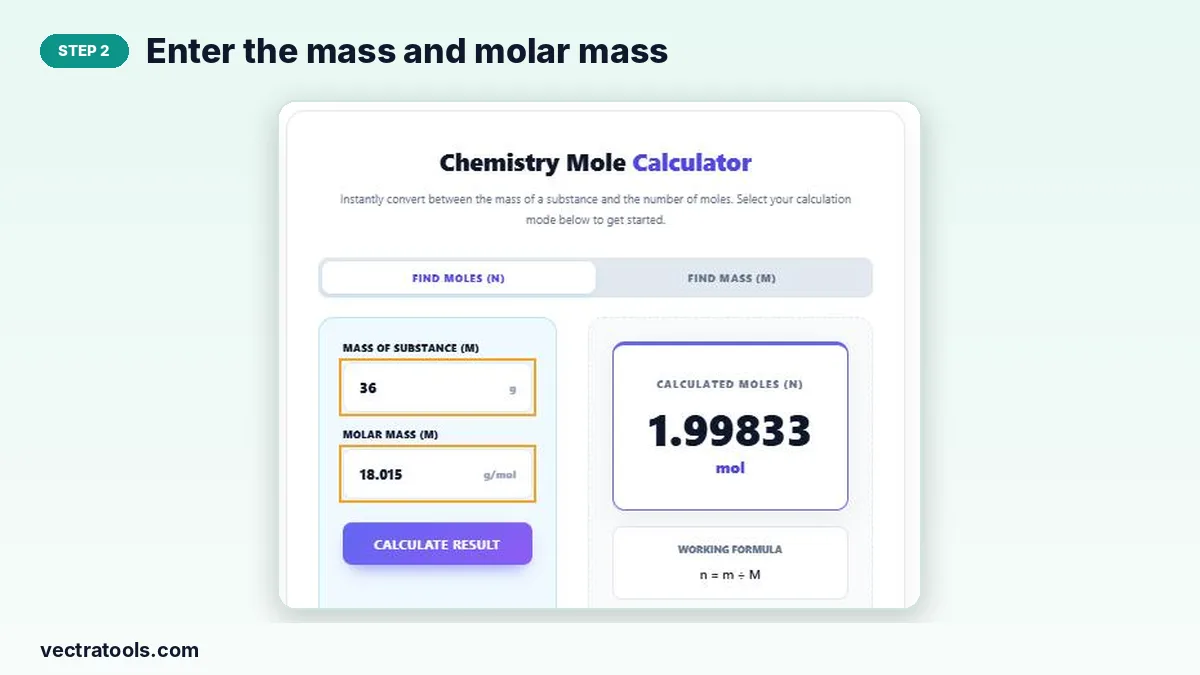
Step 2: Enter the Mass and Molar Mass
Type the mass in grams and the molar mass in g/mol, for example 36 g and 18.015 g/mol for water.
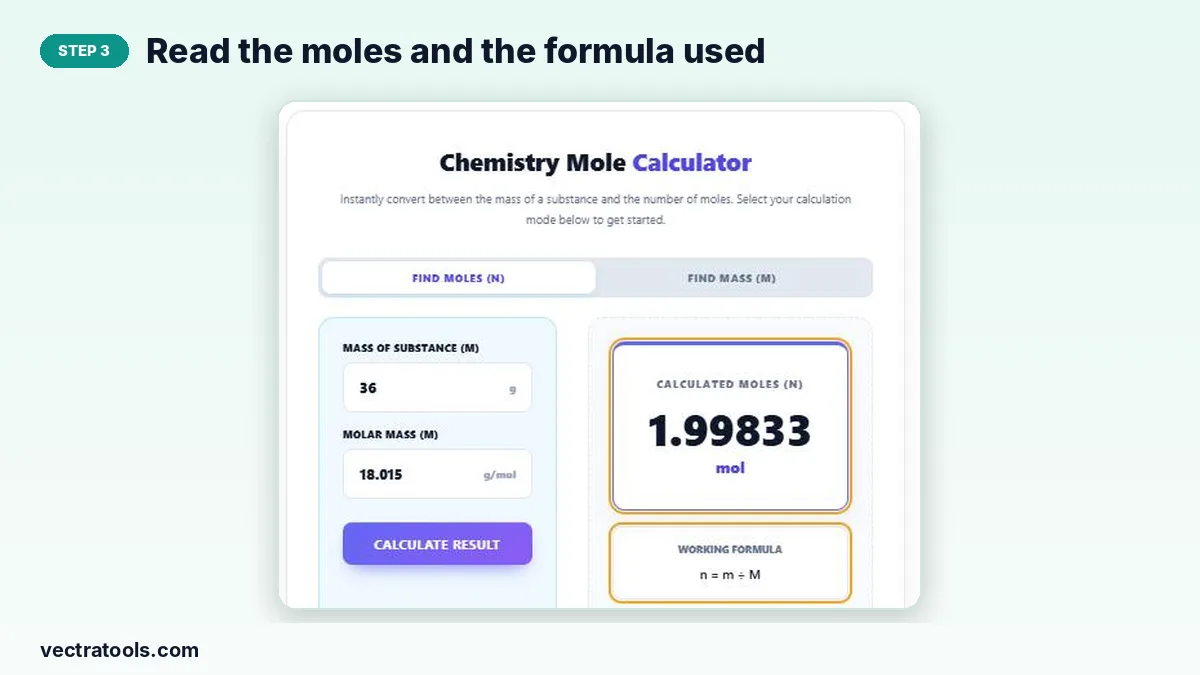
Step 3: Read the Moles and the Formula Used
Click Calculate Result. The answer appears in mol, with the working formula n = m ÷ M shown underneath.
Step 4: Switch Modes to Find Mass From Moles
Choose Find Mass, enter the number of moles and the molar mass, and calculate to get the mass in grams, such as 146.1 g of NaCl.
What Is a Mole?
A mole is the chemist’s counting unit. One mole of any substance contains 6.022 × 10²³ particles, a number called Avogadro’s constant. Because one mole of a substance has a mass in grams equal to its relative formula mass, the mole links the mass you can weigh on a balance to the number of particles taking part in a reaction.
Tips for Mole Calculations
- Always check units: mass in grams, molar mass in g/mol.
- Convert kilograms to grams first (1 kg = 1,000 g).
- Keep extra significant figures until the final answer.
- Use the balanced equation to convert moles of one substance to another.
Why Use a Mole Calculator?
Mole conversions appear in almost every chemistry topic, from stoichiometry to solutions and gas laws. A mole calculator gives fast, accurate answers and shows the formula, which makes it ideal for checking homework and lab calculations.
Frequently Asked Questions
Is this mole calculator free?
Yes. It is free with no sign-up.
How do I convert grams to moles?
Divide the mass in grams by the molar mass in g/mol: n = m ÷ M.
How do I convert moles to grams?
Multiply the number of moles by the molar mass: m = n × M.
What is the molar mass of water?
About 18.015 g/mol (2 × 1.008 + 15.999).
What is Avogadro’s number?
6.022 × 10²³ particles per mole.
Where do I find molar mass?
Add the atomic masses from the periodic table, or use our molar mass calculator.