

Interactive Periodic Table – All 118 Elements With Search
Interactive Periodic Table
Explore elements, search by name or symbol, and view detailed atomic properties instantly.
Quick answer
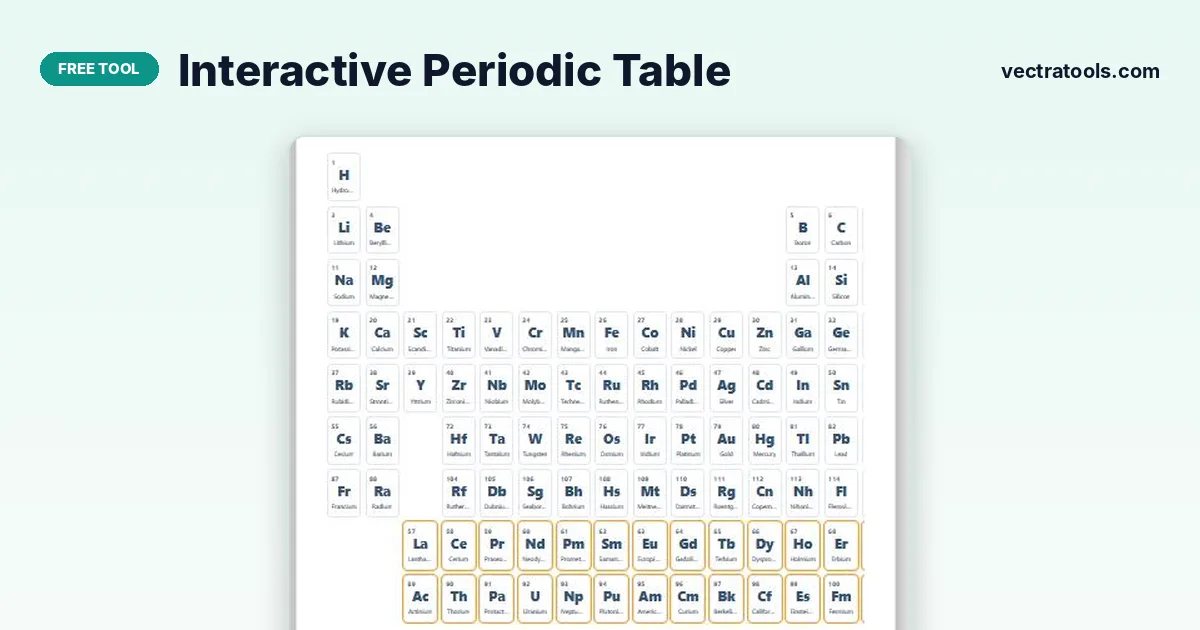
An interactive periodic table lets you explore the chemical elements by clicking and searching instead of reading a static chart. This one shows all 118 elements in their correct groups and periods. Type a name or symbol, such as Iron or Fe, to highlight it, then click any element to see its atomic number, atomic mass and category.
Our free interactive periodic table is built for students, teachers and anyone revising chemistry. It loads instantly, works on phones and laptops, and includes the lanthanide and actinide series in their own rows below the main table.
Atomic masses use standard atomic weights rounded for everyday use. For radioactive elements without a stable isotope, the mass shown is the mass number of the longest-lived or best-known isotope.
How the Periodic Table Is Organised
- Periods (rows): elements in the same row have the same number of electron shells.
- Groups (columns): elements in the same column have similar chemical properties, such as the reactive alkali metals in group 1 or the unreactive noble gases in group 18.
- Blocks: s-block (groups 1 and 2), p-block (groups 13 to 18), d-block (transition metals) and f-block (lanthanides and actinides).
Element Categories
| Category | Examples | Key property |
|---|---|---|
| Alkali metals | Li, Na, K | Very reactive, soft metals |
| Alkaline earth metals | Be, Mg, Ca | Reactive, form 2+ ions |
| Transition metals | Fe, Cu, Au | Hard, conductive, colourful compounds |
| Metalloids | B, Si, Ge | Properties of metals and non-metals |
| Non-metals | H, C, N, O | Poor conductors, many are gases |
| Halogens | F, Cl, Br, I | Very reactive non-metals |
| Noble gases | He, Ne, Ar | Very unreactive gases |
| Lanthanides and actinides | La, U, Pu | f-block metals, many radioactive actinides |
How to Use the Interactive Periodic Table
Use the interactive periodic table in four steps.
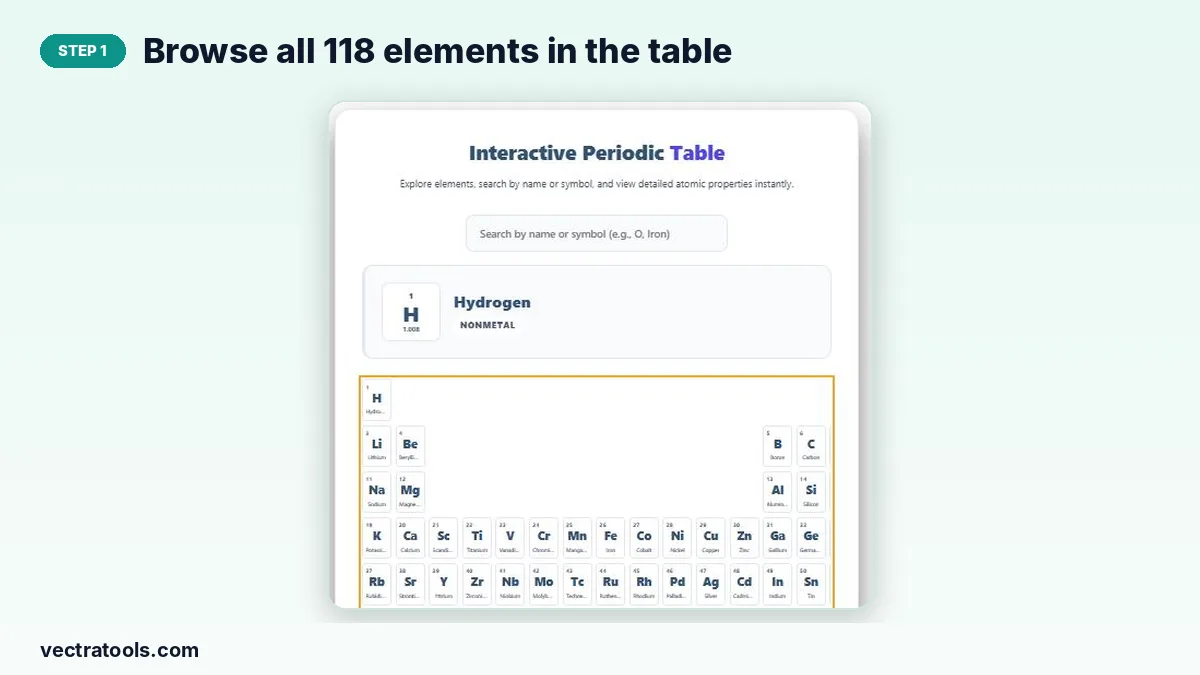
Step 1: Browse All 118 Elements in the Table
Scroll through the table to see every element in its group and period. On small screens, swipe the table sideways.
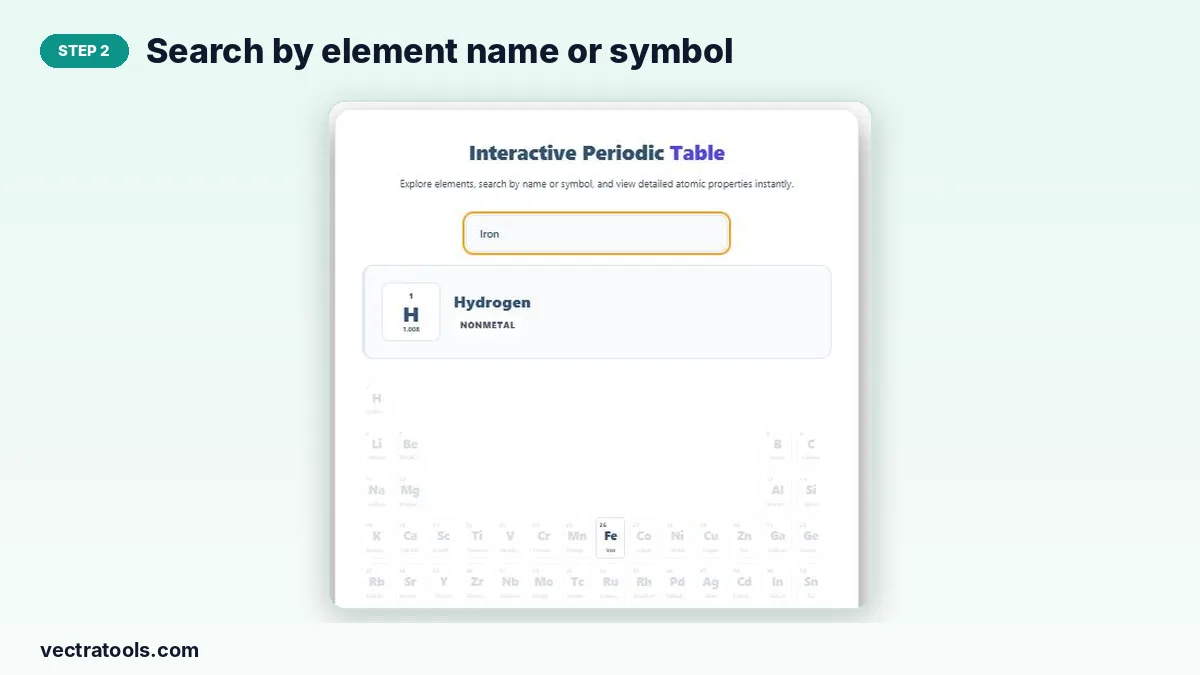
Step 2: Search by Element Name or Symbol
Type a name or symbol in the search box, for example Iron or Fe. Matching elements stay bright while others fade.
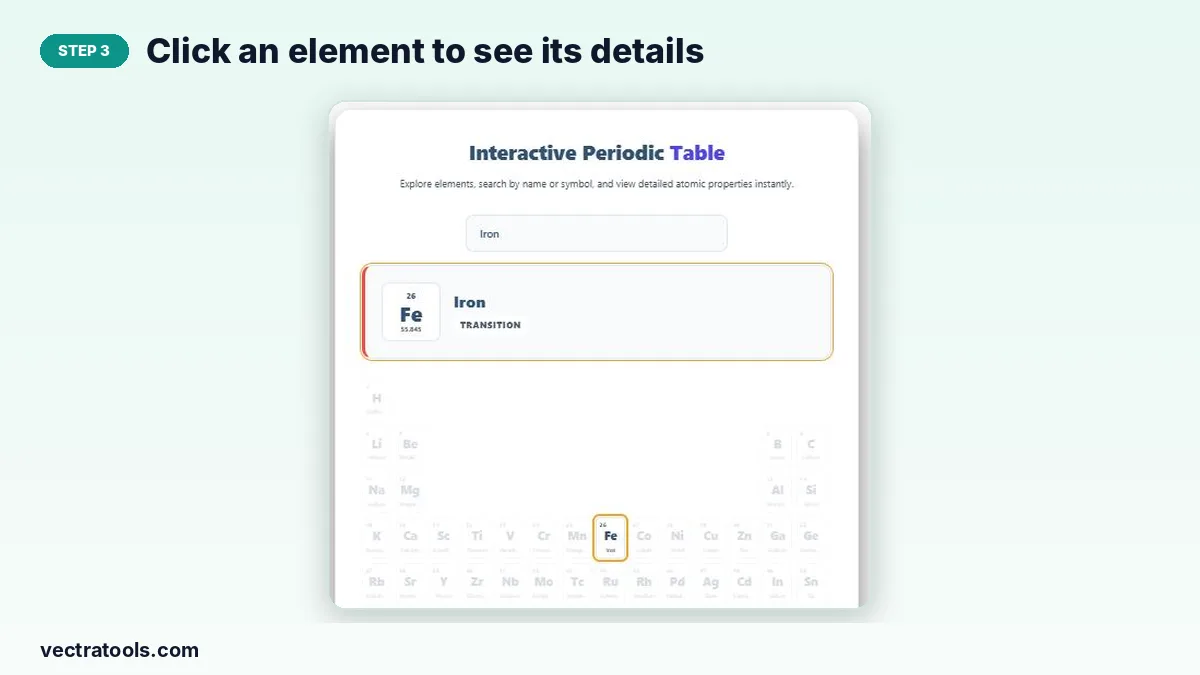
Step 3: Click an Element to See Its Details
Click any tile. The info panel shows the element’s symbol, atomic number, atomic mass and category, such as Iron, 26, 55.845, transition metal.
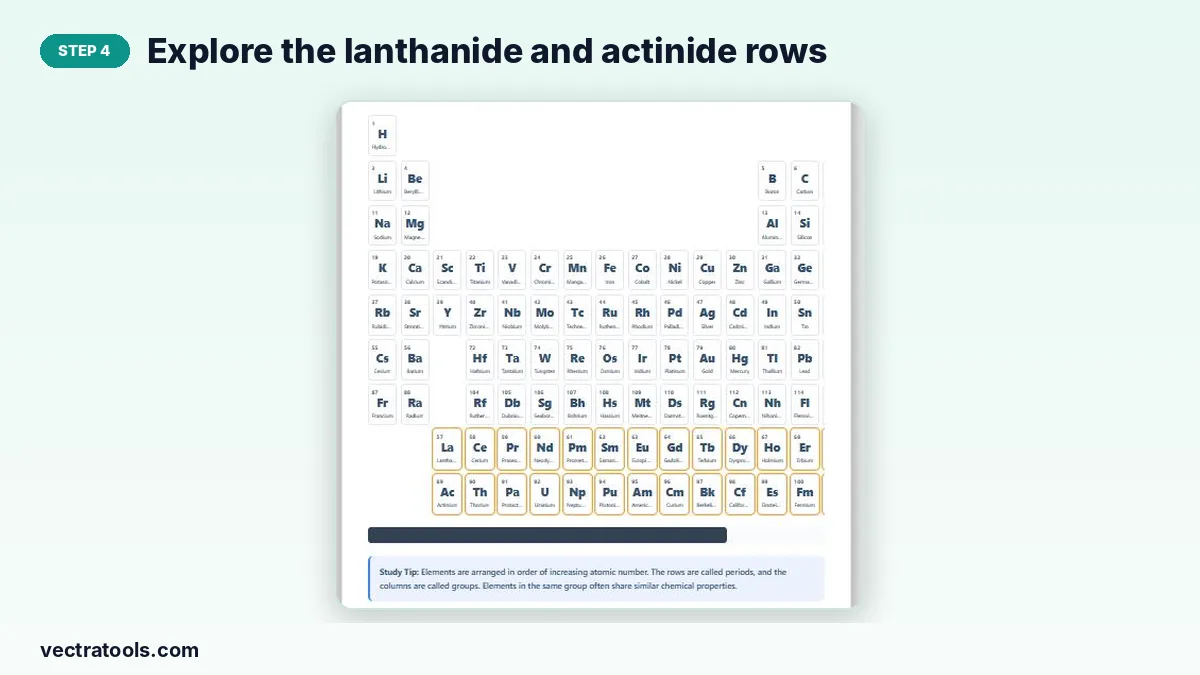
Step 4: Explore the Lanthanide and Actinide Rows
The two rows under the main table hold the lanthanides (57 to 71) and actinides (89 to 103). Click any of them to see their details too.
Tips for Learning the Periodic Table
- Learn the first 20 elements in order; they appear most often in school chemistry.
- Use the group number to predict charges: group 1 forms 1+ ions, group 17 forms 1− ions.
- Make flashcards of symbols that do not match English names, such as Na (sodium), K (potassium), Fe (iron) and Au (gold).
- Use the search in this interactive periodic table to quiz yourself quickly.
Why Use an Interactive Periodic Table?
A printed chart can be crowded and hard to read. An interactive periodic table lets you search, zoom in on one element and see clear details, which makes revision faster and helps you remember patterns across groups and periods.
Frequently Asked Questions
Is this interactive periodic table free?
Yes. It is free and works on any device.
How many elements are in the periodic table?
There are 118 confirmed elements, from hydrogen (1) to oganesson (118).
What is atomic mass?
The average mass of an element’s atoms, measured in atomic mass units (u), taking natural isotopes into account.
Why are lanthanides and actinides shown separately?
Placing them in their own rows keeps the table a practical width. They belong between groups 2 and 4 in periods 6 and 7.
How do I find an element quickly?
Type its name or symbol in the search box and it will be highlighted.
Which element is the most common in the universe?
Hydrogen, element number 1.