

Matrix Inverse Calculator – 3×3 and 4×4 Inverse & Determinant in 2 Easy Steps
Matrix Inverse Calculator
Free matrix inverse calculator – enter your matrix values below to calculate its inverse (M⁻¹) and determinant.
Matrix Settings
Input Matrix (M)
Use this free matrix inverse calculator to find the inverse and determinant of any 3×3 or 4×4 matrix in seconds.
Quick answer
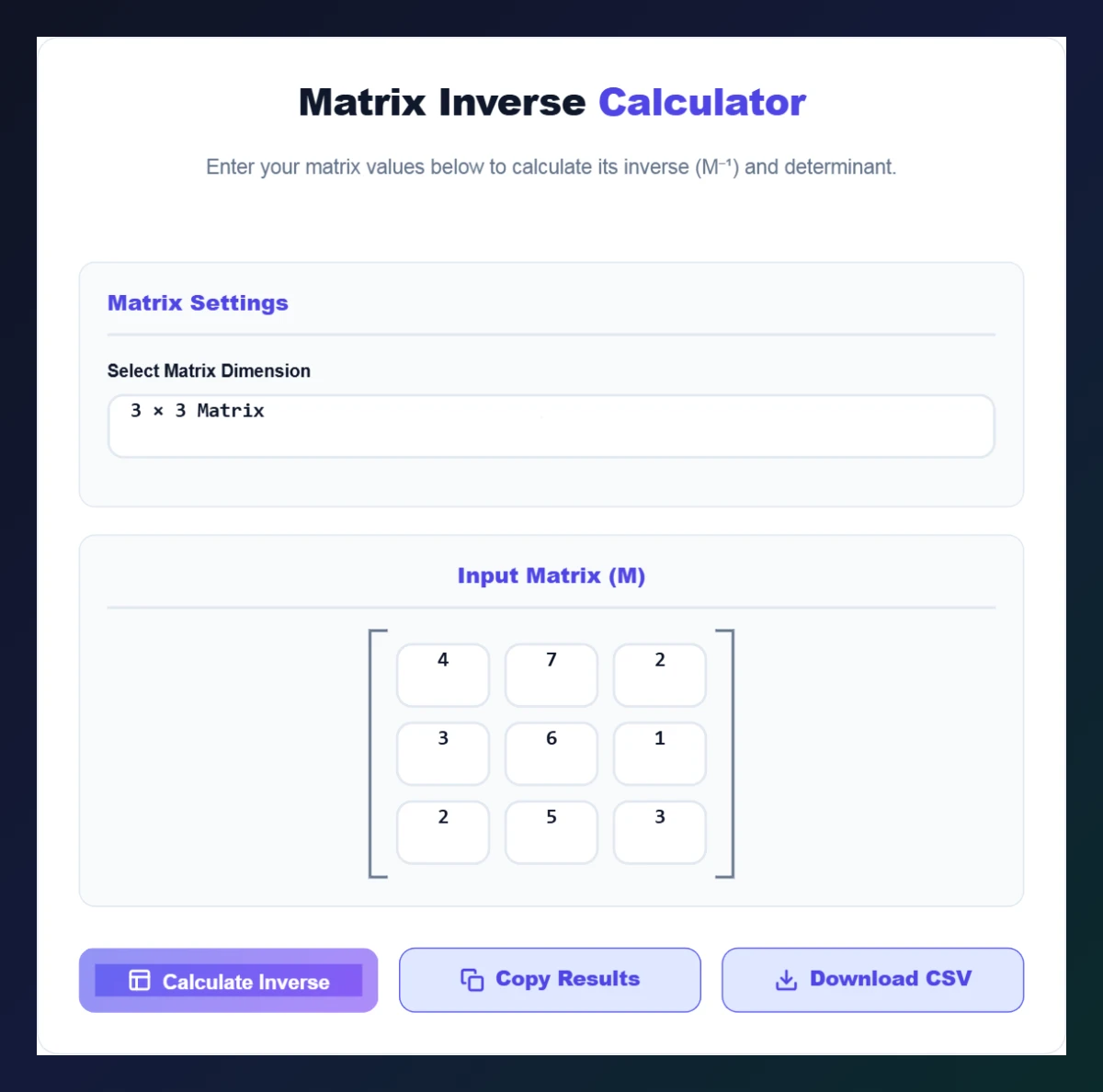
A matrix M has an inverse M⁻¹ only if its determinant is not zero; then M × M⁻¹ = I (the identity matrix). Example: M = [[4,7,2],[3,6,1],[2,5,3]] has det M = 9, and the first row of its inverse is (1.4444, −1.2222, −0.5556), i.e. (13/9, −11/9, −5/9). If the determinant is 0 – for example [[1,2,3],[4,5,6],[7,8,9]] – the matrix is singular and has no inverse. This matrix inverse calculator checks that for you.
Table of Contents
Inverting a 3×3 matrix by hand means nine cofactors, a determinant and a transpose – and a 4×4 is far worse. One sign error and the whole answer is wrong.
Our free matrix inverse calculator does the work in your browser. Choose 3×3 or 4×4, type your values and get the inverse matrix and determinant instantly. Singular matrices are detected with a clear message, and you can copy the result or download it as CSV.
How to Find the Inverse of a Matrix
- Calculate the determinant. If it is 0, stop – there is no inverse.
- Find the matrix of cofactors (minors with alternating signs).
- Transpose it to get the adjugate matrix.
- Divide every entry by the determinant: M⁻¹ = adj(M) ÷ det(M).
Worked example (3×3)
For M = [[4,7,2],[3,6,1],[2,5,3]]: det M = 4(6·3 − 1·5) − 7(3·3 − 1·2) + 2(3·5 − 6·2) = 4·13 − 7·7 + 2·3 = 52 − 49 + 6 = 9. The first cofactor is 6·3 − 1·5 = 13, so the top-left entry of M⁻¹ is 13 ÷ 9 ≈ 1.4444 – exactly what the matrix inverse calculator shows.
Key Properties of the Inverse
| Property | Rule |
|---|---|
| Identity | M × M⁻¹ = M⁻¹ × M = I |
| Inverse of inverse | (M⁻¹)⁻¹ = M |
| Product | (AB)⁻¹ = B⁻¹A⁻¹ |
| Determinant | det(M⁻¹) = 1 ÷ det(M) |
| Transpose | (Mᵀ)⁻¹ = (M⁻¹)ᵀ |
How to Use the Matrix Inverse Calculator
Get the inverse in two steps.
Step 1: Choose the Size and Enter Your Matrix
Under Matrix Settings, choose 3 × 3 or 4 × 4. Type the values of Input Matrix (M) row by row and click Calculate Inverse.
Step 2: Read the Inverse and Determinant
The result shows the Inverse Matrix (M⁻¹) to four decimals and the Determinant. If the determinant is 0 you will see “Singular Matrix – inverse does not exist”. Use Copy Results or Download CSV to save the answer.

Where Matrix Inverses Are Used
- Solving linear systems: x = A⁻¹b for equations like 4x + 7y + 2z = …
- Computer graphics: undoing transformations and converting between coordinate spaces.
- Statistics: least-squares regression uses (XᵀX)⁻¹.
- Engineering and economics: input–output models and circuit analysis.
Tips
- Decimals like 1.4444 often hide simple fractions – here 13/9.
- Check your answer by multiplying M × M⁻¹; you should get the identity matrix (within rounding).
- Very small determinants (close to 0) make the inverse unstable and very large.
Multiply or transpose matrices with the Matrix Transpose & Multiplication Calculator, or find eigenvalues with the Eigenvalue Eigenvector Calculator.
Frequently Asked Questions
When does a matrix have an inverse?
When its determinant is not zero. Such matrices are called invertible or non-singular.
What does “singular matrix” mean?
A singular matrix has determinant 0 and no inverse. [[1,2,3],[4,5,6],[7,8,9]] is an example.
How do I check if the inverse is correct?
Multiply the original matrix by the inverse. The result should be the identity matrix.
Can it invert 2×2 matrices?
This matrix inverse calculator supports 3×3 and 4×4. For 2×2, swap the diagonal, negate the other two entries and divide by the determinant.
Why are results shown as decimals?
Inverses often contain fractions; the calculator rounds them to four decimals.
Is the matrix inverse calculator free?
Yes. It is free, runs in your browser and needs no sign-up.