

Eigenvalue Eigenvector Calculator – 2x2 Matrix With Steps
Eigenvalue Calculator
Free eigenvalue eigenvector calculator – enter a 2x2 matrix to find its characteristic equation, eigenvalues (λ), and normalized eigenvectors (v).
Input Matrix (A)
v₂ = [0, 0]
Use this free eigenvalue eigenvector calculator to find the characteristic equation, eigenvalues and normalized eigenvectors of any 2x2 matrix.
Quick answer
An eigenvalue eigenvector calculator solves Av = λv. For a 2x2 matrix, the eigenvalues are the roots of the characteristic equation λ² − (trace)λ + det = 0, and each eigenvector solves (A − λI)v = 0. Example: A = [[4, 1], [2, 3]] gives λ² − 7λ + 10 = 0, so λ = 5 and λ = 2, with normalized eigenvectors (0.7071, 0.7071) and (0.4472, −0.8944).
Table of Contents
Eigenvalues and eigenvectors show up everywhere in linear algebra – from stability analysis and vibration problems to Markov chains and principal component analysis. Working them out by hand is easy to get wrong, especially the signs in the eigenvectors.
Our free eigenvalue eigenvector calculator handles any real 2x2 matrix. Enter four numbers and it returns the characteristic equation, both eigenvalues (real or complex) and unit-length eigenvectors, so you can check homework or exam practice in seconds.
What Are Eigenvalues and Eigenvectors?
For a square matrix A, an eigenvector v is a non-zero vector whose direction does not change when A is applied – it is only stretched or shrunk. The stretch factor is the eigenvalue λ:
A v = λ v
If λ = 3, the matrix triples the length of v. If λ is negative, it flips v. Complex eigenvalues mean the matrix includes a rotation, so no real direction stays fixed.
How to Find Eigenvalues of a 2x2 Matrix
For A = [[a, b], [c, d]], set det(A − λI) = 0. This gives the characteristic equation:
λ² − (a + d)λ + (ad − bc) = 0
Here a + d is the trace and ad − bc is the determinant. Solve with the quadratic formula. The discriminant (trace² − 4·det) tells you the type of answer:
| Discriminant | Eigenvalues |
|---|---|
| Positive | Two different real eigenvalues |
| Zero | One repeated real eigenvalue |
| Negative | Two complex conjugate eigenvalues (a ± bi) |
Worked example
- A = [[4, 1], [2, 3]]. Trace = 4 + 3 = 7, determinant = 4·3 − 1·2 = 10.
- Characteristic equation: λ² − 7λ + 10 = 0 → (λ − 5)(λ − 2) = 0, so λ = 5 and λ = 2.
- For λ = 5: (A − 5I) = [[−1, 1], [2, −2]] → v = (1, 1). Normalized: (0.7071, 0.7071).
- For λ = 2: (A − 2I) = [[2, 1], [2, 1]] → v = (1, −2). Normalized: (0.4472, −0.8944).
Quick check: the eigenvalues add up to the trace (5 + 2 = 7) and multiply to the determinant (5 × 2 = 10). Use the eigenvalue eigenvector calculator above to confirm your hand-worked answers.
How to Use the Eigenvalue Eigenvector Calculator
Solve any real 2x2 eigen system in three steps.
Step 1: Enter Your 2x2 Matrix
Type the four entries of matrix A into the Input Matrix (A) grid: top-left, top-right, bottom-left, bottom-right. Decimals and negative numbers are allowed. Example: 4, 1, 2, 3.
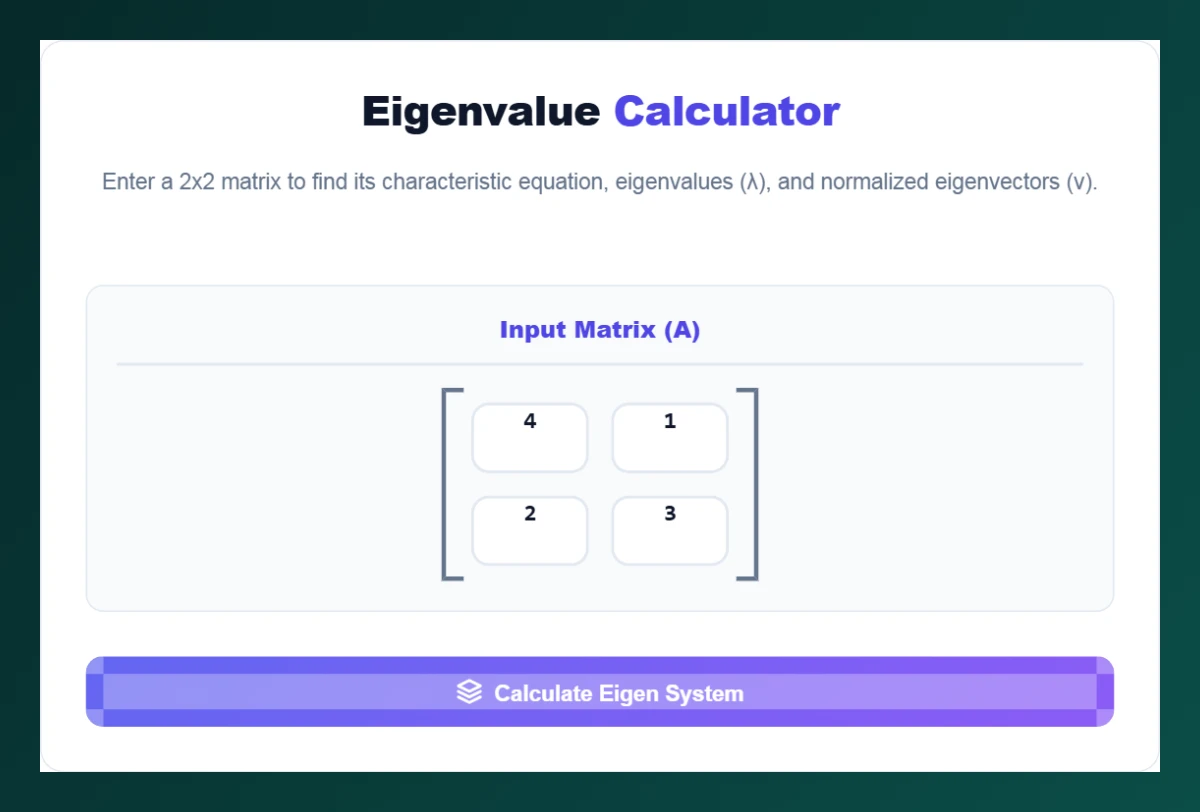
Step 2: Click Calculate Eigen System
Press Calculate Eigen System. The calculator shows the characteristic equation (λ² − 7λ + 10 = 0), the eigenvalues λ = 5 and λ = 2, and the normalized eigenvectors (0.7071, 0.7071) and (0.4472, −0.8944).
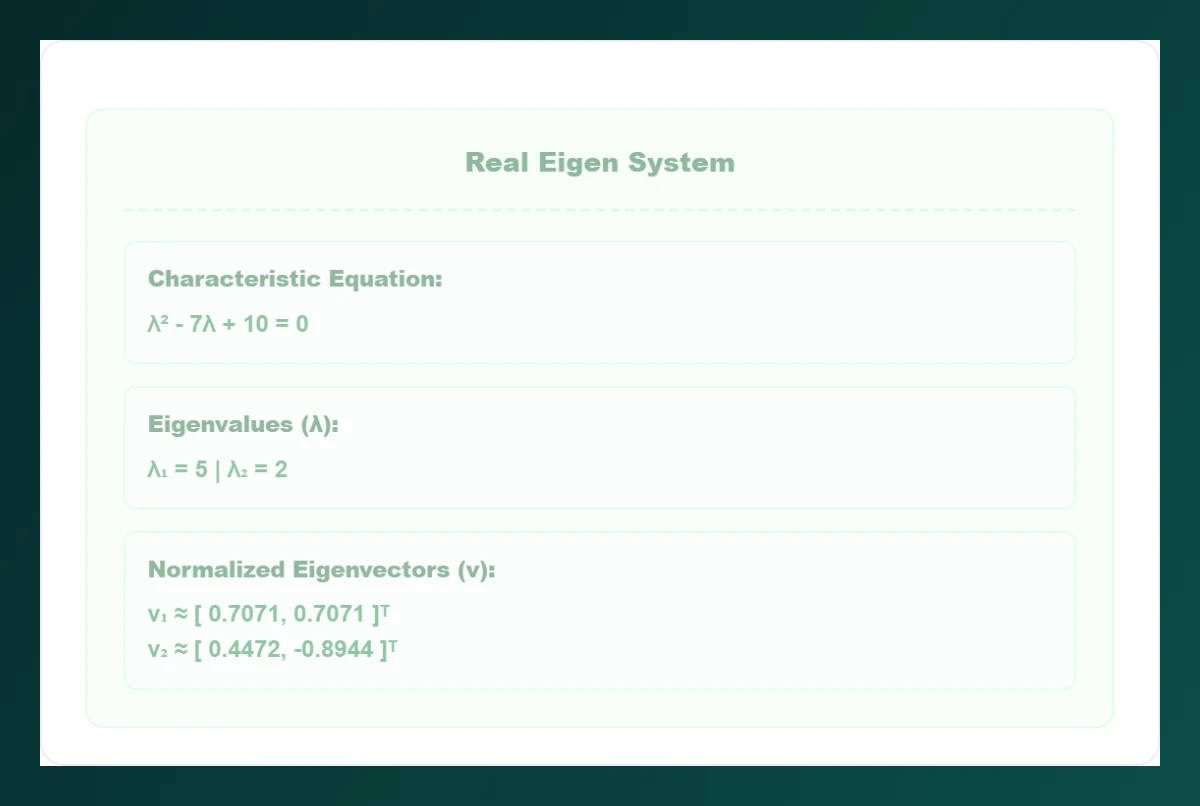
Step 3: Read Complex Results When They Appear
If the discriminant is negative, the tool switches to a Complex Eigen System. For the rotation matrix [[0, −1], [1, 0]] it returns λ² + 1 = 0 and the eigenvalues 0 + 1i and 0 − 1i.
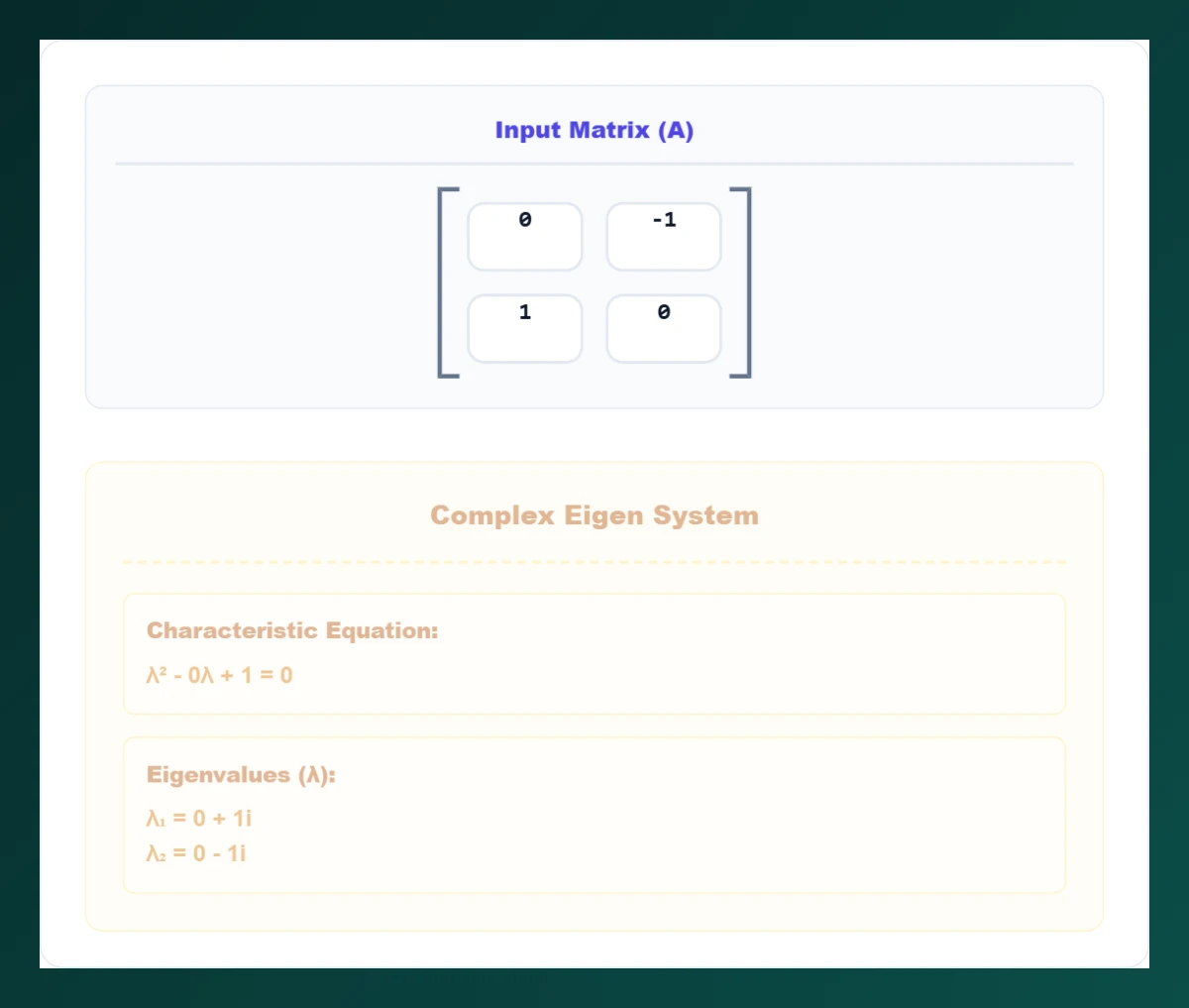
Useful Eigenvalue Properties
- Sum = trace: λ₁ + λ₂ = a + d.
- Product = determinant: λ₁ × λ₂ = ad − bc. A zero eigenvalue means the matrix is singular (not invertible).
- Triangular matrices: the eigenvalues are simply the diagonal entries.
- Symmetric matrices: eigenvalues are always real and eigenvectors are perpendicular.
- Scaling: any non-zero multiple of an eigenvector is still an eigenvector – that is why the calculator normalizes them to length 1.
Where Eigenvalues and Eigenvectors Are Used
- Data science: principal component analysis (PCA) uses eigenvectors of a covariance matrix to find the main directions of variation.
- Engineering: natural vibration frequencies of structures come from eigenvalue problems.
- Differential equations: the sign of the eigenvalues decides whether a system is stable or unstable.
- Markov chains and PageRank: the steady state is an eigenvector with eigenvalue 1.
- Physics: quantum states and measured energies are eigenvectors and eigenvalues of operators.
Common Mistakes to Avoid
- Using A − λ instead of A − λI – subtract λ only on the diagonal.
- Forgetting that the bottom-left entry enters the determinant as −bc.
- Expecting a unique eigenvector – any scalar multiple is also correct, so compare directions, not exact numbers.
Solved your matrix with the eigenvalue eigenvector calculator and need more matrix tools? Use the Matrix Inverse Calculator, the Matrix Transpose & Multiplication Tool or the Vector Dot & Cross Product Calculator.
Frequently Asked Questions
How do you find eigenvalues of a 2x2 matrix?
Solve det(A − λI) = 0, which gives λ² − (trace)λ + det = 0, then use the quadratic formula.
How do you find the eigenvectors?
Substitute each eigenvalue into (A − λI)v = 0 and solve for a non-zero vector v. The calculator then normalizes it to length 1.
Can eigenvalues be complex?
Yes. If trace² − 4·det is negative, the eigenvalues are a complex conjugate pair such as 0 ± 1i.
What does a zero eigenvalue mean?
The matrix is singular: its determinant is zero and it has no inverse.
Does this calculator support 3x3 matrices?
This eigenvalue eigenvector calculator is built for 2x2 matrices, the most common case in coursework.
Is the eigenvalue calculator free?
Yes. It is free, needs no sign-up and runs entirely in your browser.