

Black-Scholes Options Pricing Calculator – Free Call & Put Prices in 3 Steps
Black-Scholes Simulator
Calculate the theoretical fair value of European Call and Put options instantly.
Use this free Black-Scholes options pricing calculator to find the fair value of a European call and put option in seconds. Enter five numbers, press one button, and you get both option prices plus the d1 and d2 values behind them.
Quick answer
The Black-Scholes model prices a European option from five inputs: stock price (S), strike price (K), volatility (σ), risk-free rate (r) and time to expiry (T). The call price is C = S·N(d1) − K·e−rT·N(d2) and the put price is P = K·e−rT·N(−d2) − S·N(−d1). For S = 100, K = 100, σ = 20%, r = 5% and one year to expiry, the call is worth about $10.45 and the put about $5.57.
Table of Contents
Option traders, finance students and anyone checking a broker quote run into the same problem: the formula is long, and one wrong step with the natural log or the normal distribution throws the answer off. This tool does the maths for you and shows the working values so you can check them against your own notes.
Everything runs in your browser. Nothing you type is stored or sent anywhere, and there is no sign-up.
What Is the Black-Scholes Model?
The Black-Scholes model, published by Fischer Black and Myron Scholes in 1973 and extended by Robert Merton, gives a theoretical price for an option that can only be exercised on its expiry date. It assumes the stock price moves randomly with constant volatility, interest rates stay fixed, there are no transaction costs, and the stock pays no dividend during the option’s life.
Those assumptions are never perfectly true, yet the model is still the starting point for option pricing. Traders use it to compare a market price with a fair value and to back out implied volatility from quoted premiums.
Black-Scholes Formula Explained
The calculator uses the standard closed-form solution:
- d1 = [ln(S/K) + (r + σ²/2)·T] ÷ (σ·√T)
- d2 = d1 − σ·√T
- Call = S·N(d1) − K·e−rT·N(d2)
- Put = K·e−rT·N(−d2) − S·N(−d1)
Here N( ) is the cumulative standard normal distribution, the same curve you can explore with our Normal Distribution Calculator. Time is entered in days and converted to years with T = days ÷ 365, and volatility and the interest rate are entered as percentages.
A quick way to read the output: N(d2) is the risk-neutral probability that a call finishes in the money, and N(d1) is the call’s delta, or how much the call price moves for a $1 change in the stock.
How Each Input Changes the Option Price
| If this goes up | Call price | Put price |
|---|---|---|
| Stock price (S) | Rises | Falls |
| Strike price (K) | Falls | Rises |
| Volatility (σ) | Rises | Rises |
| Risk-free rate (r) | Rises | Falls |
| Days to expiry (T) | Rises | Usually rises |
How to Use the Black-Scholes Options Pricing Calculator
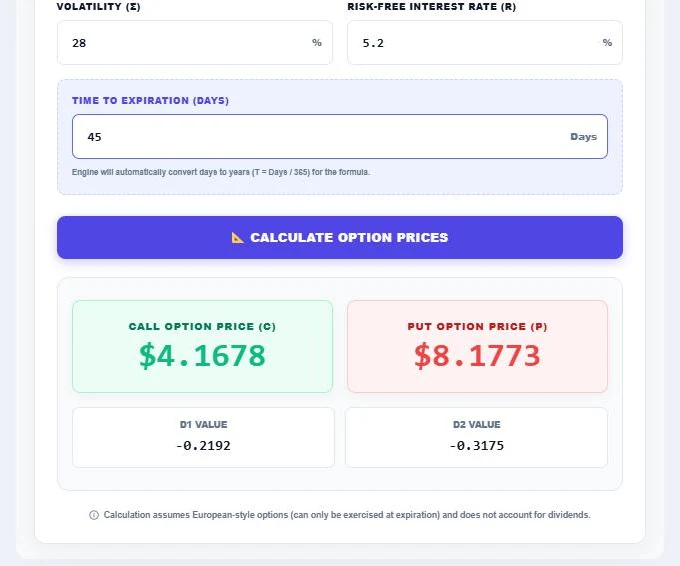
The whole process takes three steps. The screenshots below use a stock trading at $150 with a $155 strike and 45 days left.
Step 1: Enter the Five Inputs
Type the current stock price and the strike price in dollars. Add annual volatility as a percentage (28 means 28%), the risk-free rate as a percentage (a Treasury bill yield is a common choice), and the number of calendar days until expiry.

Step 2: Calculate Call and Put Prices
Press Calculate Option Prices. The tool shows the call price, the put price, and the d1 and d2 values. In this example the call is worth $4.17 and the put $8.18. The put is worth more because the stock sits below the strike, so the put is already in the money.
Step 3: Test Different Scenarios
Change one input at a time to see how sensitive the price is. Raising volatility from 28% to 45% lifts the call to $7.70 and the put to $11.71. Both gain because a wider range of outcomes makes the option’s upside bigger while the loss is still capped at the premium.

Check Your Result With Put-Call Parity
For European options on a non-dividend stock, call − put = S − K·e−rT. In the 45-day example, 7.70 − 11.71 = −4.01, and 150 − 155·e−0.052×45/365 also equals −4.01. If your own spreadsheet does not pass this test, there is a mistake in it.
Worked Example: Pricing an At-the-Money Option by Hand
Take a stock at $100, a $100 strike, 20% volatility, a 5% risk-free rate and 365 days to expiry, so T = 1.
- σ·√T = 0.20 × 1 = 0.20
- d1 = [ln(100/100) + (0.05 + 0.02) × 1] ÷ 0.20 = 0.07 ÷ 0.20 = 0.35
- d2 = 0.35 − 0.20 = 0.15
- N(0.35) ≈ 0.6368 and N(0.15) ≈ 0.5596
- K·e−rT = 100 × e−0.05 ≈ 95.12
- Call = 100 × 0.6368 − 95.12 × 0.5596 ≈ $10.45
- Put = 95.12 × (1 − 0.5596) − 100 × (1 − 0.6368) ≈ $5.57
Enter the same numbers in the Black-Scholes options pricing calculator above and it returns a call of $10.4506, a put of $5.5735, d1 of 0.3500 and d2 of 0.1500. Matching a hand calculation like this is the fastest way to trust a pricing tool before you rely on it.
Black-Scholes Greeks in Plain Words
The Greeks measure how the option price reacts when one input changes. They all come from the same Black-Scholes formula, and d1 is the key ingredient in most of them.
- Delta: change in option price for a $1 move in the stock. Call delta is N(d1); put delta is N(d1) − 1.
- Gamma: how fast delta itself changes. It is highest for at-the-money options close to expiry.
- Vega: change in price for a 1 percentage point change in volatility. Calls and puts share the same vega.
- Theta: value lost each day as expiry gets closer, all else equal.
- Rho: change in price for a 1 percentage point change in the interest rate.
You can see vega at work in Step 3 above: a 17-point jump in volatility added about $3.53 to both the call and the put.
Who Uses a Black-Scholes Calculator?
- Retail option traders checking whether a quoted premium looks cheap or expensive.
- Finance and MBA students verifying homework answers for derivatives courses and CFA or FRM practice questions.
- Employees with stock options getting a rough idea of what their grant could be worth, keeping in mind that employee options have extra rules the model does not cover.
- Analysts and teachers showing how volatility and time drive option value without building a spreadsheet.
Limits of the Black-Scholes Model
- It prices European options only. Most US stock options are American style and can be exercised early, which matters most for puts and dividend payers.
- It ignores dividends. A dividend lowers the call value and raises the put value.
- It assumes one constant volatility, while real markets show a volatility smile across strikes.
- It assumes smooth price moves, so sudden gaps after earnings or news are underpriced.
Treat the result as a fair-value estimate, not a trading signal. To see what a trade could earn at expiry, try the Stock Options Profit Calculator, and for sizing a position against your stop loss use the Risk to Reward Calculator.
Frequently Asked Questions
What does a Black-Scholes calculator do?
It works out the theoretical price of a European call and put option from the stock price, strike price, volatility, risk-free rate and time to expiry, using the Black-Scholes formula.
What volatility should I enter?
Use annualised volatility as a percentage. Historical volatility comes from past price moves; implied volatility comes from current option prices. Many traders enter implied volatility from their broker to match the market.
Which interest rate is the risk-free rate?
Usually the yield on a government bill with a maturity close to the option’s expiry, such as a 3-month US Treasury bill.
Can I use this for American options?
It gives a close estimate for American calls on stocks that pay no dividend, because early exercise is rarely worth it. For American puts or dividend stocks the true value can be higher.
What are d1 and d2?
They are standardised distances between the stock price and strike, adjusted for rate, volatility and time. N(d1) is the call delta and N(d2) is the risk-neutral chance the call ends in the money.
Why are my results different from my broker’s price?
Brokers show market prices, which include dividends, early-exercise value, supply and demand, and a volatility that changes by strike. Black-Scholes gives a model value, so small gaps are normal.