

Temperature Converter – Celsius to Fahrenheit and Fahrenheit to Celsius
Temperature Converter
Convert Celsius and Fahrenheit instantly with the exact formula
Quick answer
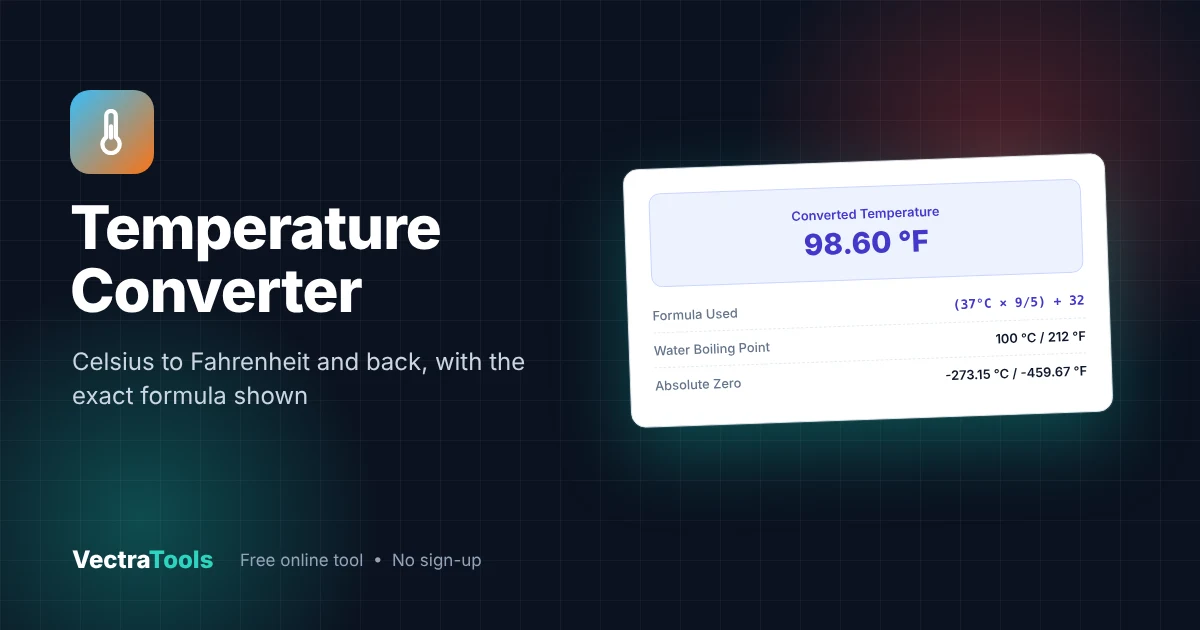
A temperature converter changes a reading from one scale to another. To go from Celsius to Fahrenheit, multiply by 9/5 and add 32: °F = (°C × 9/5) + 32. To go from Fahrenheit to Celsius, subtract 32 and multiply by 5/9: °C = (°F − 32) × 5/9. For example, 37 °C = 98.6 °F and 350 °F = 176.67 °C.
Our free temperature converter does this in one click. Pick a direction, type a number, and it shows the converted value, the exact formula it used, and two handy reference points. It works for weather, cooking, body temperature, science homework, and any reading that comes in the "wrong" unit.
What Is a Temperature Converter?
A temperature converter is a tool that translates a temperature from one scale into another. The two scales people mix up most are Celsius (°C), used in most countries and in science, and Fahrenheit (°F), used in the United States and a few other places for weather, cooking and health.
Unlike length or weight, temperature does not convert with a single multiplier. The two scales have different zero points as well as different degree sizes, so a correct conversion needs both a multiplication and an offset. That is why mental guesses are often a few degrees off, and why a temperature converter is worth using when the number matters.
Temperature Conversion Formulas
Water freezes at 0 °C (32 °F) and boils at 100 °C (212 °F) at sea level. The Celsius scale fits 100 degrees between those points and Fahrenheit fits 180, so one Celsius degree equals 1.8 (9/5) Fahrenheit degrees. Every formula below comes from those two facts.
| Conversion | Formula | Example |
|---|---|---|
| Celsius to Fahrenheit | °F = (°C × 9/5) + 32 | 25 °C = 77 °F |
| Fahrenheit to Celsius | °C = (°F − 32) × 5/9 | 68 °F = 20 °C |
| Celsius to Kelvin | K = °C + 273.15 | 25 °C = 298.15 K |
| Kelvin to Celsius | °C = K − 273.15 | 300 K = 26.85 °C |
| Fahrenheit to Kelvin | K = (°F − 32) × 5/9 + 273.15 | 32 °F = 273.15 K |
The tool on this page handles Celsius and Fahrenheit in both directions. For Kelvin, convert to Celsius first with the tool, then add 273.15.
How to Use the Temperature Converter
The tool is at the top of this page. These four steps take a few seconds.
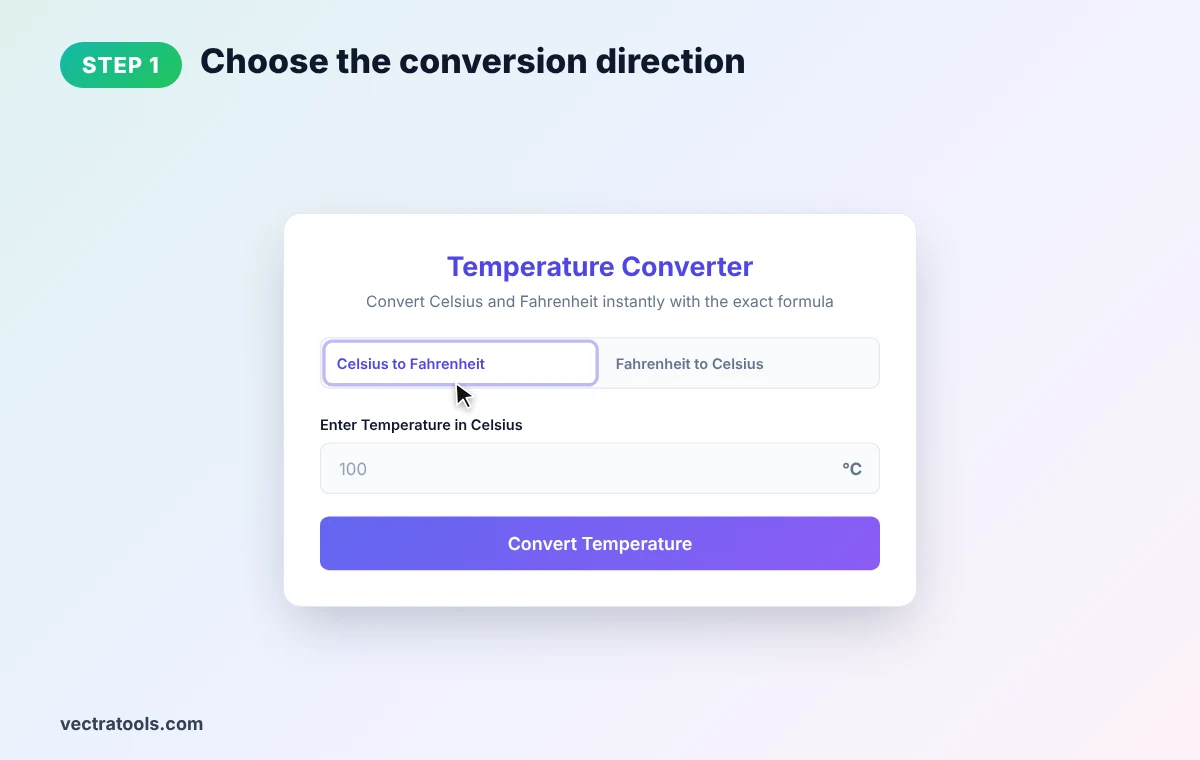
Step 1: Choose the Conversion Direction
Click Celsius to Fahrenheit or Fahrenheit to Celsius at the top of the tool. The input label and unit badge change to match the scale you picked. In our example we keep Celsius to Fahrenheit selected.
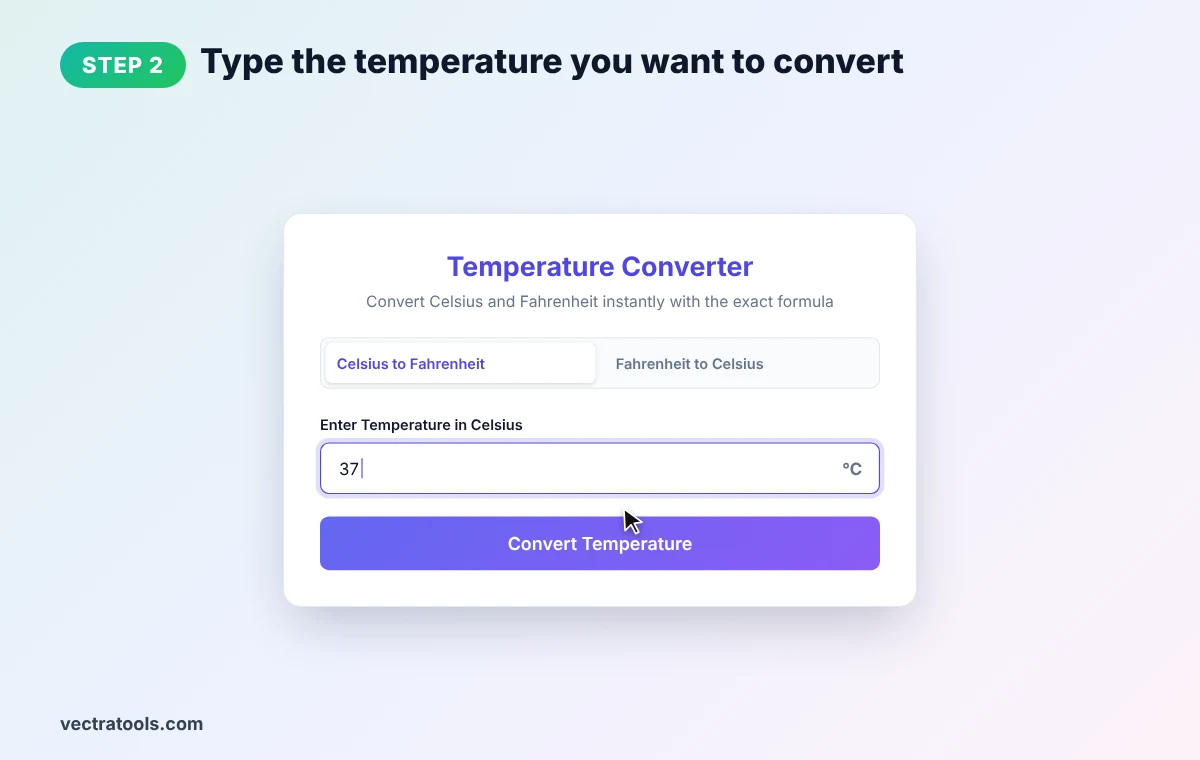
Step 2: Enter the Temperature
Type the value you want to convert into the input box. Decimals and negative numbers both work, so −40, 0 or 36.6 are all fine. We enter 37, a typical body temperature.
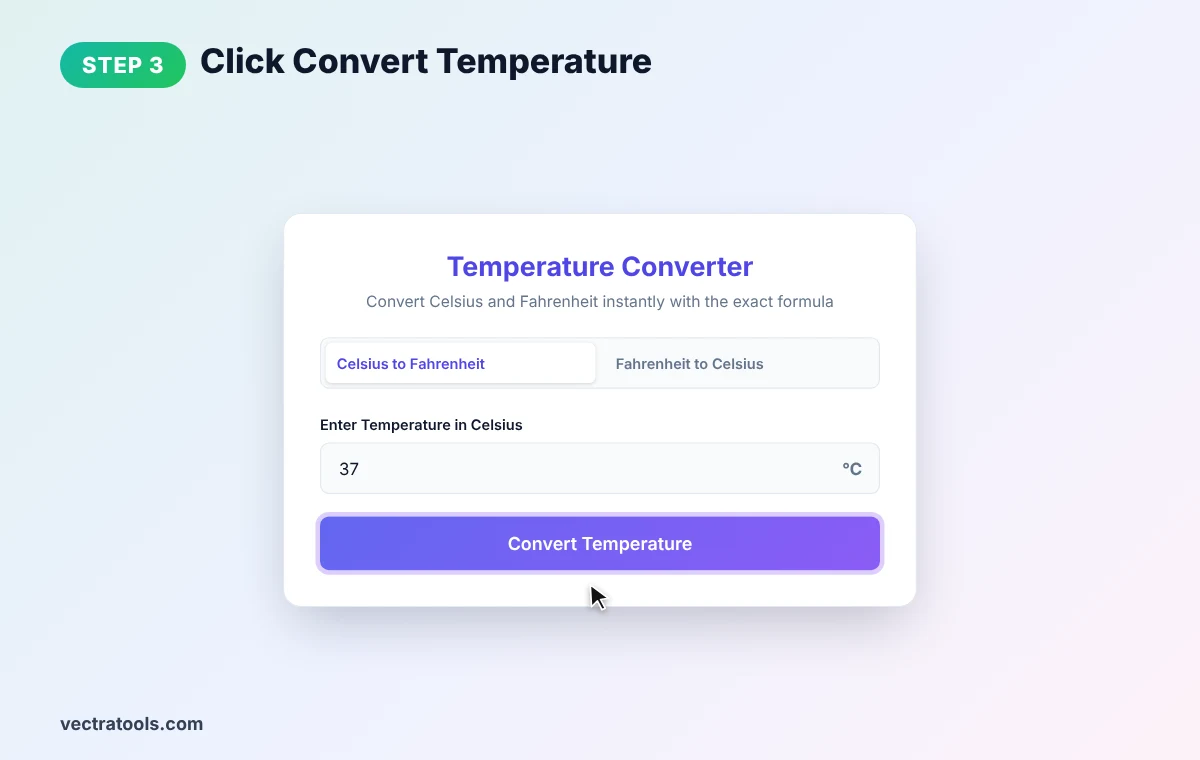
Step 3: Click Convert Temperature
Press the Convert Temperature button. If the box is empty, the tool asks you to enter a valid value instead of showing a wrong result.
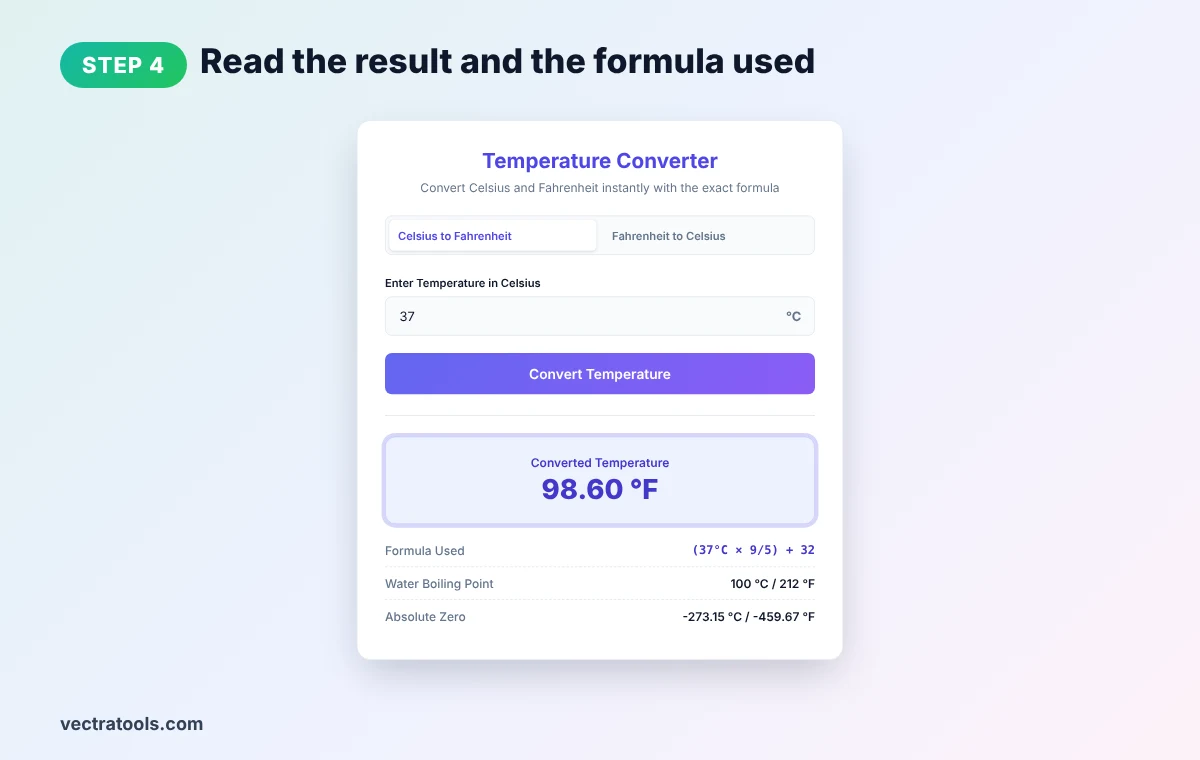
Step 4: Read the Result and Formula
The converted temperature appears in the highlighted box, rounded to two decimals: 98.60 °F. Below it you can see the formula with your number plugged in, plus the boiling point of water and absolute zero on both scales for a quick sense check. If you switch direction now, the tool converts the same number again automatically.
Worked Examples
Example 1: A Warm Day, 30 °C to Fahrenheit
Multiply 30 by 9/5 to get 54, then add 32. The answer is 86 °F, a hot summer afternoon.
Example 2: An Oven Setting, 350 °F to Celsius
Subtract 32 from 350 to get 318, then multiply by 5/9. The answer is 176.67 °C. Most recipes round this to 175 or 180 °C. If your oven uses gas marks instead, try our gas mark to Celsius converter.
Example 3: A Freezing Night, −10 °C to Fahrenheit
Multiply −10 by 9/5 to get −18, then add 32. The answer is 14 °F. Negative Celsius values above −17.78 still give a positive Fahrenheit reading.
Celsius to Fahrenheit Conversion Chart
| Celsius (°C) | Fahrenheit (°F) | What it feels like |
|---|---|---|
| −40 | −40 | Extreme cold |
| −20 | −4 | Deep freeze |
| −10 | 14 | Freezing winter day |
| 0 | 32 | Water freezes |
| 10 | 50 | Cool, jacket weather |
| 15 | 59 | Mild spring day |
| 20 | 68 | Comfortable room |
| 25 | 77 | Warm day |
| 30 | 86 | Hot day |
| 35 | 95 | Very hot |
| 37 | 98.6 | Normal body temperature |
| 40 | 104 | Heatwave |
| 100 | 212 | Water boils at sea level |
| 180 | 356 | Moderate oven |
| 200 | 392 | Hot oven |
| 250 | 482 | Very hot oven |
Fahrenheit to Celsius Conversion Chart
| Fahrenheit (°F) | Celsius (°C) |
|---|---|
| 0 | −17.78 |
| 32 | 0 |
| 50 | 10 |
| 68 | 20 |
| 72 | 22.22 |
| 80 | 26.67 |
| 90 | 32.22 |
| 98.6 | 37 |
| 100 | 37.78 |
| 212 | 100 |
| 300 | 148.89 |
| 350 | 176.67 |
| 400 | 204.44 |
| 425 | 218.33 |
| 450 | 232.22 |
Key Temperature Reference Points
| Reference point | Celsius | Fahrenheit | Kelvin |
|---|---|---|---|
| Absolute zero | −273.15 °C | −459.67 °F | 0 K |
| Where both scales meet | −40 °C | −40 °F | 233.15 K |
| Water freezes | 0 °C | 32 °F | 273.15 K |
| Typical room temperature | 20–22 °C | 68–72 °F | 293–295 K |
| Normal body temperature | 37 °C | 98.6 °F | 310.15 K |
| Water boils (sea level) | 100 °C | 212 °F | 373.15 K |
A Quick Mental Shortcut
When you only need a rough idea, double the Celsius value and add 30. For 20 °C that gives 70 °F, close to the exact 68 °F. To go the other way, subtract 30 from Fahrenheit and halve it: 80 °F becomes about 25 °C (exact: 26.67 °C).
The shortcut drifts further from the truth at high and low values. At 200 °C it gives 430 °F instead of 392 °F, which is enough to burn a cake. For cooking, medicine and science, use the temperature converter above instead.
Common Mistakes to Avoid
- Adding 32 before multiplying. For Celsius to Fahrenheit, multiply first and then add 32. Doing it the other way round gives a wrong answer.
- Forgetting the brackets in reverse. For Fahrenheit to Celsius, subtract 32 first, then multiply by 5/9.
- Treating temperature changes like temperatures. A rise of 10 °C is a rise of 18 °F, not 50 °F. The +32 offset only applies to actual readings, not to differences.
- Writing "degrees Kelvin". Kelvin is written as K with no degree sign, for example 300 K.
Who Should Use a Temperature Converter?
Travellers checking a forecast abroad, home cooks following a recipe written for another country, parents reading a thermometer set to the other scale, students solving physics and chemistry problems, and anyone working with equipment, manuals or data that use a different unit. If you also convert recipe volumes, our metric cups to fluid ounces converter pairs well with this tool.
Note
This temperature converter gives exact mathematical conversions rounded to two decimals. For a fever or other health concern, follow the advice of a doctor rather than relying on a single reading.
Frequently Asked Questions
How do I convert Celsius to Fahrenheit?
Multiply the Celsius value by 9/5 (or 1.8) and add 32. For example, 25 °C × 1.8 = 45, and 45 + 32 = 77 °F.
How do I convert Fahrenheit to Celsius?
Subtract 32 from the Fahrenheit value and multiply by 5/9. For example, (68 − 32) × 5/9 = 20 °C.
What is 37 °C in Fahrenheit?
37 °C is 98.6 °F, the figure usually quoted as normal human body temperature.
What is 350 °F in Celsius?
350 °F is 176.67 °C. Recipes usually round it to 175 °C or 180 °C, or 160 °C for a fan oven.
At what temperature are Celsius and Fahrenheit equal?
At −40. Minus 40 °C is exactly the same as minus 40 °F, the only point where the two scales match.
Can the temperature converter handle negative and decimal values?
Yes. You can enter values such as −15, 0.5 or 36.6 and the tool converts them correctly, rounding the result to two decimal places.
Is this temperature converter free?
Yes. The VectraTools temperature converter is free, needs no sign-up, and runs entirely in your browser.