

Surface Charge Density Converter – C/m² Units in 3 Easy Steps
Surface Charge Density Converter
Use this surface charge density converter: type a value into any field to instantly convert across all surface charge density measurements.
Use this free surface charge density converter to switch between coulombs per square metre (C/m²), millicoulombs per square metre (mC/m²), microcoulombs per square metre (µC/m²) and nanocoulombs per square metre (nC/m²). Type a value into any box and the other three update instantly.
Quick answer
Surface charge density σ is charge per unit area: σ = Q ÷ A. 1 C/m² = 1,000 mC/m² = 1,000,000 µC/m² = 1,000,000,000 nC/m². So 0.001 C/m² = 1 mC/m² = 1,000 µC/m², and 250 nC/m² = 0.25 µC/m² = 2.5 × 10⁻⁷ C/m².
Table of Contents
Surface charge density shows up in electrostatics, capacitor design, semiconductor physics and static electricity problems. Real values are often tiny, so physicists and engineers switch between micro and nano units all the time.
This surface charge density converter handles the powers of ten for you and shows very small values in scientific notation when needed.
Surface Charge Density Formulas
- σ = Q ÷ A (charge ÷ area)
- Field near a large charged plane: E = σ ÷ (2ε₀)
- Field just outside a conductor: E = σ ÷ ε₀
- Parallel-plate capacitor: σ = Q ÷ A = ε₀ × E
- ε₀ ≈ 8.854 × 10⁻¹² F/m (permittivity of free space)
Surface Charge Density Conversion Table
| C/m² | mC/m² | µC/m² | nC/m² |
|---|---|---|---|
| 1 | 1,000 | 1,000,000 | 1,000,000,000 |
| 0.001 | 1 | 1,000 | 1,000,000 |
| 0.000001 | 0.001 | 1 | 1,000 |
| 8.854 × 10⁻⁶ | 0.008854 | 8.854 | 8,854 |
| 2.5 × 10⁻⁷ | 0.00025 | 0.25 | 250 |
How to Use the Surface Charge Density Converter
Step 1: Enter a Value in C/m²
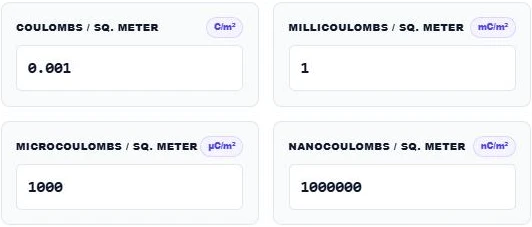
Type the density in Coulombs / Sq. Meter. For 0.001 C/m², the converter shows 1 mC/m², 1,000 µC/m² and 1,000,000 nC/m².
Step 2: Convert Small Nanocoulomb Values
Type a small value in Nanocoulombs / Sq. Meter. 250 nC/m² equals 0.25 µC/m², 0.00025 mC/m² and 2.5 × 10⁻⁷ C/m², shown in scientific notation.

Step 3: Check the Reference Matrix
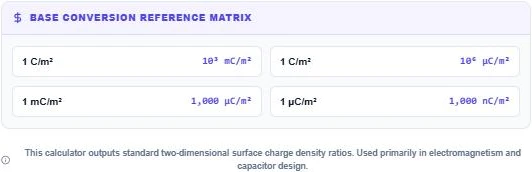
The Base Conversion Reference Matrix lists the key steps: 1 C/m² = 10³ mC/m² = 10⁶ µC/m², 1 mC/m² = 1,000 µC/m² and 1 µC/m² = 1,000 nC/m². Press Clear Fields to reset.
Worked Examples
- Capacitor plate: 10 µC spread over 0.01 m² gives σ = 10 × 10⁻⁶ ÷ 0.01 = 0.001 C/m², or 1 mC/m².
- Field from density: a conductor with σ = 8.854 µC/m² has a surface field E = σ ÷ ε₀ = 8.854 × 10⁻⁶ ÷ 8.854 × 10⁻¹² = 10⁶ V/m (1 MV/m).
- Air breakdown: dry air breaks down at roughly 3 MV/m, which corresponds to about 26.6 µC/m² on a conductor surface.
Surface, Linear and Volume Charge Density
| Type | Symbol | SI unit | Used for |
|---|---|---|---|
| Linear | λ | C/m | Charged wires and rods |
| Surface | σ | C/m² | Plates, shells, conductor surfaces |
| Volume | ρ | C/m³ | Charge spread through a solid or cloud |
Tips for Physics Problems
- Convert every value to base SI units (C, m², V/m) before using formulas, then convert the answer back with the surface charge density converter.
- Remember that 1 cm² = 10⁻⁴ m², so a density in µC/cm² is 10,000 times larger in µC/m².
- Check signs: negative σ means excess electrons on the surface.
- For curved surfaces, σ is often highest where the curvature is sharpest, which is why charge collects on points and edges.
Where Surface Charge Density Is Used
- Designing capacitors and electrostatic actuators.
- Gauss’s law problems in physics courses.
- Static electricity, triboelectric charging and ESD protection.
- Semiconductor interfaces and MOS devices.
More electrical tools: the Linear Charge Density Converter, the Electric Charge Converter and the Electric Current Converter.
Frequently Asked Questions
What is surface charge density?
It is the amount of electric charge per unit area of a surface, written σ and measured in C/m².
How do I convert C/m² to µC/m²?
Multiply by 1,000,000. 0.001 C/m² = 1,000 µC/m².
How do I convert nC/m² to µC/m²?
Divide by 1,000. 250 nC/m² = 0.25 µC/m².
How is surface charge density related to electric field?
Just outside a conductor, E = σ ÷ ε₀. Near a large thin charged sheet, E = σ ÷ (2ε₀).
Why does the tool show numbers like 2.5e-7?
Very small values are shown in scientific notation, where e-7 means × 10⁻⁷.
Is my data stored?
No. The surface charge density converter runs in your browser and nothing is saved.