

Electric Current Converter – Amps to mA in 3 Easy Steps
Electric Current Converter
Use this electric current converter: type a value into any field to instantly convert across all electrical current measurements.
Use this free electric current converter to switch between amperes (A), milliamperes (mA), microamperes (µA) and kiloamperes (kA). Type a value into any box and the other three update instantly, which saves counting zeros when reading data sheets or sizing components.
Quick answer
1 A = 1,000 mA = 1,000,000 µA, and 1 kA = 1,000 A. To convert amps to milliamps, multiply by 1,000. To convert milliamps to amps, divide by 1,000. So 2.5 A = 2,500 mA = 2,500,000 µA = 0.0025 kA, and 20 mA = 0.02 A.
Table of Contents
Electronics parts list currents in very different scales. An LED might need 20 mA, a sensor might draw 50 µA in sleep mode, a phone charger supplies 2–3 A, and a lightning strike can reach tens of kiloamps.
This electric current converter keeps all four units in step, so you can compare values from different data sheets without mistakes.
Electric Current Conversion Formulas
- mA = A × 1,000
- A = mA ÷ 1,000
- µA = A × 1,000,000
- kA = A ÷ 1,000
- Ohm’s law: current (A) = voltage (V) ÷ resistance (Ω)
Electric Current Conversion Table
| Amperes | Milliamperes | Microamperes | Typical example |
|---|---|---|---|
| 0.00005 A | 0.05 mA | 50 µA | Sensor in sleep mode |
| 0.02 A | 20 mA | 20,000 µA | Standard LED |
| 0.5 A | 500 mA | 500,000 µA | USB 2.0 port |
| 2.4 A | 2,400 mA | 2,400,000 µA | Phone fast charger |
| 10 A | 10,000 mA | 10,000,000 µA | Household appliance |
| 30,000 A | 30,000,000 mA | 3 × 10¹⁰ µA | Typical lightning strike (30 kA) |
How to Use the Electric Current Converter
Step 1: Enter a Value in Amperes
Type the current in Amperes (A). For 2.5 A, the converter shows 2,500 mA, 2,500,000 µA and 0.0025 kA.

Step 2: Convert Milliamps to Amps
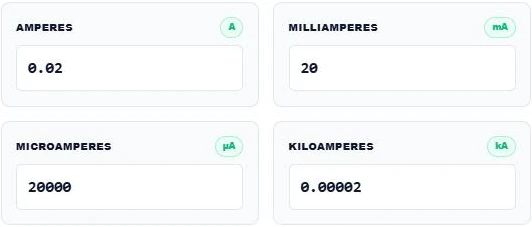
Type in Milliamperes (mA) to go the other way. A 20 mA LED current equals 0.02 A, 20,000 µA and 0.00002 kA. Any box can be the starting point.
Step 3: Check the Reference Matrix
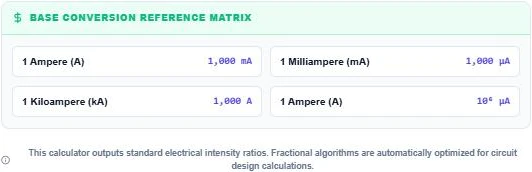
The Base Conversion Reference Matrix lists the key steps: 1 A = 1,000 mA, 1 mA = 1,000 µA, 1 kA = 1,000 A and 1 A = 10⁶ µA. Press Clear Fields to reset.
Worked Examples
- LED resistor: a 5 V supply with a 250 Ω resistor gives 5 ÷ 250 = 0.02 A, or 20 mA.
- Battery life: a 2,000 mAh battery powering a 20 mA load lasts about 2,000 ÷ 20 = 100 hours.
- Power: power (W) = voltage × current, so a 12 V device drawing 500 mA uses 12 × 0.5 = 6 W.
AC vs DC Current
Direct current (DC) flows one way, as from a battery. Alternating current (AC) reverses many times per second, as in mains power. AC current is usually quoted as an RMS value, which gives the same heating effect as that DC current. The unit conversions in this electric current converter work the same way for both.
Choosing Wire and Fuse Ratings
Wires and fuses are rated in amps. Add up the current of every device on a circuit, convert milliamp ratings to amps first, and choose a fuse a little above the normal load but below what the wire can safely carry. When in doubt, follow local electrical codes or ask a qualified electrician.
Safety Note
Current, not voltage alone, causes harm in an electric shock. Currents of a few tens of milliamps through the body can be dangerous, which is why residual current devices (RCDs / GFCIs) commonly trip at around 30 mA or less. Always isolate power before working on circuits.
Measuring Current
A multimeter measures current in series with the circuit, usually with separate mA and A input jacks. Start on the highest range, then switch down. Clamp meters measure current in a single wire without breaking the circuit, which is useful for amps and kiloamps in power systems.
More electrical tools: the Electric Charge Converter, the Magnetic Flux Converter and the Frequency Converter.
Frequently Asked Questions
How many milliamps are in an amp?
One amp equals 1,000 milliamps.
How do I convert mA to A?
Divide by 1,000. 20 mA = 0.02 A.
How many microamps are in a milliamp?
One milliamp equals 1,000 microamps.
What is a kiloampere used for?
Kiloamperes describe very large currents, such as in power grids, welding, short-circuit ratings and lightning.
How do I find current from voltage and resistance?
Use Ohm’s law: current = voltage ÷ resistance. 9 V across 450 Ω is 0.02 A (20 mA).
Is my data stored?
No. The electric current converter runs in your browser and nothing is saved.