

Linear Charge Density Converter – C/m Units in 3 Easy Steps
Linear Charge Density Converter
Use this linear charge density converter: type a value into any field to instantly convert across all linear charge density measurements.
Use this free linear charge density converter to switch between coulombs per metre (C/m), millicoulombs per metre (mC/m), microcoulombs per metre (µC/m) and nanocoulombs per metre (nC/m). Type a value into any box and the other three update instantly.
Quick answer
Linear charge density λ is charge per unit length: λ = Q ÷ L. 1 C/m = 1,000 mC/m = 1,000,000 µC/m = 1,000,000,000 nC/m. So 0.00002 C/m = 0.02 mC/m = 20 µC/m = 20,000 nC/m, and 500 nC/m = 0.5 µC/m = 5 × 10⁻⁷ C/m.
Table of Contents
Linear charge density describes charge spread along a line, such as a wire, a rod, a beam of particles or the edge of a thin conductor. It appears in Gauss’s law problems, cable design and particle physics.
This linear charge density converter handles the powers of ten for you, which matters because textbook problems often mix micro- and nanocoulombs per metre.
Linear Charge Density Formulas
- λ = Q ÷ L (charge ÷ length)
- Field around a long straight line of charge: E = λ ÷ (2πε₀r) = 2kλ ÷ r
- Total charge on a length: Q = λ × L
- k ≈ 8.99 × 10⁹ N·m²/C² and ε₀ ≈ 8.854 × 10⁻¹² F/m
Linear Charge Density Conversion Table
| C/m | mC/m | µC/m | nC/m |
|---|---|---|---|
| 1 | 1,000 | 1,000,000 | 1,000,000,000 |
| 0.001 | 1 | 1,000 | 1,000,000 |
| 0.00002 | 0.02 | 20 | 20,000 |
| 0.000001 | 0.001 | 1 | 1,000 |
| 5 × 10⁻⁷ | 0.0005 | 0.5 | 500 |
How to Use the Linear Charge Density Converter
Step 1: Enter a Value in C/m
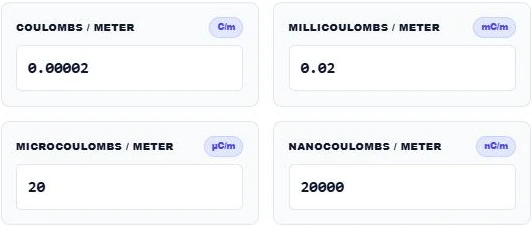
Type the density in Coulombs / Meter. For 0.00002 C/m, the converter shows 0.02 mC/m, 20 µC/m and 20,000 nC/m.
Step 2: Convert Nanocoulombs per Metre
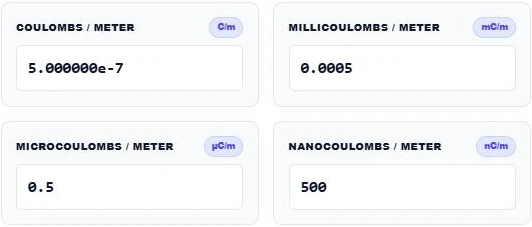
Type a small value in Nanocoulombs / Meter. 500 nC/m equals 0.5 µC/m, 0.0005 mC/m and 5 × 10⁻⁷ C/m, shown in scientific notation as 5.000000e-7.
Step 3: Check the Reference Matrix
The Base Conversion Reference Matrix lists the key steps: 1 C/m = 10³ mC/m = 10⁶ µC/m, 1 mC/m = 1,000 µC/m and 1 µC/m = 1,000 nC/m. Press Clear Fields to reset.

Worked Examples
- Charge on a rod: a 2 m rod carrying 40 µC has λ = 40 ÷ 2 = 20 µC/m, or 0.00002 C/m.
- Field near a wire: a long line with λ = 500 nC/m produces E = 2kλ ÷ r = 2 × 8.99 × 10⁹ × 5 × 10⁻⁷ ÷ 0.1 ≈ 89,900 V/m at 10 cm.
- Total charge: 3 m of a line at 0.5 µC/m holds 1.5 µC.
Linear, Surface and Volume Charge Density
| Type | Symbol | SI unit | Shape |
|---|---|---|---|
| Linear | λ | C/m | Wires, rods, beams |
| Surface | σ | C/m² | Plates, sheets, shells |
| Volume | ρ | C/m³ | Solids, clouds of charge |
Where Linear Charge Density Is Used
- Gauss’s law problems with infinite lines and cylinders.
- Coaxial cable and transmission line design.
- Charged particle beams in accelerators and electron guns.
- Electrostatic precipitators that use charged wires to clean exhaust gases.
- Modelling lightning leaders and charged power lines.
In each case the linear charge density converter helps you move between the tiny values found in textbooks and the units your calculator or simulation expects.
Tips for Physics Problems
- Convert to C/m first, solve in SI units, then convert the answer back.
- Watch for lengths in centimetres; 1 cm = 0.01 m, so µC/cm is 100 times larger in µC/m.
- The field from a line of charge falls off as 1/r, not 1/r² as for a point charge.
- Keep the sign of λ to get the field direction right.
More electrical tools: the Surface Charge Density Converter, the Electric Charge Converter and the Electric Current Converter.
Frequently Asked Questions
What is linear charge density?
It is the electric charge per unit length along a line, written λ and measured in C/m.
How do I convert C/m to µC/m?
Multiply by 1,000,000. 0.00002 C/m = 20 µC/m.
How do I convert nC/m to µC/m?
Divide by 1,000. 500 nC/m = 0.5 µC/m.
What is the electric field of a line charge?
For a long straight line, E = λ ÷ (2πε₀r), which decreases with 1/r.
Why do I see 5.000000e-7?
That is scientific notation for 5 × 10⁻⁷, used for very small values.
Is my data stored?
No. The linear charge density converter runs in your browser and nothing is saved.