

RD Calculator – Recurring Deposit Maturity in 3 Easy Steps
Recurring Deposit (RD) Calculator
Use this RD calculator to find the maturity amount and interest on your monthly deposits.
Use this free recurring deposit RD calculator to find the maturity amount and interest earned on a monthly RD. Enter how much you deposit each month, the annual interest rate and the term in years or months, and the tool shows your total principal, interest and final payout.
Quick answer
A recurring deposit of 5,000 a month at 6.5% for 5 years grows to about 3,55,284 with monthly compounding: 3,00,000 deposited plus 55,284 interest. A 1,000 monthly RD at 7% for 12 months matures at about 12,465. Banks that compound quarterly pay slightly less, around 3,54,954 in the first example.
Table of Contents
A recurring deposit (RD) lets you save a fixed amount every month and earn a fixed interest rate, much like a fixed deposit built in small steps. RDs are popular in India, Pakistan, Bangladesh and Nepal with banks and post offices, and they suit anyone who wants a disciplined savings habit with a known result.
This RD calculator shows exactly what your monthly savings will be worth on the maturity date, so you can compare rates and terms before you open an account.
Recurring Deposit Formula
The calculator uses monthly compounding, with each deposit made at the start of the month:
- Maturity = P × [((1 + i)n − 1) ÷ i] × (1 + i)
- P = monthly deposit
- i = annual rate ÷ 12 ÷ 100
- n = number of monthly deposits
- Interest = Maturity − (P × n)
Many Indian banks compound RD interest quarterly instead. The result is a little lower, usually by less than 0.1% of the maturity value.
How to Use the RD Calculator
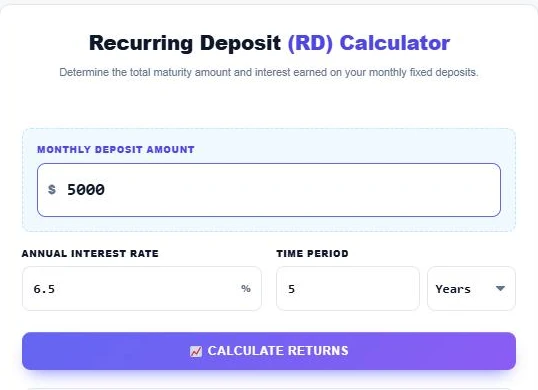
Step 1: Enter Your Monthly Deposit, Rate and Term
Type the Monthly Deposit Amount (5,000), the Annual Interest Rate your bank offers (6.5%) and the Time Period (5 years). The currency sign is only a label; the maths works for rupees, taka or any other currency.
Step 2: Read the Maturity Amount
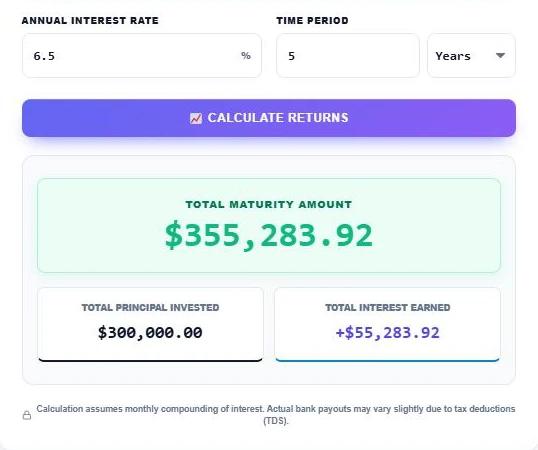
Press Calculate Returns. Your total maturity amount is 3,55,283.92. Of that, 3,00,000 is your own money and 55,283.92 is interest earned.
Step 3: Try a Short Term in Months
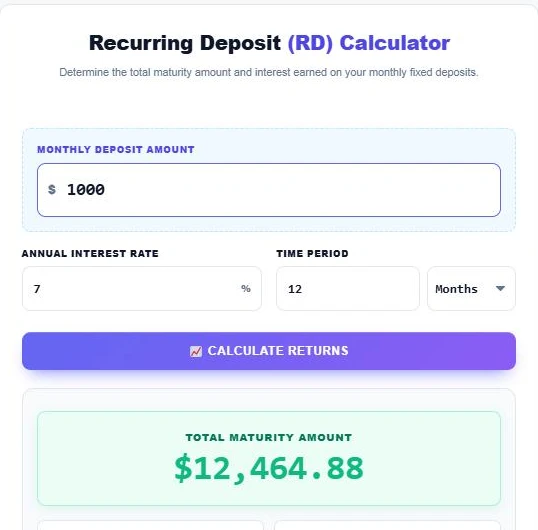
Switch the unit to Months for short RDs. A 1,000 monthly deposit at 7% for 12 months matures at 12,464.88, earning 464.88 in interest.
RD Maturity Table
Monthly deposit of 2,000 at 6.5% per year:
| Term | Total deposited | Interest earned | Maturity amount |
|---|---|---|---|
| 1 year | 24,000 | 862 | 24,862 |
| 2 years | 48,000 | 3,389 | 51,389 |
| 3 years | 72,000 | 7,693 | 79,693 |
| 5 years | 1,20,000 | 22,114 | 1,42,114 |
| 10 years | 2,40,000 | 98,631 | 3,38,631 |
Interest grows faster in later years because earlier deposits have been compounding for longer.
How Much Does the Rate Matter?
On a 5,000 monthly RD for 5 years, raising the rate from 6.5% to 7.5% lifts maturity from about 3,55,284 to 3,64,902, nearly 9,600 more. Senior citizens often get an extra 0.25% to 0.50%, so check the rate for your age group.
RD vs Fixed Deposit vs SIP
- Recurring deposit: fixed monthly saving, fixed rate, guaranteed maturity amount.
- Fixed deposit: one lump sum at a fixed rate. Earns more interest on the same total because all the money is invested from day one.
- Mutual fund SIP: monthly investing in the market. Higher potential return but no guarantee.
Things to Know Before Opening an RD
- Missed instalments: many banks charge a small penalty for late deposits.
- Premature closure: breaking an RD early usually means a lower rate and possibly a penalty.
- Tax: RD interest is usually taxable as income. In India, TDS may apply if interest crosses the yearly threshold.
- Term limits: banks usually allow terms from 6 months to 10 years.
Tips to Get More From Your RD
- Compare rates at a few banks and small finance banks.
- Set up an auto-debit so you never miss a month.
- Line up the maturity date with a planned expense such as fees, travel or a down payment.
- Use this RD calculator to test a slightly higher monthly amount; small increases add up.
Related tools: the PPF Maturity Calculator, the Inflation Purchasing Power Calculator and the Emergency Fund Calculator.
Frequently Asked Questions
How is RD maturity calculated?
Each monthly deposit earns compound interest until the maturity date. The calculator adds them all: Maturity = P × [((1 + i)^n − 1) ÷ i] × (1 + i), with i as the monthly rate.
What is the maturity of 5,000 per month for 5 years at 6.5%?
About 3,55,284 with monthly compounding, including 55,284 interest.
Do banks compound RD interest monthly or quarterly?
Many Indian banks compound quarterly. That gives a slightly lower figure than monthly compounding.
Is RD interest taxable?
In most countries, yes. It is added to your income, and banks may deduct tax at source.
Can I close an RD early?
Usually yes, but the bank may pay a lower rate and charge a penalty.
Is my data stored?
No. The RD calculator runs in your browser and nothing is saved.