

50/30/20 Budget Calculator – Needs, Wants and Savings in 3 Easy Steps
50/30/20 Budget Calculator
Use this 50/30/20 budget calculator: enter your monthly after-tax income to plan your budget and track actual spending.
Use this free 50/30/20 budget calculator to split your monthly take-home pay into needs, wants and savings. Enter your after-tax income to see the recommended amount for each bucket, then type what you actually spent to see how much is left or where you went over.
Quick answer
The 50/30/20 rule puts 50% of after-tax income toward needs, 30% toward wants and 20% toward savings and extra debt payments. On a $4,000 monthly take-home pay, that is $2,000 for needs, $1,200 for wants and $800 for savings. On $6,000 it is $3,000, $1,800 and $1,200.
Table of Contents
The 50/30/20 rule is one of the simplest ways to budget. Instead of tracking dozens of categories, you sort every expense into three groups and check that each stays within its share. It was popularised by US Senator Elizabeth Warren and her daughter Amelia Warren Tyagi in their book on personal finance.
This 50/30/20 budget calculator works out the targets for you and turns into a quick monthly tracker once you add your real spending.
The 50/30/20 Formula
- Needs = After-tax income × 50%
- Wants = After-tax income × 30%
- Savings and debt = After-tax income × 20%
- Remaining = Target − Actual amount spent or saved
How to Use the 50/30/20 Budget Calculator
Step 1: Enter Your Monthly After-Tax Income
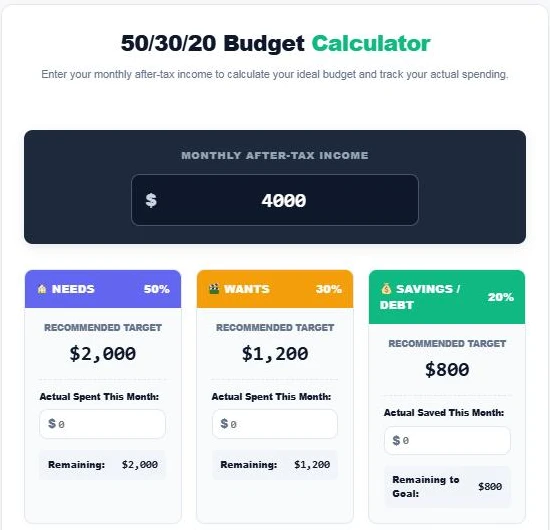
Type your Monthly After-Tax Income, the amount that actually reaches your account ($4,000). The three cards fill in straight away: Needs $2,000, Wants $1,200 and Savings / Debt $800.
Step 2: Add What You Actually Spent
Under each card, enter your real spending for the month. With $1,800 on needs, $1,400 on wants and $500 saved, you have $200 left for needs, you are $200 over on wants (shown in red), and you are $300 short of your savings goal.

Step 3: Check Your Savings Goal
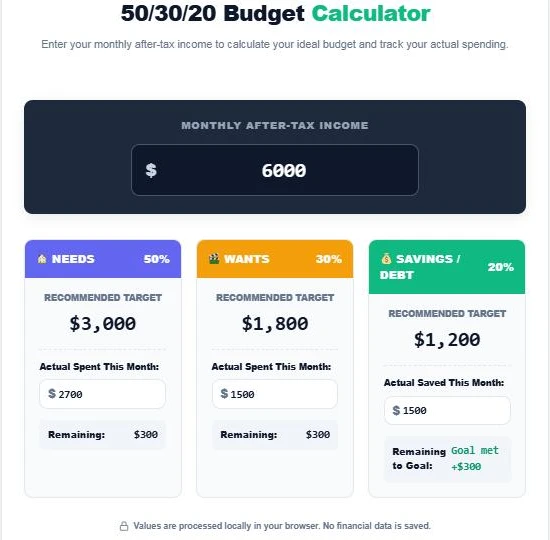
At $6,000 income with $2,700 on needs, $1,500 on wants and $1,500 saved, both spending buckets have $300 to spare and the savings card shows Goal met +$300, because you saved more than the $1,200 target.
What Counts as Needs, Wants and Savings?
| Needs (50%) | Wants (30%) | Savings and debt (20%) |
|---|---|---|
| Rent or mortgage | Dining out and takeaways | Emergency fund |
| Utilities and internet | Streaming and subscriptions | Retirement contributions |
| Groceries | Shopping and hobbies | Investments |
| Insurance | Travel and holidays | Extra debt payments above the minimum |
| Minimum loan payments | Gym and entertainment | Saving for a home or car |
| Transport to work | Upgrades beyond the basic option | Sinking funds for big expenses |
Budget Targets at Different Incomes
| Monthly take-home pay | Needs 50% | Wants 30% | Savings 20% |
|---|---|---|---|
| $2,500 | $1,250 | $750 | $500 |
| $4,000 | $2,000 | $1,200 | $800 |
| $6,000 | $3,000 | $1,800 | $1,200 |
| $8,000 | $4,000 | $2,400 | $1,600 |
What If Your Needs Are Over 50%?
In high-rent cities or on a lower income, needs can easily take 60% or more. That is common. Try these steps:
- Use a 60/20/20 or 70/20/10 split for now and aim to move toward 50/30/20 over time.
- Look for the biggest fixed costs first: rent, car payments and insurance.
- Protect the savings share, even if it is small, so you build an emergency fund.
- Review subscriptions; they often hide in “needs” when they are really wants.
Tips for Sticking to the Budget
- Pay yourself first: move the 20% to savings on payday.
- Use separate accounts or cards for needs and wants.
- Check the calculator mid-month so you can adjust before you overspend.
- Treat irregular costs, such as yearly insurance, as monthly amounts.
Related tools: the Emergency Fund Calculator, the Net Worth Calculator and the Hourly to Salary Converter.
Frequently Asked Questions
What is the 50/30/20 rule?
A budgeting method that splits after-tax income into 50% needs, 30% wants and 20% savings and debt repayment.
Is the 50/30/20 rule based on gross or net income?
Net income, the take-home pay after tax and payroll deductions.
How much should I save on a $4,000 monthly income?
20%, which is $800 a month.
Does paying off debt count as savings?
Minimum payments are needs. Payments above the minimum count toward the 20% savings share.
What if I cannot fit into 50/30/20?
Use a split that works for now, such as 60/20/20, and adjust as income grows or costs fall.
Is my data stored?
No. The 50/30/20 budget calculator runs in your browser and nothing is saved.