

Luminous Intensity Converter – Candela to Lumen With Beam Angle in 3 Easy Steps
Candela to Lumen Calculator
Use this luminous intensity converter to calculate luminous flux (Lumens) from luminous intensity (Candela) using the exact beam angle.
Use this free luminous intensity converter to turn candela into lumens, or lumens into candela, for any beam angle. Enter the candela rating or lumen output of a light, set the beam angle with the slider or box, and the tool gives the matching value instantly, with a quick reference chart for common angles.
Quick answer
To convert candela to lumens, multiply the candela by the solid angle of the beam: lumens = cd × 2π × (1 − cos(beam angle ÷ 2)). A 2,000 cd spotlight with a 40° beam gives about 757.8 lumens. Going the other way, 800 lumens in a 60° beam equals about 950.4 cd. A narrower beam concentrates the same lumens into a higher candela value.
Table of Contents
Torch, flashlight, LED strip and stage lighting specs often list candela, while household bulbs and projectors list lumens. Because the two measure different things, you cannot convert between them without knowing how wide the beam is. That is where most quick online answers go wrong.
This luminous intensity converter includes the beam angle in every calculation, so the result matches the physics. It runs in your browser.
Candela vs Lumen: What Is the Difference?
- Candela (cd) measures luminous intensity: how much light goes in one particular direction. It tells you how bright the centre of a beam looks.
- Lumen (lm) measures luminous flux: the total visible light a source emits in all the directions it covers.
- Beam angle is the width of the cone of light, usually measured where intensity falls to half of the peak.
Think of a garden hose. Lumens are the total water flow; candela is how hard the water hits at the centre of the spray. Narrowing the nozzle does not add water, but it makes the jet stronger.
Candela to Lumen Formula
- Solid angle (sr) = 2π × (1 − cos(θ ÷ 2)), where θ is the full beam angle
- Lumens = candela × solid angle
- Candela = lumens ÷ solid angle
- For a light that shines equally in every direction (360°), the solid angle is 4π, so lumens = 4π × cd ≈ 12.57 × cd.
The formula assumes the intensity is even across the beam. Real lamps fade toward the edges, so manufacturer figures can differ a little.
Lumens per 1,000 Candela by Beam Angle
| Beam angle | Solid angle (sr) | Lumens from 1,000 cd |
|---|---|---|
| 10° | 0.0239 | 23.9 |
| 15° | 0.0538 | 53.8 |
| 25° | 0.1489 | 148.9 |
| 36° | 0.3075 | 307.5 |
| 60° | 0.8418 | 841.8 |
| 90° | 1.8403 | 1,840.3 |
| 120° | 3.1416 | 3,141.6 |
How to Use the Luminous Intensity Converter
Step 1: Enter Candela and Beam Angle
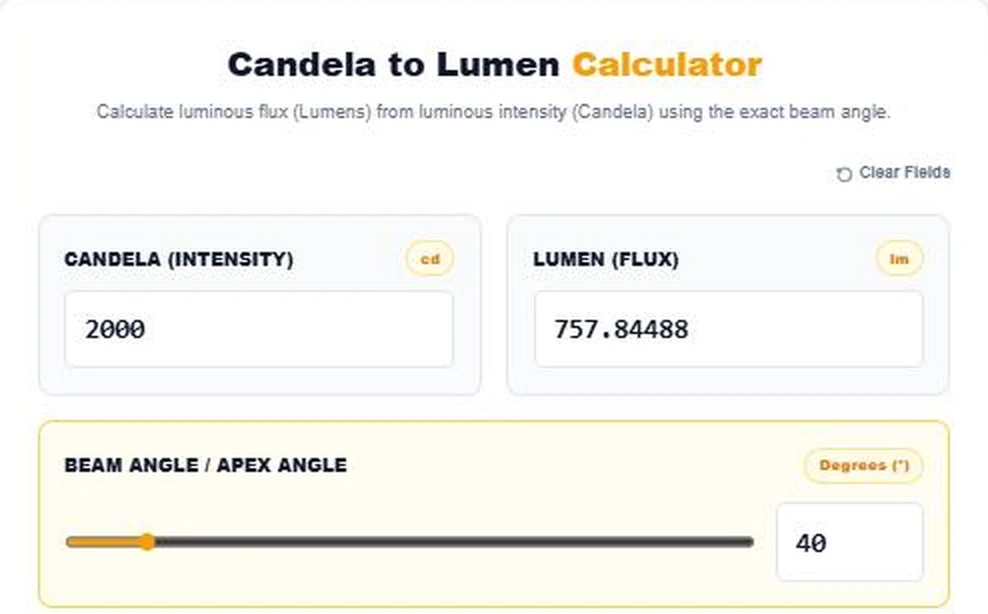
Type the candela value and set the beam angle with the slider or the number box. A 2,000 cd light with a 40° beam converts to 757.84 lumens.
Step 2: Convert Lumens to Candela
Type in the Lumen box instead to go the other way. A lamp producing 800 lumens in a 60° beam has a centre intensity of about 950.36 cd.

Step 3: Check the Quick Reference Chart
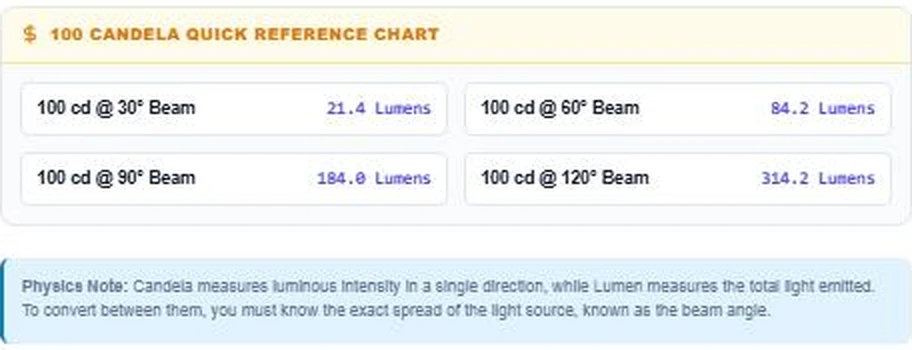
The chart shows how much flux 100 cd produces at 30°, 60°, 90° and 120° beams: 21.4, 84.2, 184.0 and 314.2 lumens. It is a fast way to see how strongly beam angle changes the result.
Choosing the Right Beam Angle
- Narrow spots (10° to 25°): highlighting artwork, product displays and long-throw flashlights.
- Medium floods (30° to 60°): track lighting, downlights over tables and general accent lighting.
- Wide floods (90° and above): room lighting, garages and work areas where even coverage matters.
Practical Examples
Two bulbs can both produce 400 lumens yet look very different. In a 25° spotlight, 400 lumens gives about 2,686 cd at the centre, bright enough to make a picture stand out. In a 120° flood, the same 400 lumens gives only about 127 cd, a soft, even wash. When you compare lamps, check both figures along with the beam angle.
Need brightness of screens instead? Use the Luminance Unit Converter. For light falling on a surface, try the Illuminance Converter.
Frequently Asked Questions
Can you convert candela to lumens without a beam angle?
No. Candela measures light in one direction and lumens measure total light, so you need the beam angle to link them.
How many lumens is 1 candela?
For a source that shines equally in all directions, 1 cd equals about 12.57 lumens. For a 120° beam it is about 3.14 lumens, and for a 30° beam about 0.21 lumens.
Why does a narrow beam have higher candela?
Because the same lumens are packed into a smaller cone, so more light reaches each point in the centre of the beam.
Is higher candela or higher lumens better for a flashlight?
Candela decides how far the beam reaches; lumens decide how much area it lights. Long-range torches favour candela, while work lights favour lumens.
What beam angle should I use for a bulb?
Use the angle printed on the packaging or datasheet, often between 15° and 120° for LED spots and floods.
Is my data saved?
No. The luminous intensity converter runs entirely in your browser.