

Radiation Converter – Sievert to Rem, mSv to mrem in 3 Easy Steps
Radiation Converter
Use this radiation converter to change equivalent radiation dose instantly between Sieverts (Sv) and Roentgen equivalent man (rem).
Use this free radiation converter to change dose values between sieverts (Sv), millisieverts (mSv), microsieverts (µSv), rem and millirem (mrem). Type a number in either box and the other side updates instantly, so you can go from sievert to rem or rem to sievert without doing the maths.
Quick answer
1 sievert (Sv) = 100 rem, and 1 rem = 0.01 Sv = 10 mSv. That means 1 mSv = 100 mrem and 1 µSv = 0.1 mrem. To convert sieverts to rem, multiply by 100. To convert rem to sieverts, divide by 100. For example, 2.4 mSv = 240 mrem and 5 rem = 50 mSv.
Table of Contents
Radiation doses show up in medical reports, dosimeter readings, nuclear safety rules and science homework. The trouble is that some sources use the SI unit, the sievert, while US regulations and older documents still use rem. Mixing them up by a factor of 100 is an easy mistake.
This radiation converter handles all five common units in both directions and shows a quick formula reference beneath the boxes.
Sievert vs Rem: What Is the Difference?
Both units measure equivalent dose or effective dose, which is the biological effect of radiation on the body rather than the raw energy absorbed. They describe the same thing on different scales.
- Sievert (Sv) is the SI unit, used by the International Commission on Radiological Protection (ICRP) and most countries.
- Rem stands for roentgen equivalent man. It is the older CGS unit, still used in US Nuclear Regulatory Commission rules and many American documents.
- One sievert is a very large dose, so everyday values are usually given in millisieverts or microsieverts, or in millirem in the US.
Do not confuse these with the gray (Gy) and rad, which measure absorbed dose. For X-rays and gamma rays, 1 Gy gives 1 Sv, but for alpha particles or neutrons the equivalent dose is higher because those types of radiation cause more damage.
Radiation Unit Conversion Table
| From | Sv | mSv | µSv | rem | mrem |
|---|---|---|---|---|---|
| 1 Sv | 1 | 1,000 | 1,000,000 | 100 | 100,000 |
| 1 mSv | 0.001 | 1 | 1,000 | 0.1 | 100 |
| 1 µSv | 0.000001 | 0.001 | 1 | 0.0001 | 0.1 |
| 1 rem | 0.01 | 10 | 10,000 | 1 | 1,000 |
| 1 mrem | 0.00001 | 0.01 | 10 | 0.001 | 1 |
How to Use the Radiation Converter
Step 1: Choose Units and Enter a Value
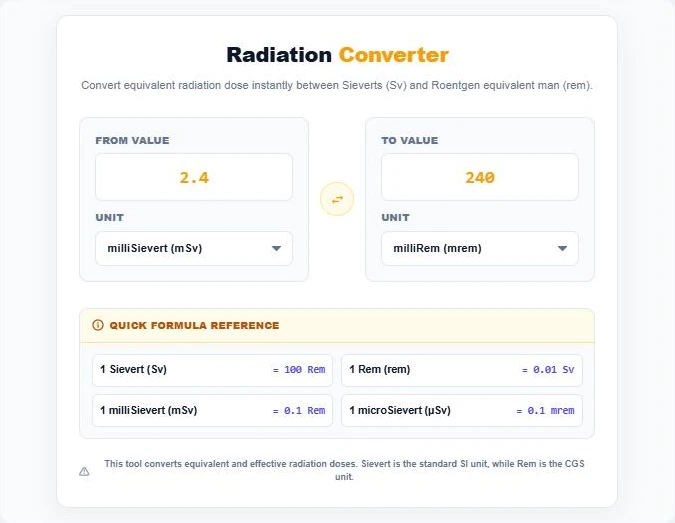
Pick the unit you have in the From menu and the unit you want in the To menu, then type your number. In this example, a yearly background dose of 2.4 mSv converts to 240 mrem.
Step 2: Convert in Either Direction
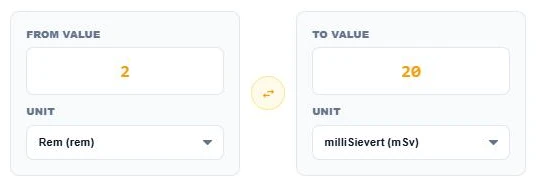
You can also type in the To box and the From box updates. Here 20 mSv, the yearly occupational limit recommended by the ICRP, is shown as 2 rem. Use the swap button in the middle to flip the units.
Step 3: Check the Formula Reference
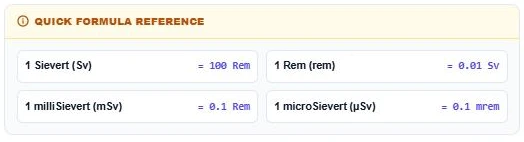
The quick reference panel under the converter lists the key relationships, so you can sanity-check a result or convert a value by hand when you are away from the tool.
Typical Radiation Doses in Sieverts and Rem
These rough figures help put a number in context. Real doses vary with equipment, location and duration.
| Source | Approx. dose (mSv) | Approx. dose (mrem) |
|---|---|---|
| Dental X-ray | 0.005 | 0.5 |
| Chest X-ray | 0.1 | 10 |
| Long-haul flight | 0.05 | 5 |
| Average yearly natural background (worldwide) | 2.4 | 240 |
| CT scan of the abdomen | 8 to 10 | 800 to 1,000 |
| Yearly public dose limit (excluding medical and natural) | 1 | 100 |
| Yearly occupational limit, ICRP (averaged) | 20 | 2,000 |
| Yearly occupational limit, US NRC | 50 | 5,000 |
Doses above about 1 Sv (100 rem) received over a short time can cause acute radiation sickness. Everyday medical and background doses are far below that level.
Sievert to Rem Conversion Examples
- 0.5 Sv × 100 = 50 rem
- 3 mSv × 100 = 300 mrem
- 150 µSv × 0.1 = 15 mrem
- 25 rem ÷ 100 = 0.25 Sv (250 mSv)
- 500 mrem ÷ 100 = 5 mSv
Need other unit conversions for lab or engineering work? Try the Volumetric Flow Rate Converter or the Length Converter.
Frequently Asked Questions
How many rem are in a sievert?
There are 100 rem in 1 sievert. To convert sieverts to rem, multiply by 100.
How do I convert mSv to mrem?
Multiply by 100. For example, 1 mSv equals 100 mrem and 2.4 mSv equals 240 mrem.
How do I convert rem to sievert?
Divide by 100. For example, 5 rem equals 0.05 Sv, which is 50 mSv.
Is a sievert the same as a gray?
No. A gray measures absorbed energy, while a sievert measures biological effect. For X-rays and gamma rays they are numerically equal; for alpha particles and neutrons the sievert value is higher.
Why does the US still use rem?
US Nuclear Regulatory Commission rules were written in rem and millirem, so many American dosimeters, reports and training materials still use those units alongside sieverts.
Is this radiation converter suitable for medical decisions?
It converts units accurately, but it does not assess risk. Ask a radiologist, medical physicist or radiation safety officer about any specific exposure.