

Gregorian to Hijri Calendar – Islamic Calendar 2026 and 2027
Gregorian to Hijri Calendar

Quick answer
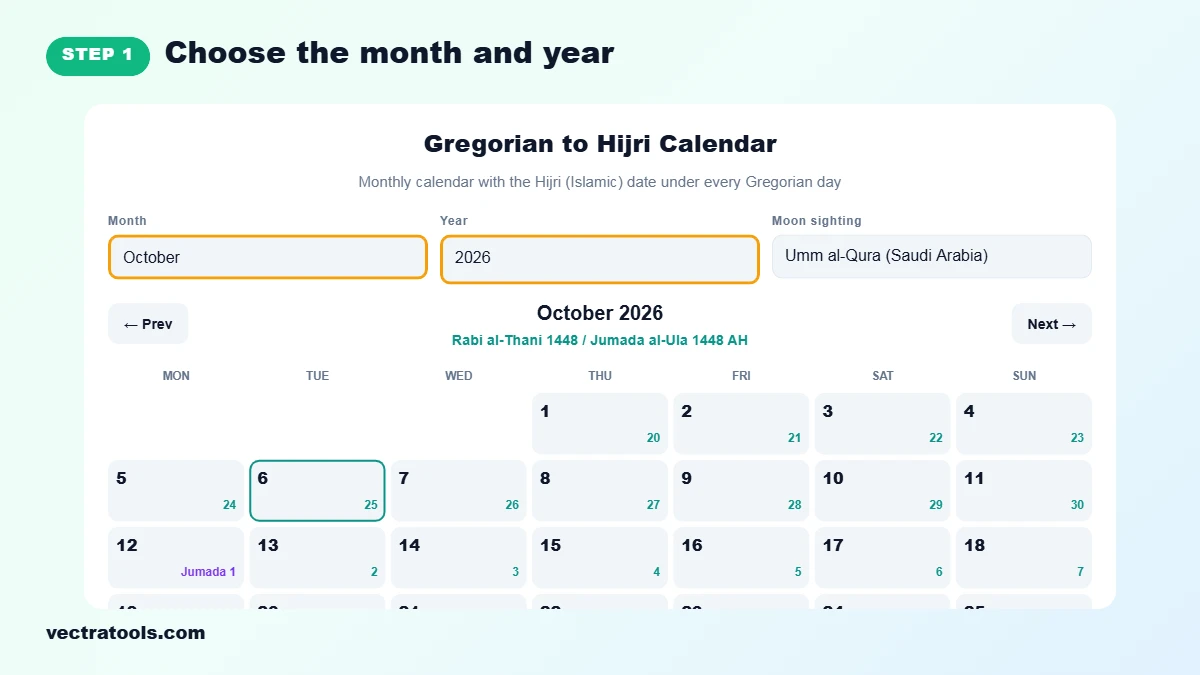
This Hijri calendar shows a normal Gregorian month with the Islamic date under every day, so you can see both calendars at once. October 2026 runs from 20 Rabi al-Thani to 20 Jumada al-Ula 1448 AH on the Umm al-Qura calendar. Key dates such as the first day of Ramadan, Eid al-Fitr and Eid al-Adha are highlighted, for example Eid al-Fitr 1448 on 9 March 2027.
Our free Gregorian to Hijri calendar is handy for planning Ramadan, Hajj and Eid, scheduling events around Islamic dates, and seeing at a glance which Hijri month a Gregorian month overlaps.
How the Two Calendars Line Up
The Gregorian calendar follows the Sun and has 365 or 366 days. The Hijri calendar follows the Moon, with 12 months of 29 or 30 days, about 354 days a year. Because the Hijri year is about 11 days shorter, every Gregorian month overlaps two Hijri months, and Islamic occasions move about 11 days earlier each year.
| Occasion | Hijri date | Expected date (Umm al-Qura) |
|---|---|---|
| First day of Ramadan 1448 | 1 Ramadan 1448 | Mon 8 Feb 2027 |
| Eid al-Fitr 1448 | 1 Shawwal 1448 | Tue 9 Mar 2027 |
| Day of Arafah 1448 | 9 Dhul Hijjah 1448 | Sat 15 May 2027 |
| Eid al-Adha 1448 | 10 Dhul Hijjah 1448 | Sun 16 May 2027 |
| Islamic New Year 1449 | 1 Muharram 1449 | Sun 6 Jun 2027 |
These dates are calculated. In many countries the month starts only after the crescent is seen, so the actual day can be one day later.
How to Use the Gregorian to Hijri Calendar
Step 1: Choose the Month and Year
Open the Gregorian to Hijri calendar. It shows the current month. Pick another month and year from the boxes, for example October 2026. The heading shows the Hijri months it covers: Rabi al-Thani and Jumada al-Ula 1448 AH.
Step 2: Read the Hijri Date Under Each Day
Each box shows the Gregorian day in bold and the Hijri day in the corner. When a new Hijri month starts, its name appears in purple, such as Jumada 1 on 12 October 2026. Today is outlined in teal.

Step 3: Spot Ramadan, Eid and Other Islamic Dates
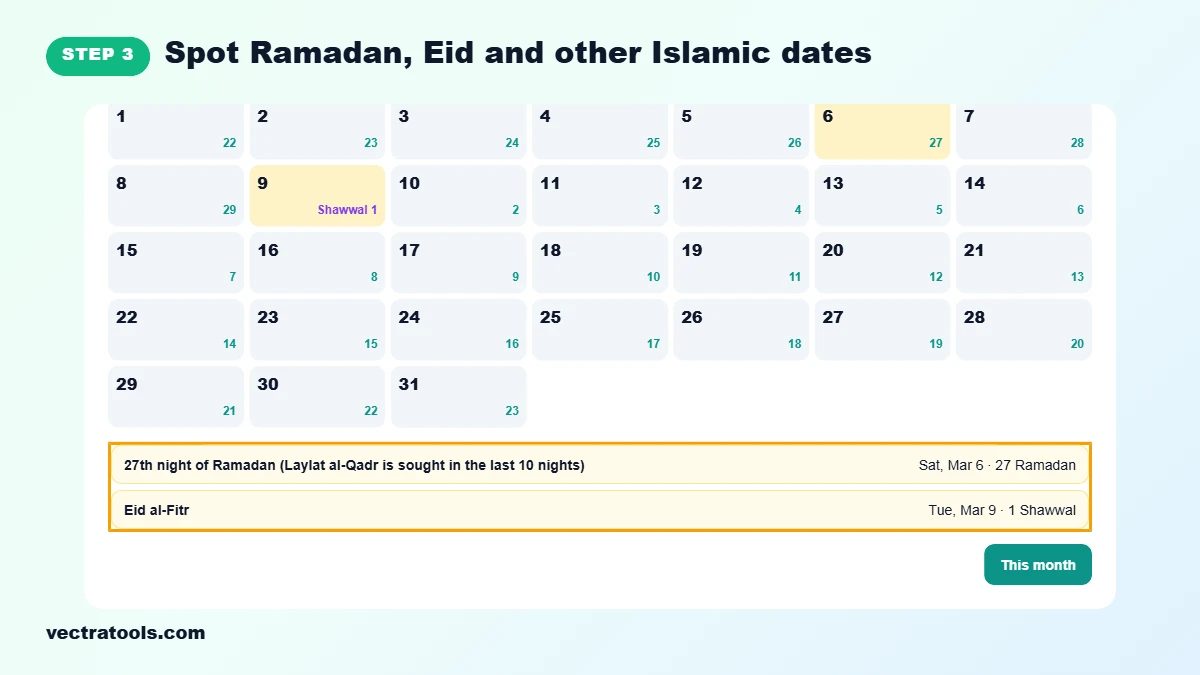
Important Islamic dates are shaded yellow and listed under the calendar. In March 2027 you can see the 27th night of Ramadan on 6 March and Eid al-Fitr on Tuesday 9 March.
Step 4: Match Your Local Moon Sighting
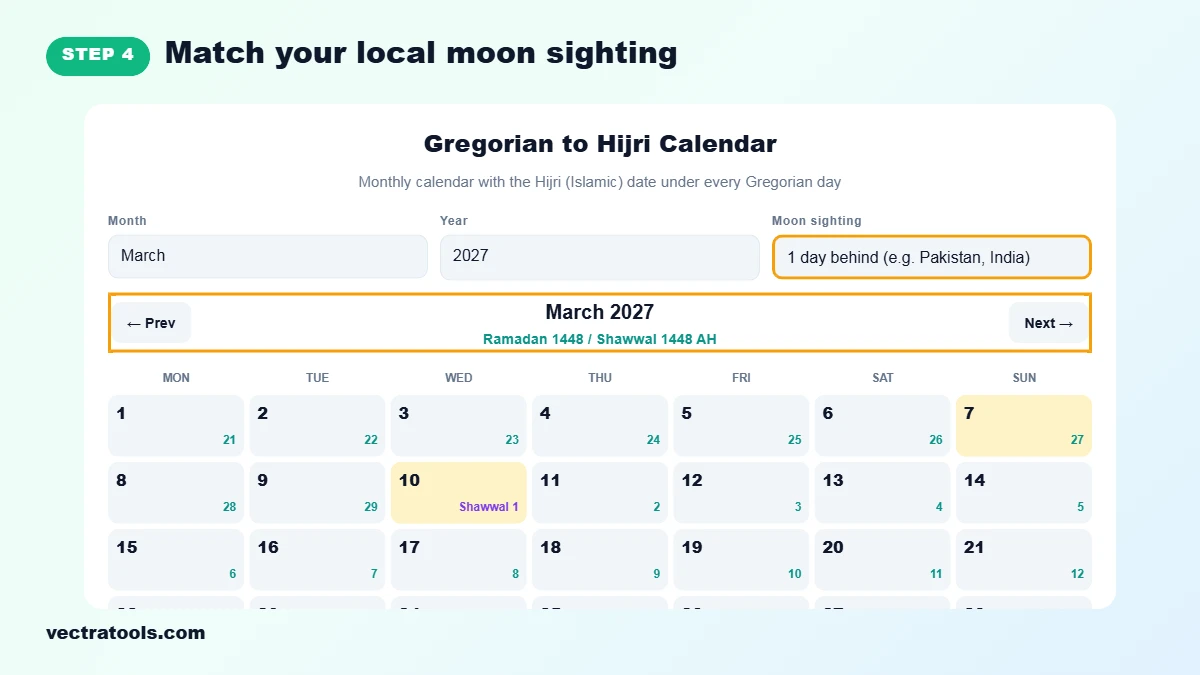
If you live where Islamic dates are usually a day behind Saudi Arabia, such as Pakistan or India, choose 1 day behind. Eid al-Fitr 1448 then moves to 10 March 2027. Use Prev and Next to move through the months.
Who Uses a Gregorian to Hijri Calendar
- Families: plan holidays and visits around Ramadan and the two Eids.
- Schools and offices: set term dates and closures in countries that observe Islamic holidays.
- Travellers: check whether a trip falls during Ramadan or the Hajj season.
- Mosques and organisers: prepare monthly timetables that show both dates.
Hijri Calendar Tips
- Hover over or tap a day to see the full Hijri date.
- Confirm the start of Ramadan and the Eid days with your local moon sighting announcement.
- To convert a single date, use the Hijri date converter, which also gives the Arabic date.
Frequently Asked Questions
What Hijri month is it now?
The calendar opens on the current month and shows the Hijri months it overlaps in the heading. October 2026 covers Rabi al-Thani and Jumada al-Ula 1448 AH.
When is Ramadan 2027?
On the Umm al-Qura calendar, 1 Ramadan 1448 is expected on Monday 8 February 2027. The actual start depends on moon sighting.
When is Eid al-Fitr 2027?
Eid al-Fitr 1448 is expected on Tuesday 9 March 2027, or a day later in countries that follow local sighting.
Why does each Gregorian month show two Hijri months?
Hijri months follow the Moon and last 29 or 30 days, so they rarely start on the 1st of a Gregorian month.
Which calendar does it use?
It uses the Umm al-Qura calendar of Saudi Arabia, with an option to shift the dates one day behind.
Can I see past or future years?
Yes. Choose any year from 1900 to 2100.
Is this Hijri calendar free?
Yes. It is free, needs no sign-up and works on any device.