

Due Date Calculator
Due Date Calculator
Calculate your estimated pregnancy due date & timeline

Quick answer
A due date calculator estimates when your baby is due by adding 280 days (40 weeks) to the first day of your last menstrual period (LMP), adjusted for cycle length. If you know the conception date, it adds 266 days instead. For example, an LMP of 1 March 2026 with a 28-day cycle gives an estimated due date of 6 December 2026.
Our free due date calculator gives you an estimated due date along with your current week of pregnancy, the trimester you are in, the dates your first and second trimesters end, and your likely conception date. You can calculate from the first day of your last period or, if you know it, from the date of conception.
It is a quick way to plan appointments, maternity leave and the months ahead. Your dates are processed only in your browser and are never saved or shared.
What Is a Due Date?
Your due date, or estimated date of delivery (EDD), is the day your pregnancy reaches 40 weeks counted from the first day of your last period. Pregnancy is counted this way because most people know when their period started but not the exact day they ovulated. You can read more about the estimated date of delivery and how it is calculated.
A due date is an estimate, not a deadline. Only a small share of babies, roughly 1 in 25, arrive on the exact day. Most are born between 37 and 42 weeks.
Due date (LMP) = LMP + 280 days + (cycle length − 28 days)
Due date (conception) = Conception date + 266 days
This is Naegele's rule, the standard method used by doctors and midwives.
How to Use the Due Date Calculator
Follow these five quick steps:
Step 1: Choose Your Calculation Method
Select Last Period (LMP) if you know the first day of your last period, or Conception Date if you know when you conceived, for example after IVF or ovulation tracking.

Step 2: Enter the Date
Pick the first day of your last period (or your conception date) from the calendar. Use the day bleeding started, not the day it ended.
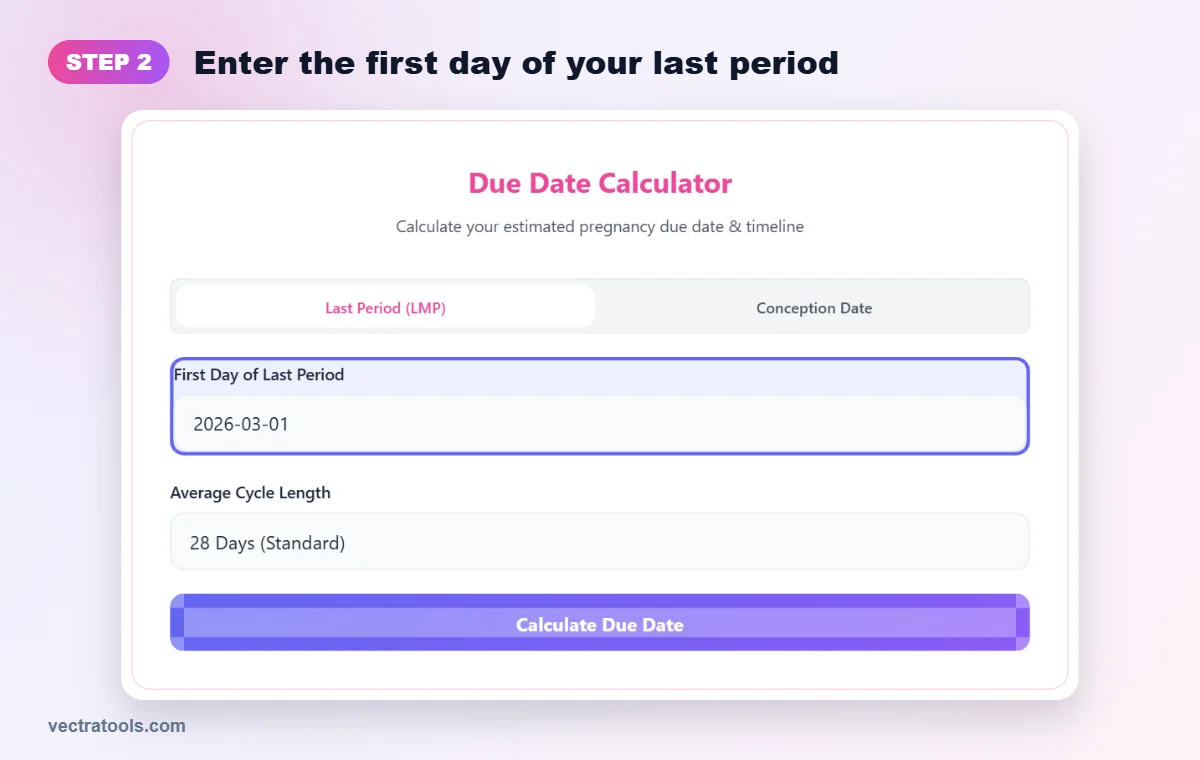
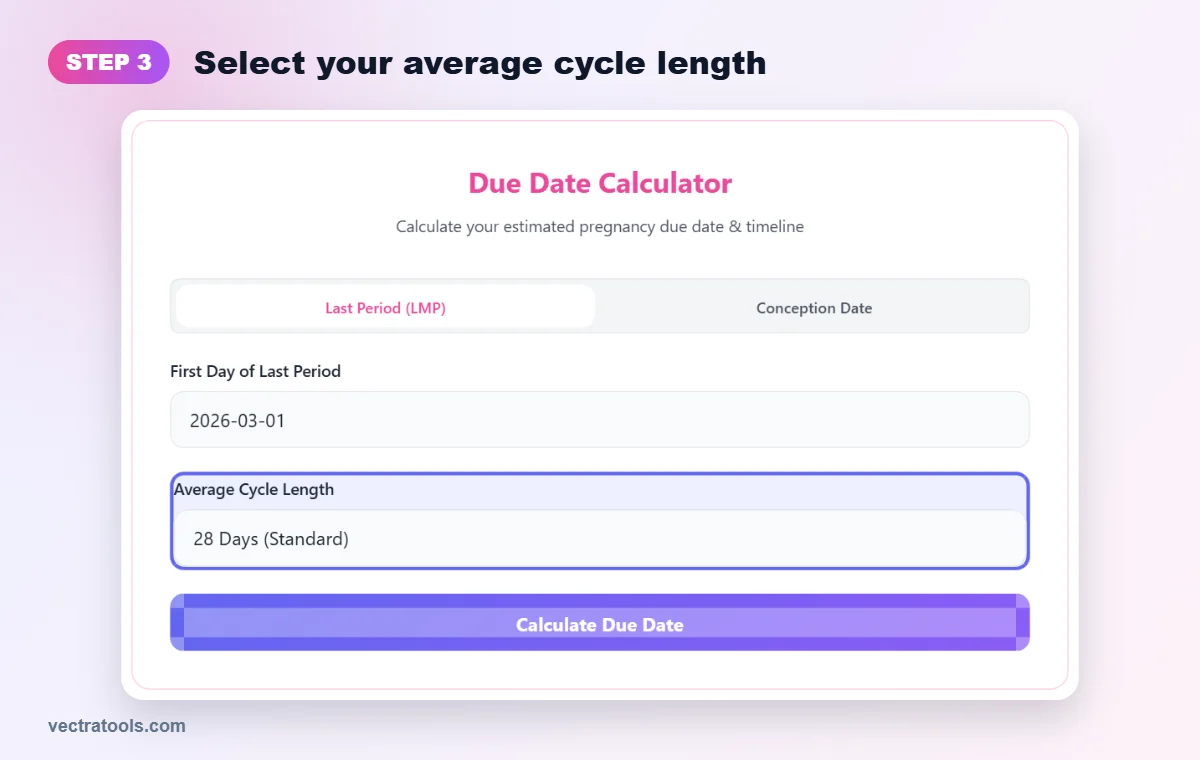
Step 3: Select Your Average Cycle Length
Choose your usual cycle length from 22 to 35 days. If you are not sure, leave it on 28 Days (Standard). A longer cycle moves the due date later; a shorter cycle moves it earlier.
Step 4: Click Calculate Due Date
Press Calculate Due Date. The due date calculator applies Naegele's rule and shows your pregnancy timeline instantly.

Step 5: Review Your Due Date and Timeline
You will see your estimated due date, which trimester you are in today, your current gestational age in weeks and days, the end dates of the first and second trimesters, and your estimated conception date.
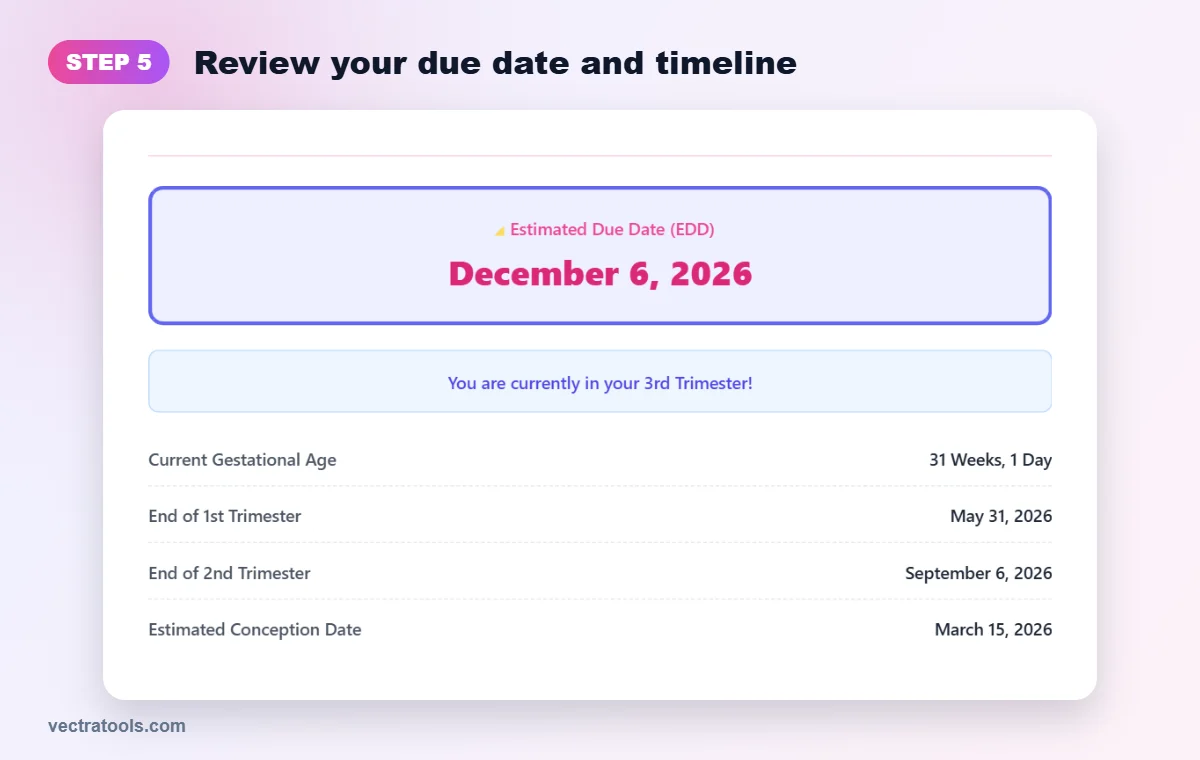
How the Due Date Is Calculated: Example
- First day of last period: 1 March 2026, with a 28-day cycle.
- Add 280 days: 1 March 2026 + 280 days = 6 December 2026.
- Conception estimate: about 14 days after the LMP, so around 15 March 2026.
- End of 1st trimester: 13 weeks after the LMP = 31 May 2026.
- End of 2nd trimester: 27 weeks after the LMP = 6 September 2026.
- Longer cycle: with a 32-day cycle, the due date moves 4 days later to 10 December 2026.
Pregnancy Trimesters at a Glance
| Trimester | Weeks | What usually happens |
|---|---|---|
| First | Weeks 1 to 13 | Pregnancy confirmed, first scan, early symptoms such as nausea and tiredness |
| Second | Weeks 14 to 27 | Anatomy scan around week 20, baby movements usually felt |
| Third | Week 28 to birth | Baby gains weight, more frequent check-ups, preparing for labour |
What Counts as Full Term?
| Category | Gestational age |
|---|---|
| Preterm | Before 37 weeks |
| Early term | 37 weeks 0 days to 38 weeks 6 days |
| Full term | 39 weeks 0 days to 40 weeks 6 days |
| Late term | 41 weeks 0 days to 41 weeks 6 days |
| Post-term | 42 weeks and beyond |
How Accurate Is a Due Date Calculator?
A due date calculator is accurate as an estimate, but the real birth date varies from person to person. Irregular cycles, uncertainty about the LMP and natural differences in pregnancy length all affect timing. An early ultrasound scan, usually in the first trimester, is the most reliable way to date a pregnancy, and your doctor or midwife may adjust your due date based on it.
Tips for the Most Reliable Estimate
- Use the first day of bleeding as your LMP, not spotting.
- Set your real cycle length if it is regularly longer or shorter than 28 days.
- Use the conception date if you had IVF or tracked ovulation.
- Trust your scan dates if your healthcare provider has updated your due date.
- Planning a pregnancy? Our Ovulation Calculator helps you find your fertile window.
Who Can Use a Due Date Calculator?
Anyone who has just had a positive pregnancy test can use a due date calculator to get a first idea of when the baby may arrive, before the first appointment. Partners and family members often use a due date calculator to plan leave, travel and support around the birth.
A due date calculator is also helpful for people tracking a pregnancy after IVF, where the transfer or conception date is known exactly. Bookmark this due date calculator so you can check your weeks pregnant again at any time.
Medical note
This due date calculator is for general information only and is not a substitute for medical advice. Always follow the dates and guidance given by your doctor or midwife.
Frequently Asked Questions
How is a due date calculated?
The standard method, Naegele's rule, adds 280 days (40 weeks) to the first day of your last menstrual period, adjusted for cycle length. If you know the conception date, 266 days are added instead.
How accurate is my due date?
It is an estimate. Only around 1 in 25 babies is born on the exact due date, and most arrive between 37 and 42 weeks. A first-trimester ultrasound gives the most accurate dating.
What if my cycle is longer or shorter than 28 days?
Select your average cycle length in the due date calculator. Each extra day above 28 moves the due date one day later, and each day below 28 moves it one day earlier.
Can I calculate my due date from the conception date?
Yes. Choose Conception Date and enter the day you conceived. The calculator adds 266 days, which is 38 weeks.
How many weeks pregnant am I?
Pregnancy is counted from the first day of your last period. The calculator shows your current gestational age in weeks and days based on today's date.
Can my doctor change my due date?
Yes. If an early ultrasound shows the baby is a different size than expected, your healthcare provider may update your due date. Use the date they give you for planning.