

Customer Lifetime Value Calculator – LTV in 3 Easy Steps
Customer Lifetime Value (LTV)
Use this customer lifetime value calculator to predict the revenue and profit one customer brings over their relationship with your business.
Use this free customer lifetime value calculator to estimate how much revenue and profit one customer brings over their whole relationship with your business. It has two modes: e-commerce and retail, based on order value and purchase frequency, and SaaS and subscription, based on monthly revenue per user and churn.
Quick answer
E-commerce LTV = Average order value × Purchases per year × Lifespan in years. SaaS LTV = Monthly ARPU ÷ Monthly churn rate. Multiply by profit margin for true (profit) LTV. A $60 order bought 4 times a year for 3 years gives $720 revenue LTV and $288 profit at a 40% margin.
Table of Contents
Customer lifetime value (CLV or LTV) tells you how much a customer is really worth, not just what they spend on the first order. Once you know it, you can decide how much to spend on ads, discounts and retention without losing money.
This customer lifetime value calculator works out both gross revenue LTV and the more useful profit-based LTV, which is the number to compare with your customer acquisition cost (CAC).
Customer Lifetime Value Formulas
E-commerce and Retail
- Annual revenue per customer = AOV × Purchase frequency per year
- Revenue LTV = Annual revenue × Average lifespan (years)
- True LTV = Revenue LTV × Profit margin %
SaaS and Subscription
- Average lifespan (months) = 1 ÷ Monthly churn rate
- Revenue LTV = Monthly ARPU × Lifespan in months, or ARPU ÷ churn
- True LTV = Revenue LTV × Gross margin %
How to Use the Customer Lifetime Value Calculator
Step 1: Enter E-commerce Customer Data
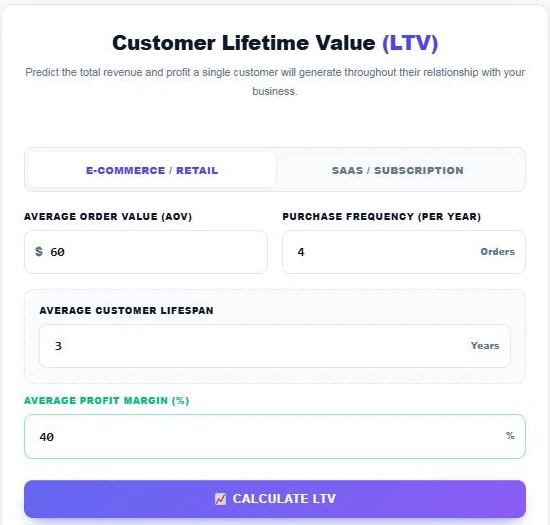
On the E-commerce / Retail tab, enter the Average Order Value ($60), Purchase Frequency per year (4), Average Customer Lifespan (3 years) and your Average Profit Margin (40%).
Step 2: Read Revenue LTV and True LTV
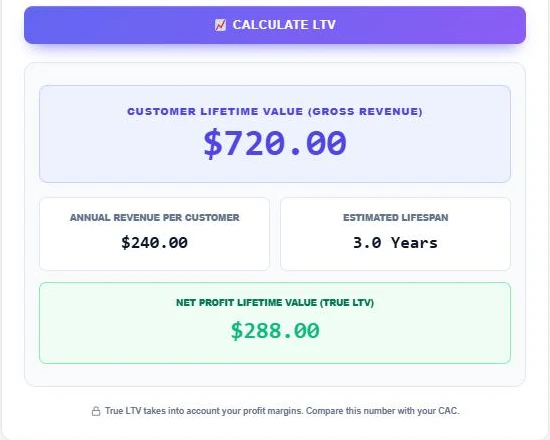
Press Calculate LTV. Each customer spends $240 a year, giving a gross revenue LTV of $720 over 3 years. After a 40% margin, the true LTV is $288, the profit you can actually use to pay for acquisition.
Step 3: Switch to SaaS / Subscription
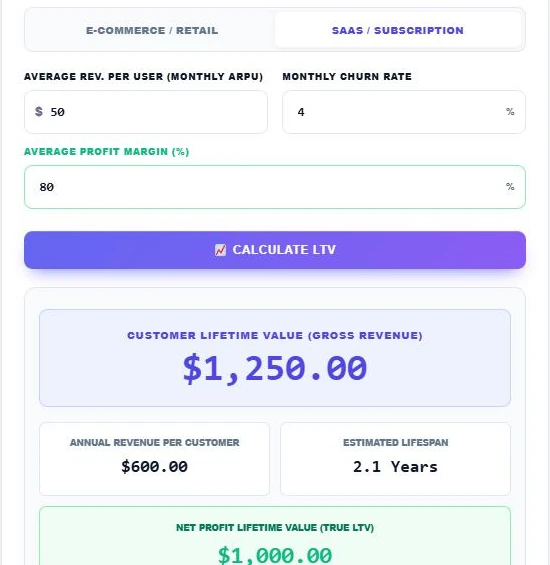
Click SaaS / Subscription. Enter monthly ARPU ($50), Monthly Churn Rate (4%) and gross margin (80%). Customers stay about 25 months (2.1 years), so revenue LTV is $1,250 and true LTV is $1,000.
LTV to CAC Ratio
Compare true LTV with customer acquisition cost:
| LTV : CAC | What it means |
|---|---|
| Below 1 : 1 | You lose money on each new customer |
| 1 : 1 to 2 : 1 | Breaking even or thin profit after overheads |
| About 3 : 1 | A common healthy target |
| 5 : 1 or higher | Very profitable; you may be under-spending on growth |
With a true LTV of $288, keeping CAC near $96 gives a 3 : 1 ratio. The SaaS example at $1,000 could support a CAC of around $330.
How Churn Changes SaaS LTV
| Monthly churn | Average lifespan | LTV at $50 ARPU |
|---|---|---|
| 2% | 50 months | $2,500 |
| 4% | 25 months | $1,250 |
| 5% | 20 months | $1,000 |
| 10% | 10 months | $500 |
Halving churn doubles lifetime value, which is why retention work often pays back faster than new acquisition.
Ways to Increase Customer Lifetime Value
- Raise order value: bundles, upsells and free-shipping thresholds.
- Increase purchase frequency: email flows, reminders and subscriptions for consumables.
- Reduce churn: better onboarding, quick support and annual plans.
- Improve margin: negotiate supplier costs and cut discount dependence.
Common Mistakes
- Using revenue LTV instead of profit LTV when setting ad budgets.
- Guessing lifespan for a new business; start with a conservative 1 to 2 years.
- Mixing all customers together. Calculate LTV for each channel or segment.
Customer Lifetime Value Calculator Example: Coffee Subscription
A coffee brand sells bags at $18, and a typical customer orders 10 times a year and stays 2 years. Revenue LTV is $18 × 10 × 2 = $360. With a 35% margin, true LTV is $126.
If paid ads bring in a new customer for $45, the LTV to CAC ratio is about 2.8 : 1. Raising average order value to $22 with a bundle lifts true LTV to $154 and the ratio to about 3.4 : 1. Try your own numbers in the customer lifetime value calculator.
Related tools: the Customer Acquisition Cost Calculator, the Customer Churn Rate Calculator and the ROAS Calculator.
Frequently Asked Questions
How do you calculate customer lifetime value?
Multiply average order value by purchases per year and by customer lifespan. $60 × 4 × 3 = $720.
How do you calculate LTV for SaaS?
Divide monthly ARPU by monthly churn rate. $50 ÷ 4% = $1,250, then multiply by gross margin for profit LTV.
What is a good LTV to CAC ratio?
Around 3 : 1 is a widely used target.
What is the difference between LTV and true LTV?
LTV is total revenue from a customer. True LTV applies your profit margin, so it shows the profit you can spend on acquisition.
How can I find average customer lifespan?
Use your own repeat-purchase data, or for subscriptions use 1 ÷ monthly churn.
Is my data stored?
No. The customer lifetime value calculator runs in your browser and nothing is saved.