

Emergency Fund Calculator – Savings Target in 3 Easy Steps
Emergency Fund Calculator
Use this emergency fund calculator to see how much cash to set aside for unexpected life events.
Use this free emergency fund calculator to work out how much cash you should keep for job loss, medical bills or urgent repairs. Enter your essential monthly costs, choose how many months to cover and add what you have already saved, and the tool shows your target, how much of it is funded and how much more you need.
Quick answer
Emergency fund target = Essential monthly expenses × Months to cover. With $2,600 of essential costs a month, a 3-month fund is $7,800 and a 6-month fund is $15,600. If you already have $5,000 saved, you are 32% of the way to the 6-month goal and need $10,600 more.
Table of Contents
An emergency fund is money set aside only for real emergencies. It stops a surprise bill from turning into credit card debt and gives you time to find a new job without panic. Most guides suggest three to six months of essential spending.
This emergency fund calculator uses your own numbers rather than a rule of thumb based on salary, so the target matches the life you actually live.
Emergency Fund Formula
- Monthly essentials = Housing + Utilities + Groceries + Transport + Minimum debt payments + Other essentials
- Target fund = Monthly essentials × Months to cover
- Amount needed = Target − Current savings
- Percent funded = Current savings ÷ Target × 100
How to Use the Emergency Fund Calculator
Step 1: Enter Your Essential Monthly Expenses
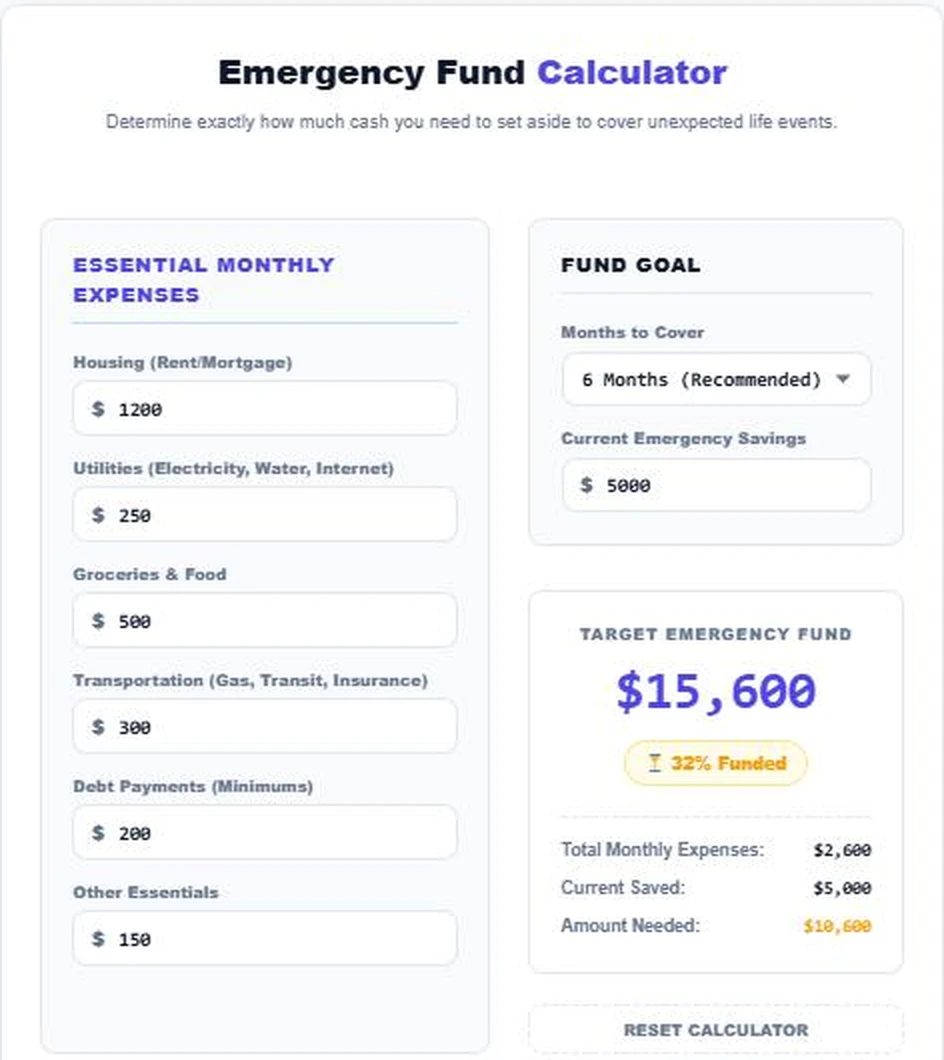
Fill in only the costs you would still pay if your income stopped: Housing ($1,200), Utilities ($250), Groceries & Food ($500), Transportation ($300), Debt Payments at the minimum ($200) and Other Essentials ($150). That totals $2,600 a month.
Step 2: Choose Months to Cover and Add Your Savings
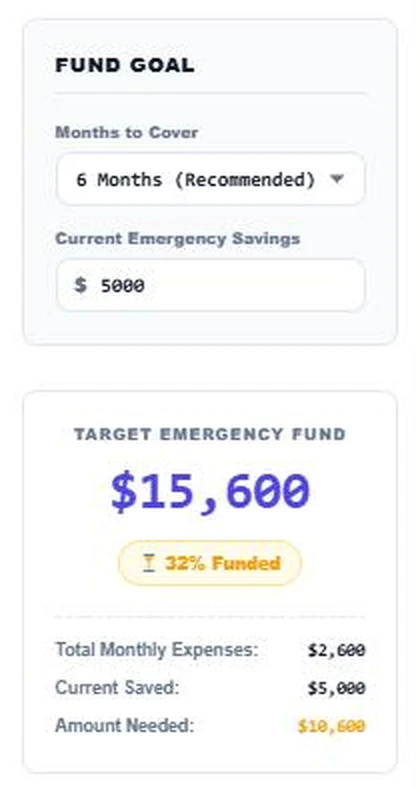
Under Fund Goal, select 6 Months (Recommended) and enter Current Emergency Savings of $5,000. The target is $15,600, you are 32% funded, and you need $10,600 more.
Step 3: See When Your Goal Is Fully Funded
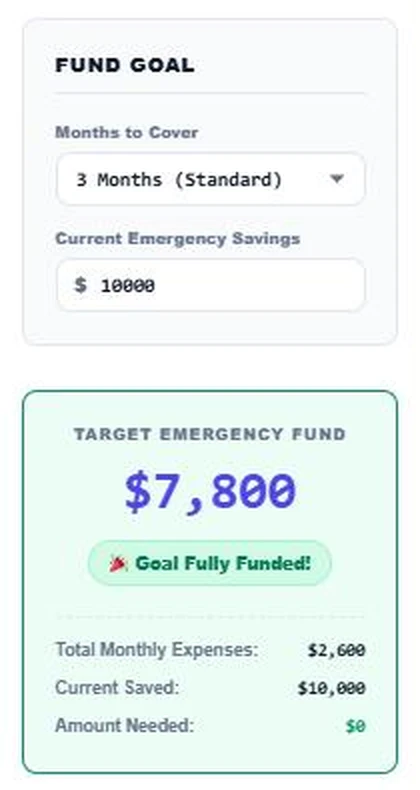
Switch to 3 Months (Standard) with $10,000 saved. The target drops to $7,800 and the card shows Goal Fully Funded! with $0 still needed. Press Reset Calculator to start again.
Emergency Fund Targets
Based on $2,600 of essential expenses a month:
| Months to cover | Target | Best for |
|---|---|---|
| 1 month | $2,600 | A first starter goal |
| 3 months | $7,800 | Stable job, dual income, no dependants |
| 6 months | $15,600 | Most households |
| 9 months | $23,400 | Single income or variable pay |
| 12 months | $31,200 | Freelancers, business owners, specialist roles |
How Many Months Do You Need?
- Choose more months if you are self-employed, the only earner, work in a volatile industry, have children or have health costs to plan for.
- Fewer months may be enough if you have two stable incomes, strong job demand in your field and good insurance.
How to Build Your Emergency Fund
- Start with one month of expenses, then build to three, then six.
- Set up an automatic transfer on payday, even if it is small.
- Put windfalls such as tax refunds or bonuses straight into the fund.
- Use the savings share of the 50/30/20 budget for this goal first.
- Cut one or two wants temporarily to speed things up.
Where to Keep Emergency Money
- A high-yield savings account or money market account that you can reach within a day or two.
- Separate from your everyday account, so it is not spent by accident.
- Not in shares or crypto, where the value can drop exactly when you need it.
What Counts as an Emergency?
Job loss, urgent medical or dental bills, essential car or home repairs and emergency travel all qualify. Holidays, sales and planned purchases do not. Use separate savings goals for those, and refill the emergency fund after you use it.
Emergency Fund Calculator Example: Freelancer
A freelance designer has essential costs of $1,900 a month and irregular income, so she picks 9 months. Her target is $17,100. She already has $4,000 saved, so she needs $13,100 more.
Saving $700 a month gets her there in about 19 months. Saving 25% of each invoice during busy months shortens that. Recheck the emergency fund calculator whenever rent or other fixed costs change.
Related tools: the 50/30/20 Budget Calculator, the Net Worth Calculator and the RD Calculator.
Frequently Asked Questions
How much should be in an emergency fund?
Most people aim for 3 to 6 months of essential expenses. With $2,600 a month, that is $7,800 to $15,600.
Should I use income or expenses to size my fund?
Use essential expenses. That is what you need to keep paying if income stops.
Should I save an emergency fund or pay off debt first?
Many people build a small starter fund first, then focus on high-interest debt, then finish the full fund.
Where should I keep my emergency fund?
In a safe, easy-to-reach account such as a high-yield savings account.
How long does it take to build an emergency fund?
Divide the amount needed by what you can save each month. $10,600 at $500 a month takes about 22 months.
Is my data stored?
No. The emergency fund calculator runs in your browser and nothing is saved.