

Definite Integral Calculator – Area Under a Curve Between Two Limits
Definite Integral Calculator
Calculate the definite integral and find the exact area under a curve. Enter your function and the upper/lower limits to compute.

Quick answer
A definite integral calculator finds the signed area under a curve between two x values. Enter the function f(x), the lower bound a and the upper bound b, then click Calculate Area. The tool evaluates ∫ f(x) dx from a to b numerically using Simpson’s 1/3 rule with 10,000 sub-intervals; for example, ∫ x² dx from 0 to 5 = 41.66667.
Our free definite integral calculator handles polynomials, trigonometric, exponential and logarithmic functions. Four quick examples (x², sin x, 1/x and eˣ) show how it works in one click.
Because it integrates numerically, the definite integral calculator gives a decimal answer rather than an antiderivative. With 10,000 sub-intervals the result is extremely accurate for smooth functions. Areas below the x-axis count as negative, as in standard calculus.
How the Definite Integral Is Calculated
Simpson’s 1/3 rule splits the interval [a, b] into an even number n of small strips of width h = (b − a) ÷ n and fits parabolas through the points:
- ∫ f(x) dx ≈ (h ÷ 3) × [f(x₀) + 4f(x₁) + 2f(x₂) + 4f(x₃) + … + 4f(xₙ₋₁) + f(xₙ)]
With n = 10,000 the error is tiny for well-behaved functions, so results usually match exact answers to five decimal places.
Example Results
| Integral | Exact value | Calculator result |
|---|---|---|
| ∫₀⁵ x² dx | 125/3 | 41.66667 |
| ∫₀^π sin(x) dx | 2 | 2 |
| ∫₁¹⁰ 1/x dx | ln 10 | 2.30259 |
| ∫₀² eˣ dx | e² − 1 | 6.38906 |
How to Use the Definite Integral Calculator
Use the definite integral calculator in four steps.
Step 1: Enter the Function to Integrate
Type f(x) using ^ for powers, for example x^2, sin(x), 1/x or exp(x).
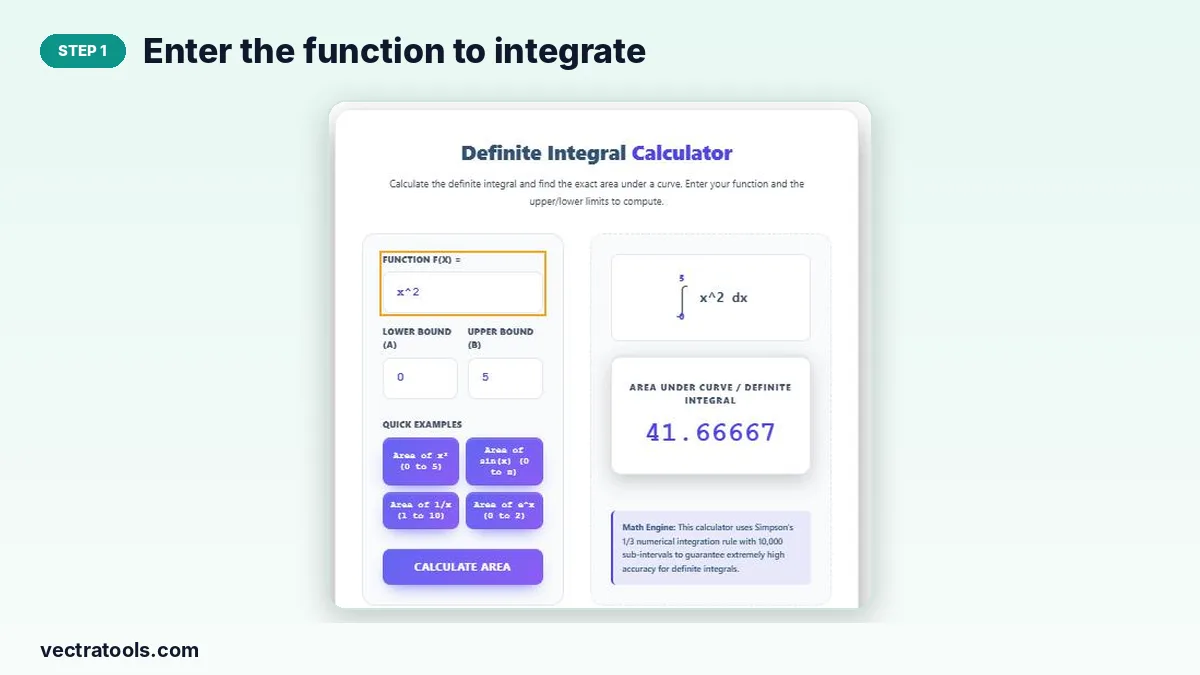
Step 2: Set the Lower and Upper Bounds
Enter the lower limit a and the upper limit b, such as 0 and 5.

Step 3: Or Try a Quick Example
Tap one of the examples to fill in a function and limits automatically, which is a quick way to learn the input format.

Step 4: Calculate the Area Under the Curve
Click Calculate Area. The integral appears in notation with the numeric answer below it.

Definite vs Indefinite Integrals
An indefinite integral is a family of functions (an antiderivative plus C). A definite integral has limits and gives a single number: the net area between the curve and the x-axis from a to b. By the Fundamental Theorem of Calculus, ∫ₐᵇ f(x) dx = F(b) − F(a), where F is any antiderivative of f.
Tips for Accurate Results
- Check the function is defined across the whole interval; 1/x from −1 to 1 crosses a vertical asymptote.
- Use radians for trigonometric functions; π is about 3.14159.
- Split the integral at points where the curve crosses the x-axis if you need total (unsigned) area.
- Swap a and b and the sign of the answer changes.
Why Use a Definite Integral Calculator?
Some integrals have no simple antiderivative, and others are long to work out by hand. A definite integral calculator gives a reliable numeric answer in a moment, ideal for checking homework, physics problems like work and displacement, or probability calculations.
Frequently Asked Questions
Is this definite integral calculator free?
Yes. It is free with no sign-up.
Does it give exact answers?
It gives highly accurate decimal answers using Simpson’s rule with 10,000 intervals, not symbolic antiderivatives.
Can the result be negative?
Yes. Area below the x-axis counts as negative in a definite integral.
Should trig functions use degrees or radians?
Radians. For example, use 3.14159 for π.
What is ∫ x² dx from 0 to 5?
125/3, which is about 41.66667.
Can it handle improper integrals?
Not directly. Avoid limits at infinity or points where the function is undefined.