

Fertility Calculator – Best Days to Conceive and Ovulation Date
Fertility Calculator
Planning for a baby? Calculate your exact fertile window, ovulation day, and best days to conceive based on your menstrual cycle.

Quick answer
A fertility calculator estimates the days in your cycle when you are most likely to get pregnant. Enter the first day of your last period, your average cycle length and, if you know it, your luteal phase, then click Calculate Fertility. You will see your best days to conceive, expected ovulation date, possible implantation days and the due date if you conceive this cycle.
Our free fertility calculator is built for people who are trying to conceive and want to time intercourse around ovulation. It runs in your browser, so your cycle details are not stored or shared.
The results are estimates based on typical cycles. Ovulation can shift from month to month, and conditions such as PCOS or thyroid problems can make cycles irregular. This fertility calculator is not a contraceptive method and is not a substitute for advice from a doctor or fertility specialist.
How the Fertility Calculator Works
- Ovulation day: first day of last period + cycle length − luteal phase (14 days by default).
- Best days to conceive: the 3 days before ovulation, ovulation day and the day after.
- Possible implantation: about 7 to 10 days after ovulation.
- Due date if pregnant: ovulation day + 266 days.
Example: with a last period on 1 October 2026, a 30-day cycle and a 14-day luteal phase, ovulation is expected on 17 October, the best days to conceive are 14 to 18 October, implantation may happen from 24 to 27 October and the estimated due date would be 10 July 2027.
What Is the Luteal Phase?
The luteal phase is the time from ovulation to the start of your next period. It is usually 12 to 16 days and tends to stay fairly constant for each person, while the first half of the cycle varies more. If you track ovulation with tests or temperature charts, entering your own luteal phase makes the fertility calculator more accurate.
How to Use the Fertility Calculator
Use the fertility calculator in four steps.
Step 1: Enter the First Day of Your Last Period
Pick the date your most recent period started (the first day of full flow).

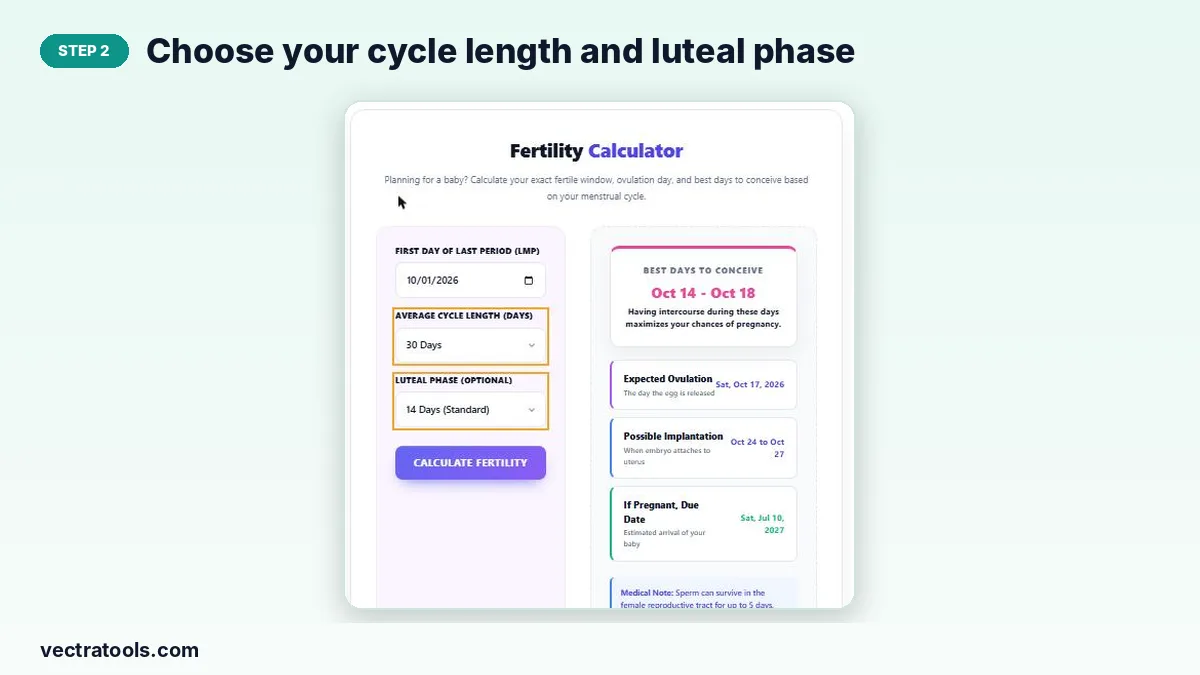
Step 2: Choose Your Cycle Length and Luteal Phase
Select your average cycle length from 21 to 35 days. Leave the luteal phase at 14 days unless you know your own.
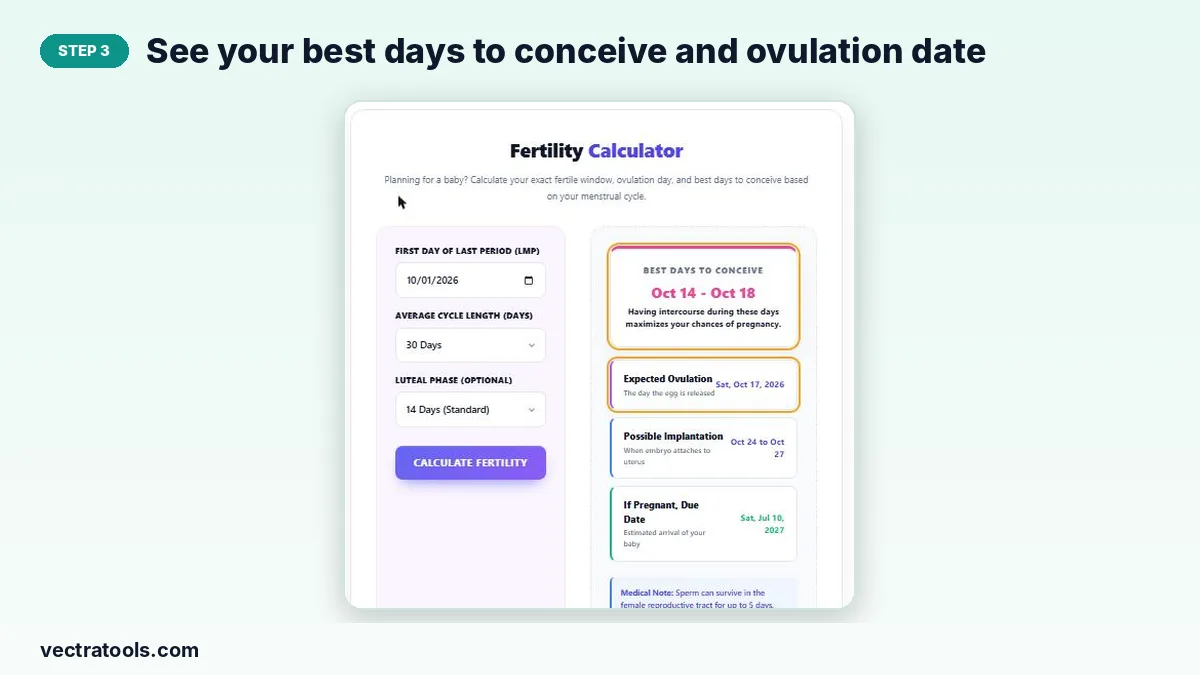
Step 3: See Your Best Days to Conceive and Ovulation Date
Click Calculate Fertility. The top card shows your most fertile days and the next card shows the expected ovulation date.
Step 4: Check Implantation Days and the Possible Due Date
Further down you will find when implantation may happen and the estimated due date if you conceive in this cycle.

Tips to Improve Your Chances of Conceiving
- Have intercourse every one to two days during your fertile window.
- Use ovulation predictor kits to confirm the LH surge before ovulation.
- Watch for clear, stretchy cervical mucus, a common sign of peak fertility.
- Take a daily folic acid supplement before and during early pregnancy, as recommended by health services.
- Limit alcohol, stop smoking and aim for regular sleep.
When to Seek Help
Speak to a doctor if you are under 35 and have been trying for 12 months, or 35 and over and trying for 6 months, without success. See a doctor sooner if your periods are very irregular or absent, or if you or your partner have a known medical condition that affects fertility.
Why Use a Fertility Calculator?
An egg survives only 12 to 24 hours after it is released, but sperm can live for up to 5 days. That means the days before ovulation matter most. A fertility calculator shows those days clearly so you can plan, rather than guessing from a calendar.
Frequently Asked Questions
Is this fertility calculator free?
Yes. It is free and private, with no sign-up.
When am I most fertile?
In the few days before ovulation and on ovulation day itself.
How is ovulation calculated?
The fertility calculator subtracts your luteal phase (usually 14 days) from the date your next period is due.
Can I get pregnant outside the fertile window?
It is much less likely, but cycles vary, so pregnancy is possible on other days.
Can I use this as birth control?
No. It gives estimates and should not be used to prevent pregnancy.
How accurate is the due date?
It is an estimate. Your doctor or midwife will confirm it, usually with an ultrasound scan.