

Weight Loss Calculator – Calories and Timeline to Your Goal Weight
Weight Loss Calculator
Discover exactly how many calories to eat and the exact date you will reach your goal weight based on healthy, sustainable pacing.
Quick answer
A weight loss calculator estimates how many calories to eat each day and how long it will take to reach your goal weight. Enter your gender, age, height, current weight, goal weight and activity level, choose a weekly pace, and click Calculate Timeline. You get a daily calorie budget, the number of weeks to goal and an estimated date.
Our free weight loss calculator combines the Mifflin-St Jeor equation with the widely used estimate that about 7,700 calories equal 1 kg of body fat (about 3,500 calories per pound). It works in metric and imperial units and includes a safety net so calorie targets never fall below common minimums.
This weight loss calculator is for healthy adults and gives estimates only. Real progress varies with water weight, hormones, sleep, medication and how accurately food is tracked. Talk to a doctor before losing weight if you are pregnant, under 18 or have a medical condition.
How the Weight Loss Calculator Works
- Estimate BMR with Mifflin-St Jeor using gender, age, height and weight.
- Multiply BMR by your activity level to get maintenance calories (TDEE).
- Convert your weekly pace into a daily deficit: kg per week × 7,700 ÷ 7.
- Subtract the deficit from TDEE to get your daily calorie budget.
- Divide the weight to lose by your weekly pace to get weeks to goal, then add that to today’s date.
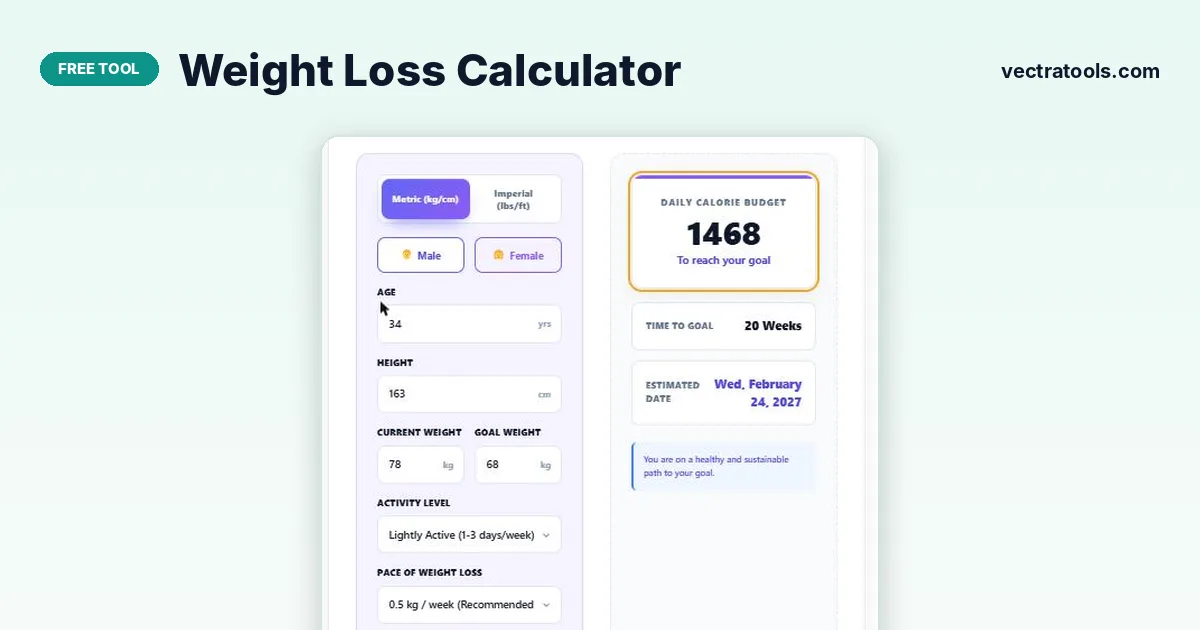
Example: a 34-year-old woman, 163 cm, 78 kg, lightly active, aiming for 68 kg at 0.5 kg a week, gets a budget of about 1,468 calories a day and reaches her goal in about 20 weeks.
Weekly Pace Options
| Pace | Daily deficit | Time to lose 10 kg |
|---|---|---|
| 0.25 kg / week (Mild) | about 275 kcal | about 40 weeks |
| 0.5 kg / week (Recommended) | about 550 kcal | about 20 weeks |
| 1 kg / week (Extreme) | about 1,100 kcal | about 10 weeks |
How to Use the Weight Loss Calculator
Plan your timeline with the weight loss calculator in four steps.
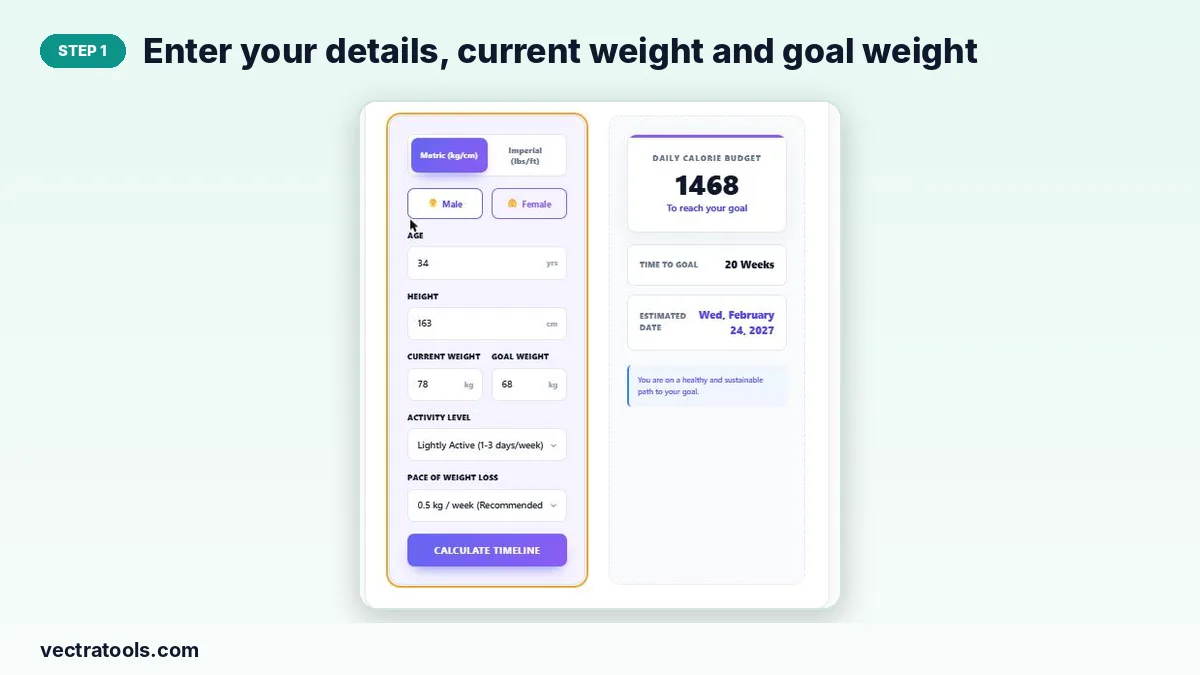
Step 1: Enter Your Details, Current Weight and Goal Weight
Choose units and gender, then enter your age, height, current weight and the goal weight you want to reach.
Step 2: Choose Your Activity Level and Weekly Pace
Select how active you are and pick a pace: 0.25 kg, 0.5 kg (recommended) or 1 kg per week.

Step 3: Read Your Daily Calorie Budget
Click Calculate Timeline. The top card shows how many calories to eat per day to lose weight at your chosen pace.

Step 4: See Weeks to Goal and Your Estimated Date
Below the budget you will see how many weeks it should take and the date you can expect to reach your goal weight.

Built-In Safety Minimum
If your chosen pace would push calories below 1,200 a day for women or 1,500 a day for men, the weight loss calculator raises your budget to that minimum, slows the weekly pace and shows a warning. This helps keep plans realistic and reduces the risk of losing muscle or missing nutrients.
Tips to Stay on Track
- Weigh yourself at the same time each morning and watch the weekly average.
- Expect a faster drop in the first week or two, mostly from water.
- Keep protein high and include strength training to protect muscle.
- Re-run the weight loss calculator every 4 to 5 kg, because your calorie needs drop as you get lighter.
- Plan for plateaus; a short break at maintenance calories can help you stay consistent.
Why Use a Weight Loss Calculator With a Timeline?
A clear end date makes a goal feel achievable. Seeing that 10 kg takes about 20 weeks at a healthy pace also helps you avoid crash diets. A weight loss calculator gives you both the daily number and the bigger picture.
Frequently Asked Questions
Is this weight loss calculator free?
Yes. It is free with no sign-up.
How many calories are in 1 kg of fat?
About 7,700 calories, or about 3,500 calories per pound. The calculator uses this estimate.
What is a safe rate of weight loss?
For most adults, about 0.5 to 1 kg (1 to 2 lb) a week is considered safe and sustainable.
Why is my goal date later than expected?
The calculator may have raised your calories to a safe minimum, which slows the pace. Increasing activity can help.
Why am I losing slower than the calculator says?
Water retention, tracking errors and changes in daily activity are common reasons. Review your average over three to four weeks.
Is this medical advice?
No. It is an estimate. Speak to a healthcare professional for personal advice.