

Percent to PPM Converter – Parts Per Million in 3 Easy Steps
Percent to PPM Converter
Use this percent to PPM converter to change percentages to parts-per-million (ppm) or vice versa instantly with our real-time calculator.
Use this free percent to PPM converter to switch between percentages and parts per million in real time. Type a percentage to get ppm, or type ppm to get the percentage, with the formula shown and a quick table of common values from 100% down to 0.00001%.
Quick answer
1% = 10,000 ppm. To convert percent to ppm, multiply by 10,000. To convert ppm to percent, divide by 10,000. So 1.5% = 15,000 ppm, 0.0025% = 25 ppm, and 420 ppm = 0.042%.
Table of Contents
Percent means parts per hundred, while ppm means parts per million. Scientists, water labs, farmers and pool owners use ppm because it handles very small concentrations without long strings of zeros after the decimal point.
This percent to PPM converter moves between the two instantly, so you can compare a lab report, a product label and a recipe that use different units.
Percent to PPM Formula
- ppm = percent × 10,000
- percent = ppm ÷ 10,000
- ppb (parts per billion) = ppm × 1,000
- For dilute water solutions, 1 ppm ≈ 1 mg per litre.
Percent to PPM Conversion Table
| Percent | PPM | PPB |
|---|---|---|
| 100% | 1,000,000 ppm | 1,000,000,000 ppb |
| 10% | 100,000 ppm | 100,000,000 ppb |
| 1% | 10,000 ppm | 10,000,000 ppb |
| 0.5% | 5,000 ppm | 5,000,000 ppb |
| 0.1% | 1,000 ppm | 1,000,000 ppb |
| 0.05% | 500 ppm | 500,000 ppb |
| 0.01% | 100 ppm | 100,000 ppb |
| 0.001% | 10 ppm | 10,000 ppb |
| 0.0001% | 1 ppm | 1,000 ppb |
How to Use the Percent to PPM Converter
Step 1: Enter a Percentage
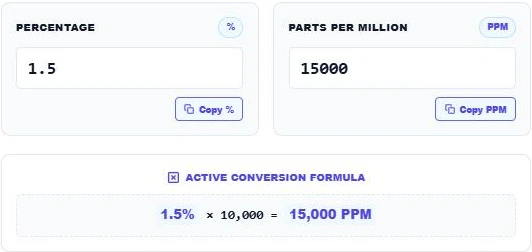
Type the value in Percentage. For 1.5%, the converter shows 15,000 ppm, and the formula panel reads 1.5% × 10,000 = 15,000 PPM. Decimals and very small numbers both work.
Step 2: Convert PPM Back to Percent
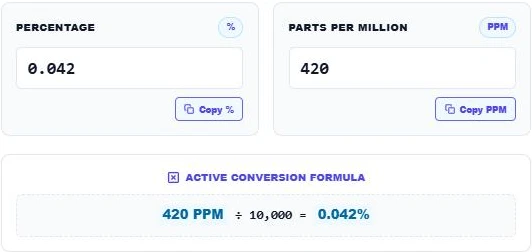
Type in Parts Per Million to go the other way. 420 ppm, a typical figure for carbon dioxide in outdoor air in recent years, equals 0.042%. Use Copy % or Copy PPM to paste the value elsewhere.
Step 3: Check the Common Values
The Common % to PPM Values panel lists each step from 100% (1,000,000 ppm) down to 0.00001% (0.1 ppm). Each step down divides by 10. Press Clear Fields to start over.

Where PPM Is Used
- Drinking water: total dissolved solids (TDS) are reported in ppm. 500 ppm is 0.05%.
- Pools: free chlorine is usually kept around 1–3 ppm.
- Air quality: carbon dioxide indoors and outdoors is measured in ppm.
- Agriculture and hydroponics: nutrient strength is given in ppm.
- Metals and chemistry: trace impurities in alloys and reagents.
- Gold and silver: high purity grades are sometimes described in ppm of impurities.
Mass vs Volume PPM
ppm is a ratio, so it can be by mass (mg/kg), by volume (µL/L) or, for gases, by moles. Make sure both numbers you compare use the same basis. In water at room temperature, 1 ppm by mass is close to 1 mg/L, which is why lab reports often treat them as equal.
Worked Examples
- Fertiliser: a nutrient solution with 0.2% nitrogen contains 0.2 × 10,000 = 2,000 ppm nitrogen.
- Salt water: seawater is about 3.5% salt, which is 35,000 ppm.
- Water filter: tap water at 250 ppm TDS is 0.025% dissolved solids.
- Gas leak alarm: a 50 ppm threshold equals 0.005% of the air.
Common Mistakes
- Multiplying by 1,000 instead of 10,000. That gives parts per hundred thousand, not ppm.
- Mixing percent by weight with ppm by volume for gases.
- Forgetting that a percentage already has the 100 built in. 0.5 as a fraction is 50%, which is 500,000 ppm.
- Rounding very small values too early. Keep at least three significant figures for lab work.
The percent to PPM converter keeps full precision, so you can copy the exact value into a report or spreadsheet.
More conversion tools: the Karat to Gold Percentage Converter, the Specific Gravity to Brix Converter and the Grains to Grams Converter.
Frequently Asked Questions
How many ppm is 1 percent?
1% equals 10,000 ppm.
How do I convert ppm to percent?
Divide ppm by 10,000. 420 ppm ÷ 10,000 = 0.042%.
What is 0.1% in ppm?
0.1% is 1,000 ppm.
Is ppm the same as mg/L?
For dilute water solutions, 1 ppm is very close to 1 mg/L, so they are often used interchangeably.
How do I convert ppm to ppb?
Multiply ppm by 1,000. 1 ppm = 1,000 ppb.
Is my data saved?
No. The percent to PPM converter runs in your browser and nothing is stored.