

Impermanent Loss Calculator – Compare HODL vs Liquidity Pool Value
Impermanent Loss Calculator
Use this free impermanent loss calculator to estimate the exact impermanent loss for a 50/50 liquidity pool.
Quick answer
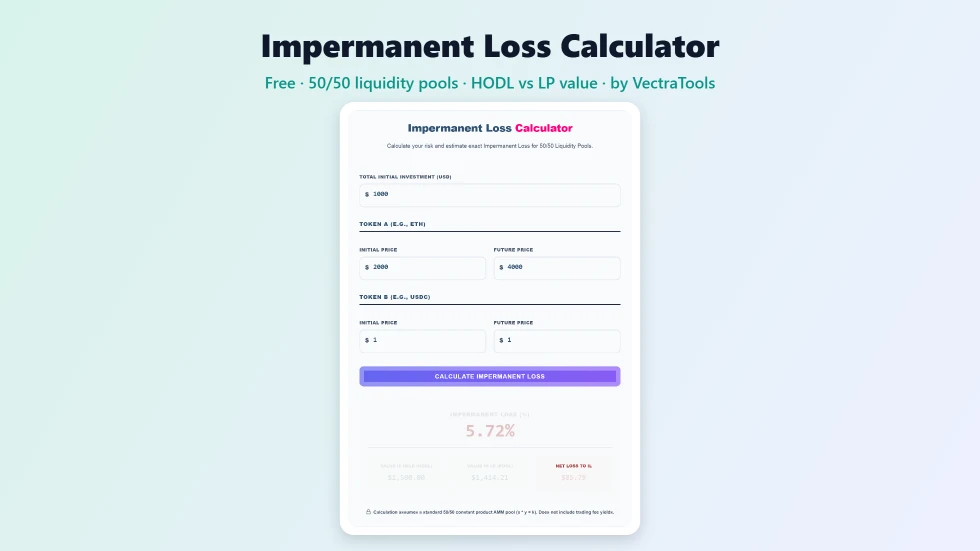
To use this impermanent loss calculator, enter your total investment, then the starting and future prices of both tokens in a 50/50 pool, such as ETH and USDC, and press Calculate Impermanent Loss. The tool compares the value if you had simply held the tokens with the value in the pool. For example, if ETH doubles from $2,000 to $4,000 while USDC stays at $1, a $1,000 deposit is worth $1,414.21 in the pool versus $1,500 held: a 5.72% impermanent loss.
Providing liquidity on Uniswap, PancakeSwap or another AMM earns trading fees, but it has a hidden cost. When the prices of the two tokens move apart, the pool automatically rebalances, and you end up with less value than if you had just held the tokens. This free impermanent loss calculator shows that cost in dollars and percent.
It uses the standard constant-product formula (x × y = k) for 50/50 pools. I verified it against the well-known benchmarks: a 2x price change gives about 5.7% impermanent loss and a 4x change about 20%. Trading fees are not included, so compare the result with the fees you expect to earn.
Impermanent Loss Calculator Features
| Feature | How it works |
|---|---|
| 50/50 pool maths | Constant-product AMM formula (x × y = k) |
| Two-token prices | Starting and future prices for token A and token B |
| Impermanent loss % | Loss compared with simply holding |
| HODL value | What your tokens would be worth if not pooled |
| LP value | What your pool share is worth after the price change |
| Net loss in dollars | Difference between HODL and LP value |
| Works with stablecoins | Set token B to $1 for ETH/USDC-style pools |
| Private | Runs in your browser with no wallet |
How to Use the Impermanent Loss Calculator
Step 1: Enter your total investment
Type the total dollar value you deposit into the pool. In a 50/50 pool, half goes into each token.

Step 2: Enter starting and future prices for both tokens
For Token A (for example ETH) and Token B (for example USDC), enter the price when you deposited and a future price you want to test. For a stablecoin, keep both prices at $1. Press Calculate Impermanent Loss.

Step 3: Compare HODL value with LP value
The result shows impermanent loss as a percentage, the value if you had held, the value in the pool and the net loss in dollars. If expected trading fees are higher than this loss, providing liquidity may still be profitable.

Impermanent Loss by Price Change
- 1.25x change: about 0.6% loss
- 1.5x change: about 2.0% loss
- 2x change: about 5.7% loss
- 3x change: about 13.4% loss
- 4x change: about 20.0% loss
- 5x change: about 25.5% loss
- The same applies when a price falls by the same ratio, for example to half.
Why It Is Called Impermanent
The loss only becomes permanent when you withdraw. If prices return to where they were when you deposited, the impermanent loss disappears. If you withdraw while prices are far apart, the loss is locked in. Fees earned while in the pool can offset some or all of it.
Impermanent Loss Calculator Tips
- Pools of two stablecoins, or of closely correlated tokens, have much lower impermanent loss.
- High-volume pools earn more fees, which can outweigh moderate impermanent loss.
- Concentrated liquidity (such as Uniswap v3) earns more fees but suffers bigger impermanent loss when prices leave your range.
- Model several future prices, both up and down, before providing liquidity.
- This impermanent loss calculator is for 50/50 pools; weighted pools behave differently.
Frequently Asked Questions
Is this impermanent loss calculator free?
Yes. It is free with no sign-up and no wallet connection.
What is impermanent loss?
It is the difference in value between holding two tokens and providing them to a liquidity pool, caused by the pool rebalancing when prices change.
How much impermanent loss is there if the price doubles?
In a 50/50 pool, a 2x change in the price ratio causes about 5.72% impermanent loss.
Does it include trading fees?
No. Trading fees earned by the pool can offset impermanent loss, so compare the result with your expected fee income.
Does it work for Uniswap v3?
It models standard full-range 50/50 pools. Concentrated liquidity positions have larger impermanent loss within their price range.
Is impermanent loss always a loss?
It is always a loss compared with holding, but you can still make an overall profit if fees and token price gains are larger.