

GUID and UUID Generator – Random UUID v4 and v7 in Bulk
UUID Generator
Generate random UUID v4 and time-ordered UUID v7 identifiers, or GUIDs for .NET, in bulk, and validate any UUID

Quick answer
A UUID generator creates universally unique identifiers, 128-bit values written as 32 hexadecimal characters such as 3f2b6c1e-8d4a-4f6b-9c2e-1a7d5e9b0c3f. Choose version 4 for fully random IDs or version 7 for IDs that sort by creation time, pick a format and copy one or download up to 1,000 at once.
Our free UUID generator follows RFC 9562, the current UUID standard, and uses your browser's cryptographic random generator. It formats IDs with or without hyphens, in braces for Microsoft GUIDs or with a urn:uuid: prefix, and it can validate a UUID to tell you its version, variant and, for v7, the time it was created.
UUID v4 vs UUID v7
| Version | How it is made | Best for |
|---|---|---|
| v4 | 122 random bits | General unique IDs, tokens, file names |
| v7 | 48-bit Unix time in milliseconds plus random bits | Database primary keys, logs and events that should sort by time |
| Nil | All zeros | A placeholder for an empty or unknown ID |
UUID Formats
| Format | Example |
|---|---|
| Standard | 3f2b6c1e-8d4a-4f6b-9c2e-1a7d5e9b0c3f |
| No hyphens | 3f2b6c1e8d4a4f6b9c2e1a7d5e9b0c3f |
| Braces (.NET GUID) | {3F2B6C1E-8D4A-4F6B-9C2E-1A7D5E9B0C3F} |
| URN | urn:uuid:3f2b6c1e-8d4a-4f6b-9c2e-1a7d5e9b0c3f |
How to Use the UUID Generator
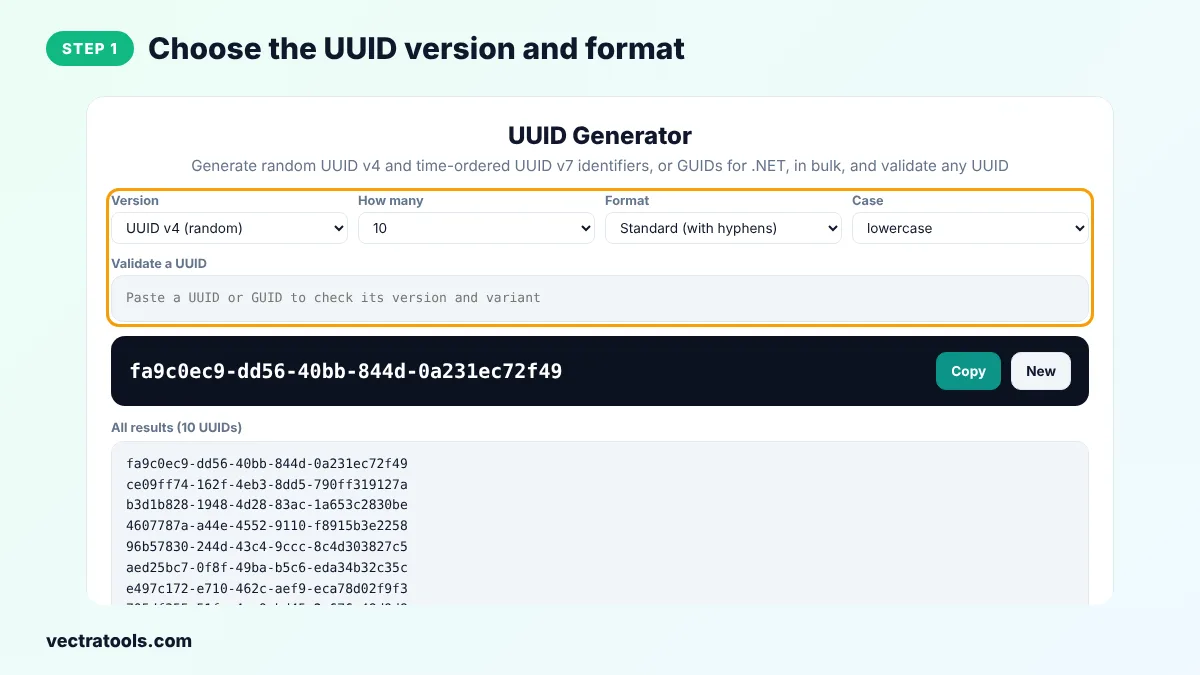
Step 1: Choose the UUID Version and Format
Select UUID v4, UUID v7 or Nil, choose how many you need and pick the format and letter case.
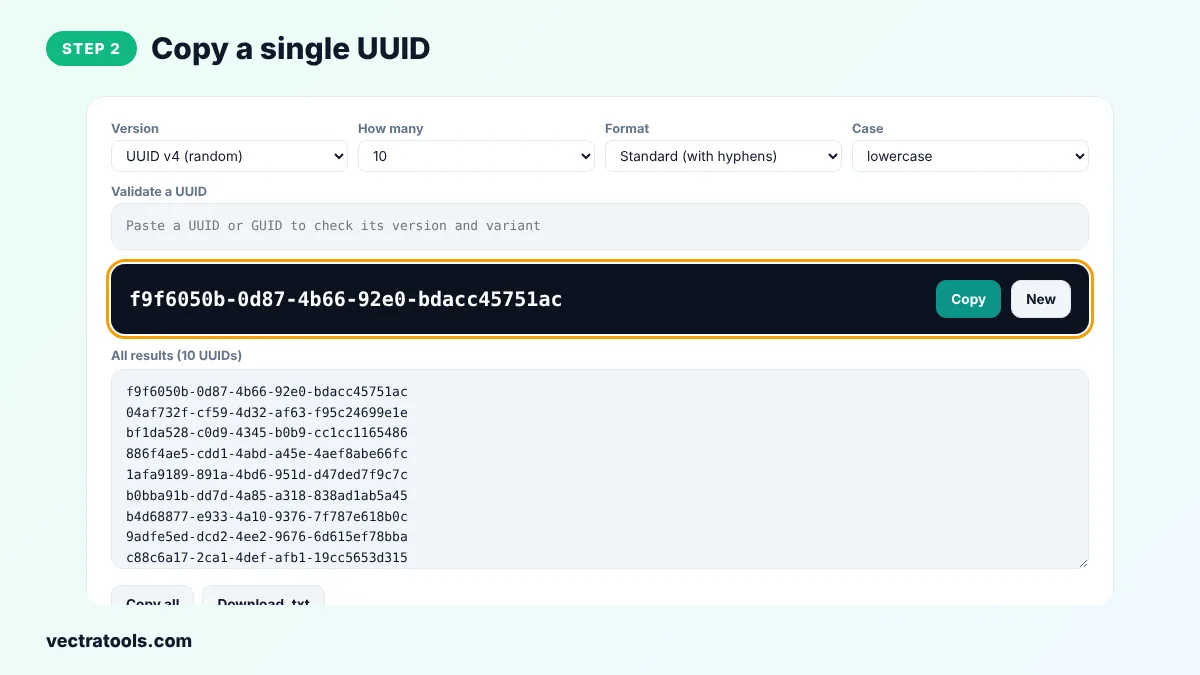
Step 2: Copy a Single UUID
The first UUID appears in the dark box. Click Copy to copy it, or New to generate a fresh set.
Step 3: Generate UUIDs in Bulk
All results are listed in the box below, one per line, ready to paste into code, SQL or a spreadsheet.

Step 4: Validate a UUID and Download the List
Paste any UUID into Validate a UUID to see its version and variant. Click Copy all or Download .txt to save the full list.

Developers use the UUID generator to seed databases, create test fixtures, name files and generate API keys for local testing. The UUID generator runs in your browser, so no ID is ever logged on a server.
How Unique Is a UUID v4?
A version 4 UUID has 122 random bits, which gives about 5.3 x 10^36 possible values. You would need to generate around a billion UUIDs every second for about 85 years before the chance of a single duplicate reached 50 percent. In practice, collisions do not happen when a good random source is used.
UUID Generator Tips
- Use UUID v7 for database primary keys. Because new IDs are always larger, inserts into B-tree indexes stay fast.
- Store UUIDs in a native uuid column in PostgreSQL, or as BINARY(16) in MySQL, rather than as text.
- GUID and UUID mean the same thing. GUID is the name Microsoft uses.
- Do not use UUIDs as passwords or secret tokens for anything sensitive. Use a dedicated token generator with more randomness.
Frequently Asked Questions
What is a UUID?
A UUID (universally unique identifier) is a 128-bit number used to identify information without a central authority. It is usually written as 32 hex digits in five groups.
What is the difference between a UUID and a GUID?
There is none. GUID (globally unique identifier) is Microsoft's name for a UUID.
Which UUID version should I use?
Use v4 for general random IDs and v7 when you want IDs that sort by creation time, such as database keys.
Are generated UUIDs really unique?
Yes, for all practical purposes. This tool uses crypto.getRandomValues, so the chance of a duplicate is astronomically small.
Can I tell when a UUID v7 was created?
Yes. Paste it into the validator. The first 48 bits store the creation time in milliseconds.
How many UUIDs can I generate at once?
Up to 1,000 per click. Click New again for more.
Is the UUID generator free?
Yes. It is free, needs no sign-up and runs in your browser.