

Exponential Growth & Decay Calculator – Discrete or Continuous in 2 Easy Steps
Exponential Growth & Decay Calculator
Free exponential growth and decay calculator – calculate future values based on continuous or discrete growth and decay rates.
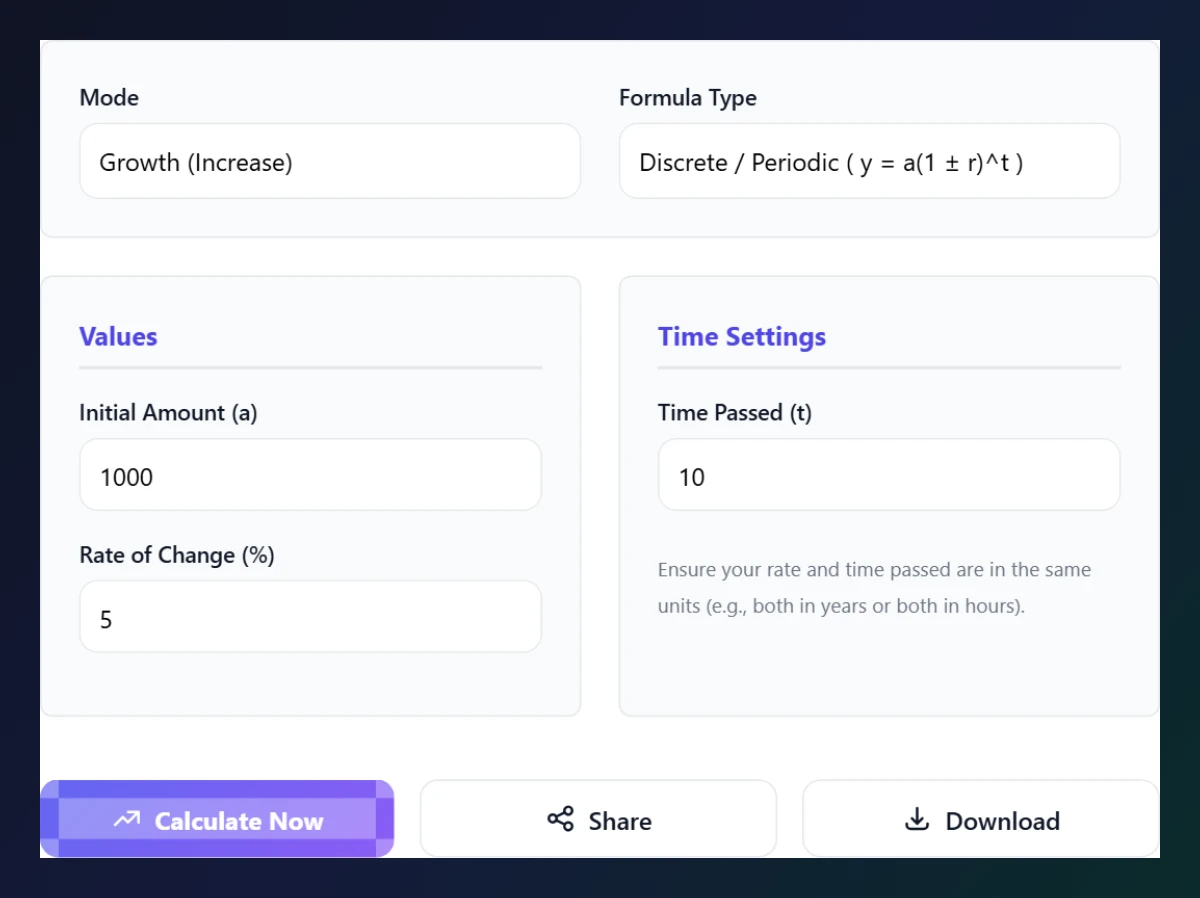
Values
Time Settings
Ensure your rate and time passed are in the same units (e.g., both in years or both in hours).
Use this free exponential growth and decay calculator to see how any amount changes over time at a steady percentage rate.
Quick answer
Discrete exponential growth uses y = a(1 + r)^t and decay uses y = a(1 − r)^t; continuous change uses y = a·e^(±rt). Example: 1,000 growing 5% per period for 10 periods = 1,000 × 1.05¹⁰ ≈ 1,628.89. Continuously it becomes 1,000 × e^0.5 ≈ 1,648.72. Decaying 5% per period for 10 periods leaves ≈ 598.74.
Table of Contents
Exponential change is everywhere: savings that compound, populations that multiply, viruses that spread, cars that lose value and medicines that leave the body. In each case the amount changes by a percentage of its current size, not by a fixed number.
Our free calculator handles both growth and decay, in both discrete (per period) and continuous form. Enter the starting amount, the rate and the time, and get the final value, the total change and the exact working formula.
Exponential Growth and Decay Formulas
| Model | Formula | When to use |
|---|---|---|
| Discrete growth | y = a(1 + r)^t | Change applied once per period (yearly interest, annual growth) |
| Discrete decay | y = a(1 − r)^t | Depreciation, yearly percentage loss |
| Continuous growth | y = a·e^(rt) | Bacteria, continuously compounded interest |
| Continuous decay | y = a·e^(−rt) | Radioactive decay, drug elimination |
Here a is the initial amount, r the rate as a decimal (5% = 0.05) and t the time in the same units as the rate.
Doubling Time and Half-Life
- Doubling time (continuous): t = ln 2 ÷ r ≈ 0.693 ÷ r. At 5% it takes about 13.9 periods.
- Half-life (continuous decay): t = ln 2 ÷ r. At 10% decay per hour, half is gone in about 6.9 hours.
- Rule of 72: for discrete growth, doubling time ≈ 72 ÷ rate %. At 8% it is about 9 years.
How to Use the Exponential Growth & Decay Calculator
Get your answer in two steps.
Step 1: Choose the Model and Enter Values
Pick Growth or Decay, then the Formula Type: discrete y = a(1 ± r)^t or continuous y = ae^(±rt). Enter the Initial Amount, Rate of Change (%) and Time Passed – using the same time unit for rate and time – and click Calculate Now.
Step 2: Read the Analysis Report
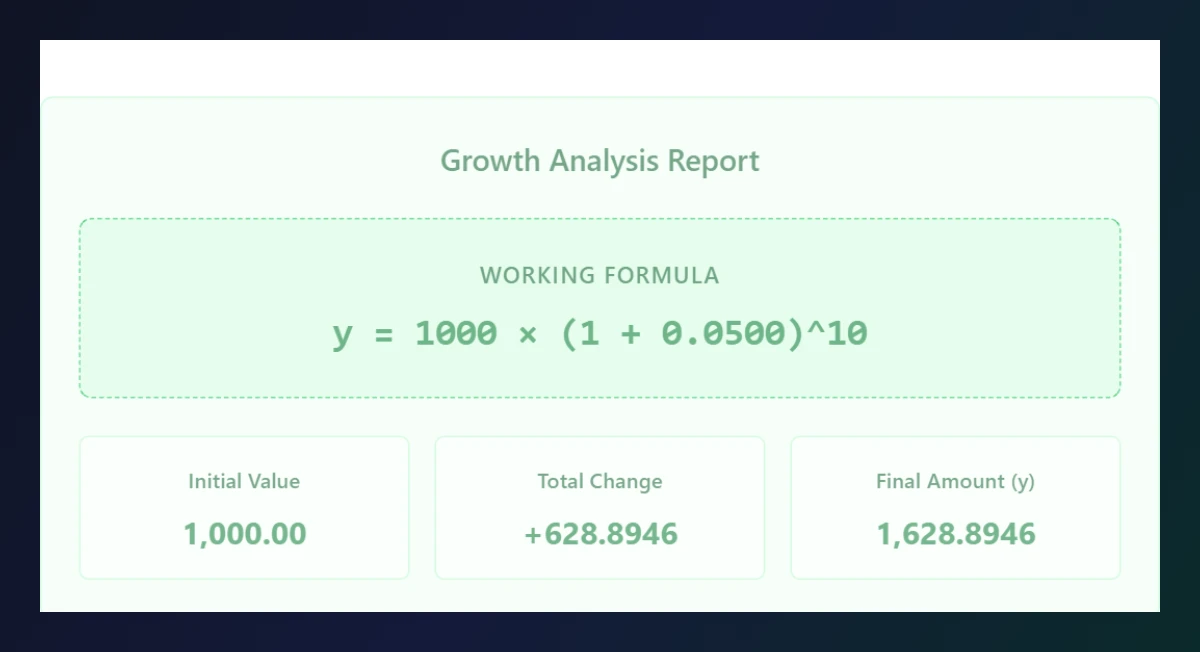
The report shows the working formula with your numbers, the Initial Value, the Total Change and the Final Amount. In the example, 1,000 at 5% for 10 periods grows to 1,628.8946 (+628.8946). Use Share or Download to keep the result.
Real-World Examples
| Scenario | Inputs | Result |
|---|---|---|
| Savings at 5% per year | a = 1,000, r = 5%, t = 10, discrete | ≈ 1,628.89 |
| Car depreciation 15% per year | a = 20,000, r = 15%, t = 5, decay | ≈ 8,874.11 |
| Bacteria, 10% per hour continuous | a = 500, r = 10%, t = 3 | ≈ 674.93 |
| Drug elimination 10%/hour | a = 500 mg, r = 10%, t = 3, continuous decay | ≈ 370.41 mg |
Exponential vs Linear Change
Linear change adds the same amount each period (+50 per year). Exponential growth adds the same percentage, so the amount added gets bigger every period. Over long periods the difference is huge – which is why compounding savings early, or controlling an outbreak early, matters so much.
For money specifically, try the Compound Interest Calculator or the Rule of 72 Calculator.
Frequently Asked Questions
What is the formula for exponential growth?
Discrete: y = a(1 + r)^t. Continuous: y = a·e^(rt), where a is the starting amount, r the rate and t the time.
What is the difference between discrete and continuous growth?
Discrete growth is applied once per period; continuous growth compounds constantly and gives a slightly higher result.
How do I calculate exponential decay?
Use y = a(1 − r)^t for per-period decay or y = a·e^(−rt) for continuous decay.
How do I find doubling time or half-life?
For continuous change, t = ln 2 ÷ r. For discrete growth, the Rule of 72 gives a quick estimate.
Do the rate and time need the same units?
Yes. A yearly rate needs time in years; an hourly rate needs time in hours.
Is the calculator free?
Yes. It is free, runs in your browser and needs no sign-up.