

Free ROAS Calculator – Calculate Return on Ad Spend
Return on Ad Spend (ROAS) Calculator
Measure the exact profitability of your ad campaigns and find your required break-even target.
Understanding ROAS and Campaign Efficiency
Welcome to our free ROAS calculator, the most efficient way to instantly measure the exact financial return on your advertising investments. Whether you are running social media promotions or search engine advertisements, tracking your marketing efficiency is absolutely essential for scaling your business. Simply enter your total advertising revenue and your total ad spend below to calculate ROAS accurately. This powerful utility will help you understand exactly how much revenue your advertising generates for every single dollar spent, allowing you to optimize your digital campaigns with complete confidence.
What Is ROAS (Return on Ad Spend)?
Return on ad spend, commonly known as ROAS, is a vital marketing metric that measures exactly how much revenue is generated for each unit of money spent on advertising. By tracking your total advertising revenue against your initial ad spend, you can easily determine the overall efficiency of your digital marketing campaigns.
For example, if you spend $1,000 on advertising and generate $4,000 in attributed revenue, your ROAS is 4x. This specific calculation means that every single dollar invested in ads successfully brought back four dollars in revenue. However, it is very important to understand a key distinction here. ROAS strictly measures revenue efficiency and not actual profit. Your true profitability will always depend on additional business factors like product costs and operational expenses, meaning ROAS should be used specifically to judge the performance of your advertising efforts.
How to Calculate ROAS
Mastering your ROAS calculation is incredibly straightforward once you understand the core mechanics behind it. To find your exact return, you simply need to divide your total campaign revenue by your total advertising costs.
The basic formula is: ROAS = Revenue ÷ Ad Spend
To see how this works in a real world scenario, let us say you launch a new promotional campaign. If your campaign brings in $5,000 in total revenue and your ad spend was $1,000, your math would look like this: $5,000 ÷ $1,000 = 5x ROAS
This 5x ROAS means every $1 spent on advertising generated $5 in attributed revenue. Depending on the marketing platform or analytics software you use, this exact same result might be displayed in a few different formats. ROAS can be shown as a multiple, a percentage, or a ratio. For example, a 5x multiple is exactly the same as 500% or a 5:1 ratio.
How to Use Our ROAS Calculator
Using our ROAS calculator is incredibly simple and requires no complicated mathematical equations. Just follow these four quick steps to get your exact numbers instantly.
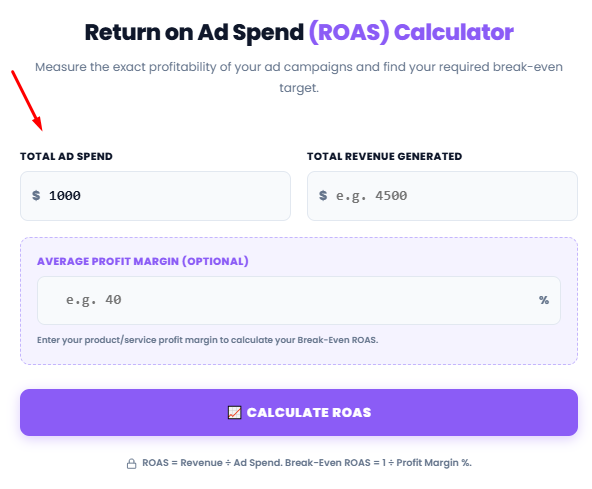
Step 1: Enter your ad spend. Provide the exact amount you invested into your advertising efforts.
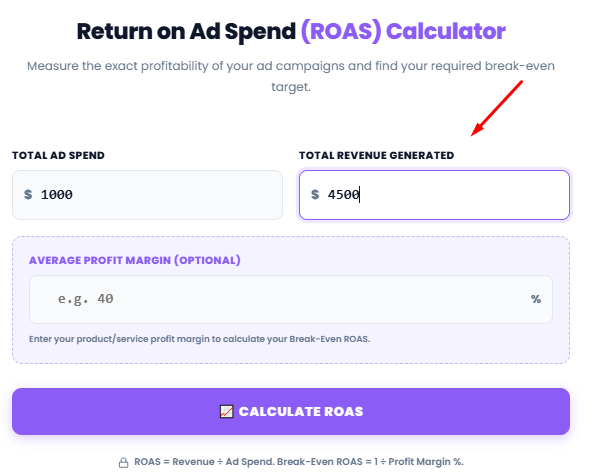
Step 2: Enter your revenue. Input the total amount of money generated directly from your marketing campaign.
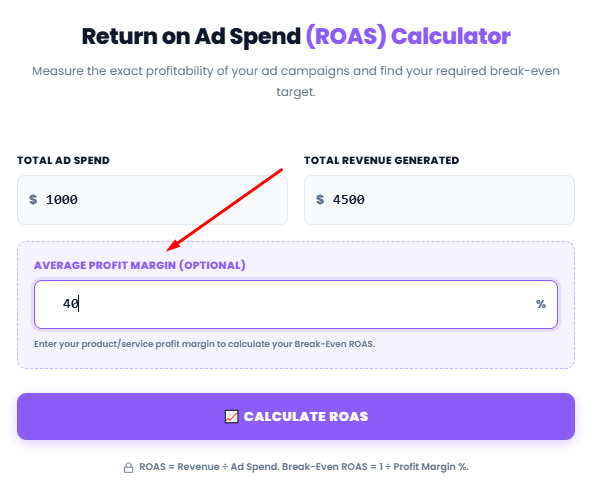
Step 3: Average Profit Margin (Optional)
Enter your average profit margin to calculate the break even ROAS for your campaign.
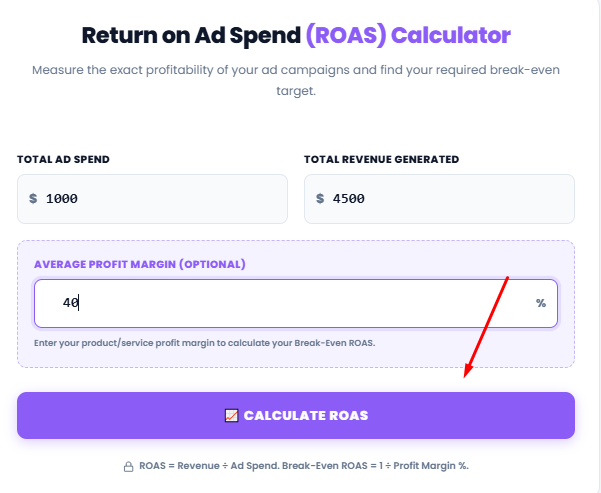
Step 4: Click Calculate. Hit the calculate button to process your data immediately.
Step 5: Review your ROAS result. Your final return will be displayed clearly, helping you understand the exact performance and efficiency of your campaign.
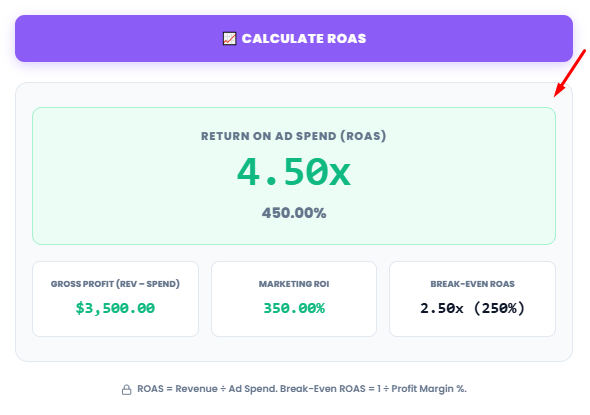
The result is displayed above, showing your ROAS, gross profit, marketing ROI, and break even ROAS.
ROAS Calculation Example
Seeing a complete worked example helps clarify exactly how the math applies to real world marketing campaigns. Let us look at a practical scenario where a business wants to evaluate its recent advertising performance.
Revenue: $10,000 Ad Spend: $2,000
By applying the standard formula, the calculation looks like this: $10,000 ÷ $2,000 = 5x
ROAS = 5x = 500%
This means the campaign generated $5 in attributed revenue for every $1 spent on advertising. Having this clear breakdown makes it much easier to understand the overall efficiency of your marketing budget and helps you make better decisions for future campaigns.
How to Calculate Break Even ROAS
Finding your break even point is arguably the most important mathematical step you can take before launching any digital advertising campaign. While knowing your general return is helpful, calculating your break even ROAS tells you the exact performance threshold your campaigns must hit so that your business neither loses money nor generates a profit.
To calculate your break even point accurately, you need to know your gross profit margin or your product cost ratio. The mathematical formula relies on your profit margin percentage and is expressed as follows:
Break Even ROAS = 1 ÷ Profit Margin
Alternatively, if you prefer calculating it using your product cost against your selling price, you divide your retail price by your net profit per item.
To see how this works in a practical e-commerce scenario, let us look at a real business example. Suppose you sell an item for $100. If your product manufacturing, shipping, and fulfillment expenses total $50, your net profit margin is 50 percent. When you divide 1 by your profit margin decimal (0.50), your break even ROAS comes out to 2x.
This means your advertisements must achieve at least a 2x multiple to cover all your direct product costs and ad spend. Any performance below a 2x return results in a direct financial loss for your company, while anything above it officially generates net profit. Mastering this calculation ensures you never scale a campaign that looks successful on the surface but is actually bleeding money behind the scenes.
What Is a Good ROAS?
One of the most common questions in digital marketing is what number actually counts as a success. It is important to understand that there is no universal good ROAS. The right target entirely depends on your specific profit margins, overall business model, direct product costs, and other advertising expenses.
Because every business operates with unique overhead costs, different profit margins will always require different break even ROAS levels just to remain profitable. A number that brings massive success for a software company might cause a retail business to lose money.
Here is a quick reference table to help you understand what these different multiples actually mean in practice:
| ROAS | Meaning |
| 1x | $1 revenue per $1 ad spend |
| 2x | $2 revenue per $1 ad spend |
| 3x | $3 revenue per $1 ad spend |
| 5x | $5 revenue per $1 ad spend |
As demonstrated in the table, achieving a single multiple means your revenue only covers your immediate advertising spend and leaves no room for operational costs. You must always evaluate your specific product fulfillment expenses alongside these numbers to discover your true profitability target and ensure your campaigns are actually making money.
What Does ROAS Percentage Mean?
When analyzing your marketing data, you might notice that some advertising platforms display your results as a multiplier while others specifically use a ROAS percentage. Understanding how to read both formats is highly beneficial because it helps you avoid any confusion when reviewing your campaign performance across different websites.
The conversion between these two visual formats is incredibly simple.
2x ROAS = 200% 3x ROAS = 300% 5x ROAS = 500%
If you want to find this exact number directly without converting a multiplier, you can use the following formula: ROAS Percentage = (Revenue ÷ Ad Spend) x 100
Knowing this calculation ensures you can accurately read your performance reports whether your chosen platform uses ratios, multiples, or percentages.
ROAS vs ROI: What Is the Difference?
People often confuse return on investment with return on ad spend, but these two performance indicators serve entirely separate purposes. When you calculate ROAS, you are only looking at the gross income produced by a marketing campaign compared to the money spent running those specific ads. In contrast, ROI evaluates the big picture by factoring in your total capital investment alongside all operational overhead.
Grasping this core difference is absolutely vital for anyone running a business. Securing a massive return on your advertising budget never guarantees true profitability. Even when your paid promotions drive tremendous sales volume, you still must account for manufacturing materials, shipping logistics, payment gateway charges, and potential customer returns. Simply put, measuring your ad spend return proves that your marketing successfully attracts buyers, whereas calculating your investment return confirms that your company is actually generating wealth.
ROAS vs Advertising ROI
Another common point of confusion is the difference between ROAS and advertising ROI. While return on ad spend looks strictly at the top line revenue generated by your campaigns, advertising ROI goes a step further by calculating the actual net profit yielded from those specific marketing efforts.
To find your advertising ROI, you must subtract your total ad costs and direct product expenses from your campaign revenue before making your final calculation. If you want to dive deeper into the actual profitability of your marketing efforts, utilizing an advertising ROI calculator alongside your standard ROAS metrics can provide a much clearer picture of your overall financial success.
Comparing Key Marketing Metrics
Evaluating your advertising efficiency requires looking beyond a single metric. To build a truly profitable digital marketing strategy, you must analyze your return on ad spend alongside other essential performance indicators. Each metric provides a different piece of the puzzle, helping you understand how your capital moves from initial ad clicks to final business revenue.
Here is how the core metrics compare and support your overall growth:
- Customer Acquisition Cost: Tracks the total financial investment required to secure one paying customer. While ROAS measures revenue per dollar spent, customer acquisition cost focuses directly on your bottom line expenses.
- Cost Per Action: Monitors how much you pay for a specific non sale conversion, such as an email newsletter signup, a content download, or a trial registration. This helps you evaluate top and middle funnel engagement before users make a purchase.
- Return on Investment: Offers the broadest financial overview by combining your advertising expenses with all underlying business overhead, including product manufacturing, inventory storage, and operational costs.
What is Target ROAS in Paid Advertising?
Target ROAS is an advanced automated bidding strategy used across major digital advertising networks like Google Ads and Meta platforms to help businesses maximize their conversion value based on a specific performance goal. Instead of manually adjusting your daily bids or trying to guess the right CPC, you set a specific return target, and the advertising platform uses machine learning algorithms to automatically optimize your bids in real time for every single auction.
When configuring this bidding model, the system analyzes historical user signals such as past search behavior, device type, geographic location, and browsing context to predict the likelihood of a conversion. If the algorithm believes a particular user search or impression is likely to generate a high revenue return, it will bid more aggressively. Conversely, if a user profile looks less promising, it will lower the bid or skip the auction entirely.
To use this automated strategy successfully, your campaigns generally need a steady history of conversions over the past thirty days so the machine learning system has enough data to make accurate predictions. Setting an unrealistic target can severely restrict your delivery and choke your traffic, while setting a balanced and data driven target helps you scale your revenue efficiently without constantly monitoring manual bid adjustments.
How to Improve Your ROAS
If your current numbers are lower than expected, there are several strategic adjustments you can make to boost your campaign efficiency. Here are the most effective ways to improve your ROAS and maximize your overall marketing revenue.
Improve ad targeting The foundation of any successful campaign is reaching the exact right audience. Narrow down your demographics, utilize custom audiences, and exclude irrelevant locations to ensure your advertisements are only shown to people who are highly likely to purchase your product.
Improving landing page conversion Driving traffic is only half the battle. If your visitors leave without buying, your budget is wasted. Optimize your landing page loading speed, ensure flawless mobile responsiveness, and create clear calls to action to turn more of those expensive clicks into actual sales.
Test different ad creatives Visuals and messaging play a massive role in capturing attention. Continuously run split tests on different images, video formats, and ad copy to discover exactly which creative variations resonate best with your target audience and drive the cheapest clicks.
Improve offer and pricing Sometimes the issue is not your marketing but the offer itself. Create compelling product bundles, introduce limited time discounts, or adjust your pricing strategy to make your product completely irresistible to potential buyers.
Reduce wasted ad spend Regularly audit your campaign performance reports to identify and immediately pause underperforming advertisements. Use negative keywords in your search campaigns to stop your daily budget from draining on irrelevant search terms that never convert.
Focus on higher value customers Increasing your average order value is one of the fastest ways to improve your metrics. Introduce post purchase upsells, promote premium products, and retarget past buyers to generate significantly more revenue from every single transaction without increasing your initial advertising costs.
Common ROAS Calculation Mistakes
Even experienced digital marketers can make errors when evaluating their campaign data. Avoiding these common calculation mistakes will ensure your performance metrics remain completely accurate and reliable.
Mixing different date ranges Always ensure your timeframes match perfectly before doing any math. Comparing your 7 day ad spend against a 30 day revenue window will create heavily inflated numbers and completely ruin the accuracy of your reporting.
Using total business revenue Your calculation should only include the specific revenue generated directly by the advertising campaign you are analyzing. Including your overall organic sales or total business income will make your paid ads look much more successful than they actually are.
Thinking ROAS equals profit As mentioned earlier in this guide, a high return on ad spend does not automatically mean your business is making money. Always remember that this metric strictly measures pure revenue efficiency, not your final net profit after product and operational expenses.
Confusing percentages with multipliers It is surprisingly easy to misread your reporting dashboards if you ignore the specific data formatting. Always remember that a return of 400% is exactly equal to a 4x multiplier, not a massive 400x return.
Ignoring attribution differences Different advertising platforms often report wildly different numbers for the exact same campaign. This happens because platforms use varying attribution models, tracking windows, currency conversions, and specific conversion definitions. You must understand how each specific platform attributes sales to avoid making poor optimization decisions.
Why Choose Our Free ROAS Calculator
Choosing the right utility to measure your advertising efficiency makes a massive difference in how quickly you can scale your business. While manual spreadsheets and basic calculators can help you find raw numbers, our specialized platform is built specifically for modern digital marketers and business owners who need speed, accuracy, and clear data visualization without any friction.
Here is a quick feature comparison showing how our platform stacks up against traditional calculation methods:
| Feature & Capability | Manual Spreadsheets | Basic Online Calculators | Our Free ROAS Calculator |
| Speed & Instant Results | Slow manual data entry | Requires page reloads | Instant calculation on input |
| Multiplier & Percentage Output | Requires separate formulas | Shows only one format | Displays multiples and percentages simultaneously |
| Cost & Accessibility | Free but requires setup | Often hidden behind popups | 100 percent free and open access |
| Ease of Use | Prone to formula errors | Simple but limited features | Clean interface designed for marketers |
| Built by Practitioners | Built by generic developers | Generic math scripts | Built by active digital marketers |
More Helpful Marketing Tools
Once you finish analyzing your advertising return, evaluating your broader digital metrics becomes the next logical step to scale your business. We highly recommend utilizing our other professional online utilities to get a complete picture of your online marketing performance.
- CPM Cost Per Mille Calculator: Quickly calculate your cost per thousand impressions to accurately measure ad exposure and evaluate your advertising campaign reach across different platforms.
- Engagement Rate Calculator: Measure how actively your audience interacts with your social media content by tracking likes, comments, shares, and overall follower engagement.
- Follower Growth Calculator: Monitor your audience expansion rate over specific time frames to understand how effectively your brand builds long term community presence and reach.
Exploring these VectraTools resources together will help you build a truly bulletproof digital strategy, optimize your marketing budgets, and keep your business running efficiently.
Frequently Asked Questions About ROAS
What is ROAS?
ROAS stands for return on ad spend. It is a marketing metric that measures exactly how much revenue your business earns for every single dollar spent on an advertising campaign.
How do you calculate ROAS?
You can easily calculate it by dividing your total campaign revenue by your total ad spend. The basic formula is simply Revenue divided by Ad Spend.
What is a good ROAS?
A good target entirely depends on your specific profit margins and overall business model. A campaign might need a much higher multiple to break even if your product manufacturing and shipping costs are high.
Is 5x ROAS good?
A 5x return is generally considered very strong across most industries. However, whether it is actually good for your specific business still depends entirely on your true profit margins and operational expenses.
Is ROAS the same as ROI?
No, they are completely different metrics. ROAS only measures the gross revenue generated specifically from your advertising costs, while ROI calculates your actual net profit after deducting all other business expenses.
What does 100% ROAS mean?
A 100% return means your campaign generated the exact same amount of revenue as your advertising cost. In other words, you made one dollar back for every one dollar spent, which usually results in a net financial loss once you factor in your actual product costs.
How do I calculate ROAS percentage?
To find the percentage, you divide your total revenue by your ad spend and then multiply that result by 100. For example, a 3x multiple becomes 300%.
Can ROAS be less than 1?
Yes. If your return falls below a 1x multiple or 100 percent, it means you are actively losing money on your advertisements because the campaign is generating less revenue than it actually costs to run.
Which platforms use ROAS metrics?
Almost all major digital advertising networks use this metric to report performance, including Google Ads, Meta Facebook Ads, TikTok Ads, and various ecommerce marketing dashboards.
The Final Word on Maximizing Return on Ad Spend
Understanding and optimizing your return on ad spend is the absolute backbone of any profitable digital marketing campaign. Whether you are running e-commerce promotions, managing lead generation funnels, or scaling multi-channel ad budgets, keeping a close eye on your revenue efficiency prevents wasted capital. For deep insights into broader economic indicators and digital advertising benchmarks, you can explore the official Google Ads Help Center to stay updated with industry-standard practices and measurement frameworks. Continuous testing, accurate attribution tracking, and a sharp focus on your true profit margins will ensure your business scales sustainably for the long haul.
Rating: ⭐⭐⭐⭐⭐ 5 out of 5
I originally developed this specific tool to manage my own search engine optimization clients and speed up their content publishing workflow. After seeing how much time it saved me during daily website management, I finally decided to make it public and share it with all of you.